
Infodemiology in the Twitter Era: Decoding Public Sentiment on Infectious Diseases in Spanish
Knowledge Extraction from Twitter Towards Infectious Diseases in Spanish
The paper presents a comprehensive infodemiology study focused on extracting knowledge from Spanish-language Twitter data related to infectious diseases such as Zika, Dengue, and Chikungunya. The authors developed a machine learning framework for multi-class Sentiment Analysis (SA) to gauge social perception and public health trends in Spanish-speaking regions.
TL;DR
Researchers have developed a specialized Natural Language Processing (NLP) framework to monitor the "digital footprint" of infectious diseases like Zika and Dengue. By analyzing nearly 40,000 Spanish tweets, the study establishes a baseline for how machine learning can transform social media noise into actionable public health insights, identifying key concerns and the overall emotional state of the public during outbreaks.
Background: Why Infodemiology Matters
Public health institutions usually rely on laboratory reports and hospital admissions—data that is often weeks behind the actual spread of a virus. Infodemiology flips this script by treating the internet as a real-time sensor. However, the challenge lies in the medium: Twitter is a chaotic stream of slang, abbreviations, and varying dialects of Spanish.
The authors argue that understanding social perception is just as important as tracking biological spread. If the public is afraid, misinformed, or critical of healthcare strategies, even the best medical intervention might fail due to lack of cooperation.
Methodology: From Raw Tweets to Sentiment Intelligence
The research follows a rigorous pipeline designed to handle the noise of social media:
- Data Acquisition & Labeling: 39,808 tweets were collected and manually annotated by volunteers into seven categories (ranging from very-positive to out-of-domain).
- Semantic Mapping: Using Word2Vec, the authors visualized how concepts cluster together. Terms like mosquito, Aedes, and transmisión formed tight semantic groups, validating that the social conversation aligns with the biological reality of the diseases.
- Feature Engineering: The study moved beyond simple word counts (Unigrams) to include Char-grams (character sequences), which are particularly effective for social media where spelling errors and word variations are common.
- Classification: Four classic Machine Learning models were tested to see which could best mimic human labeling.
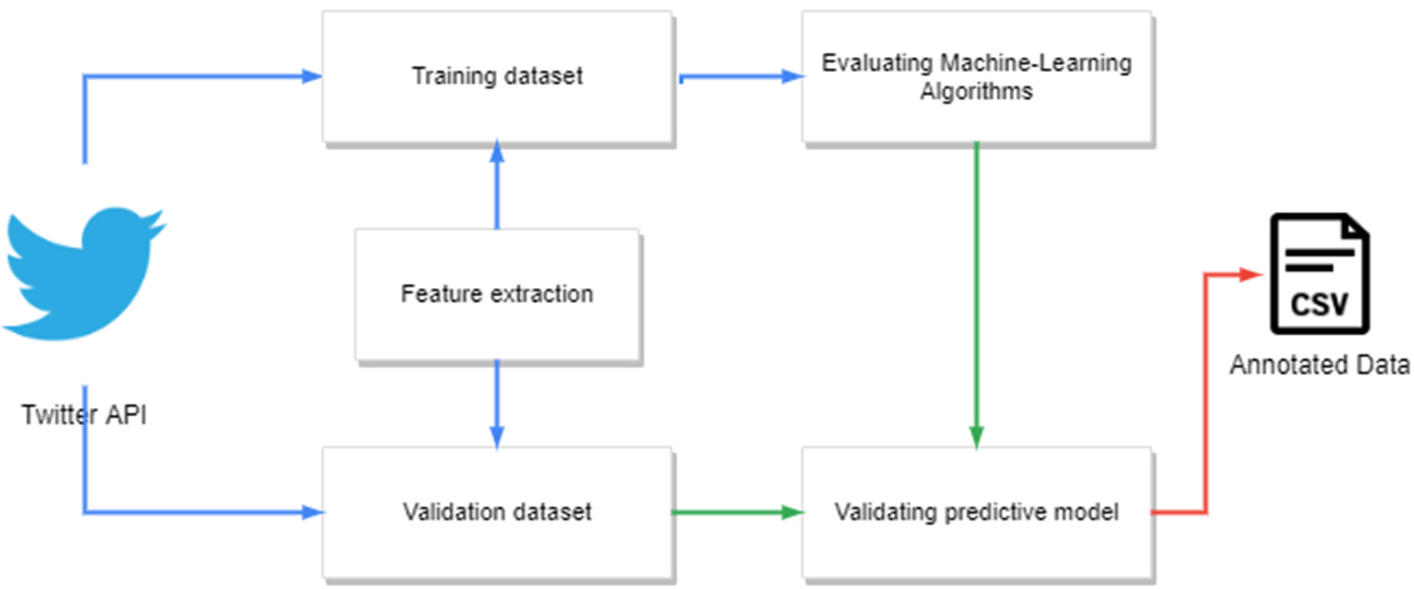 Figure 1: The technical workflow from Twitter API ingestion to final sentiment validation.
Key Findings: The Pulse of the Public
The analysis revealed that the public conversation is largely Neutral (32.5%) or Negative/Very Negative (28.1%). Interestingly, positive tweets tended to be slightly longer and more descriptive than negative ones.
In the technical evaluation, Multinomial Naive Bayes (MNB) and Logistic Regression (LR) proved to be the most robust. While simple, these models provided a reliable baseline, particularly when using char-grams (4-10 characters), which achieved an accuracy of ~44.9%.
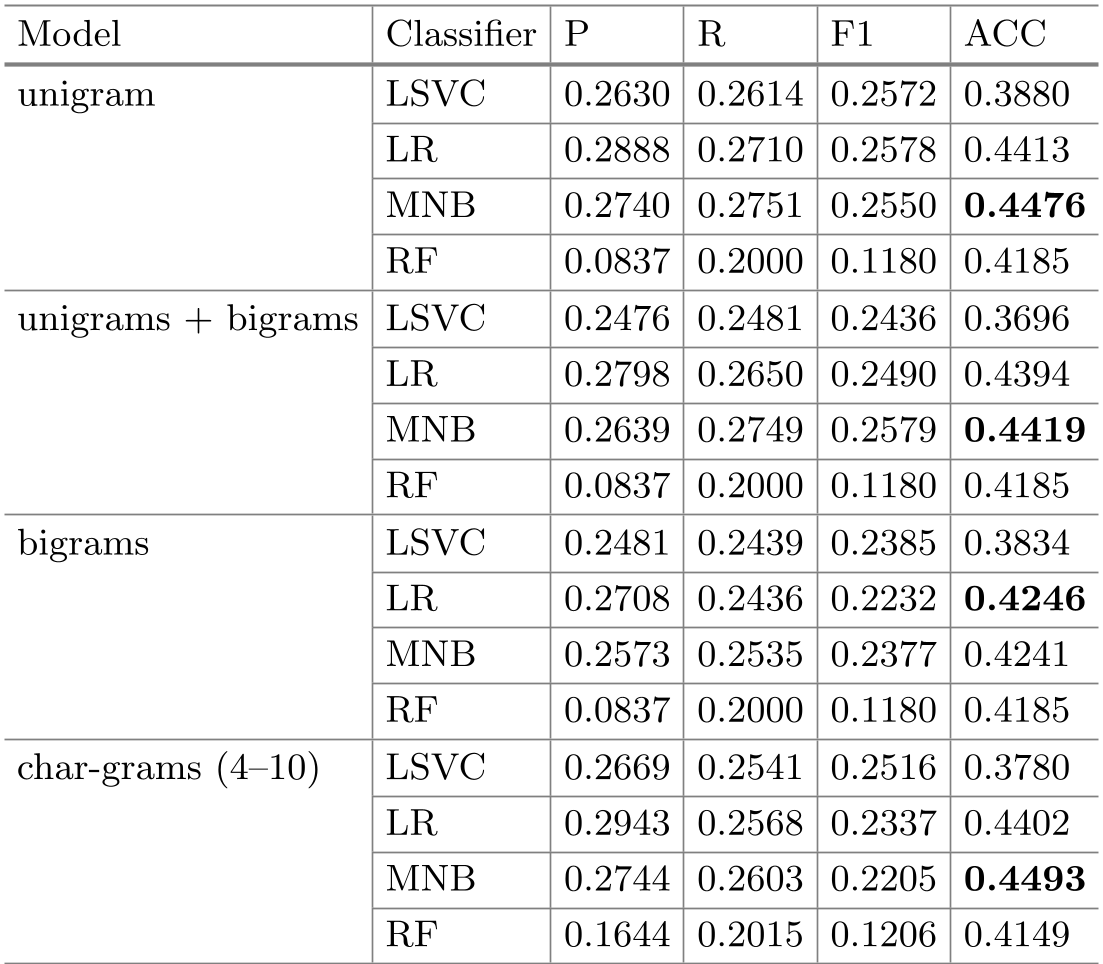 Table 1: Performance comparison showing that while Accuracy is stable, F1-scores highlight the difficulty of multi-class sentiment detection.
The "Edge Case" Challenge
A critical insight from the confusion matrices was the difficulty machines have with "extreme" emotions. Both models frequently confused "very-negative" with "neutral" or "negative." This suggests that the nuance of intense human emotion in Spanish—often expressed through sarcasm or specific cultural idioms—remains a hurdle for traditional statistical models.
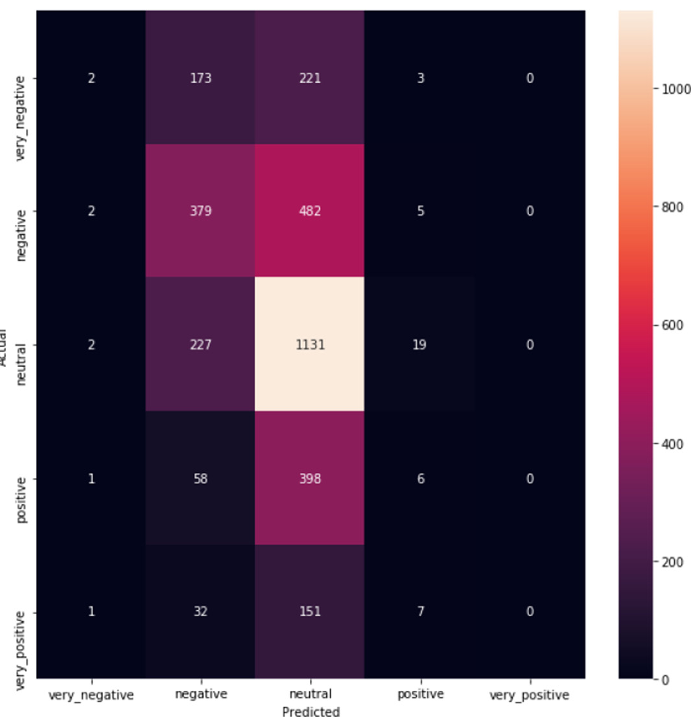 Figure 2: Confusion matrices highlighting the model's struggle with extreme sentiment polarities.
Critical Insight & Future Directions
The value of this paper isn't just in the accuracy of its classifiers, but in the creation of a specialized Spanish infectious disease corpus. Prior research has heavily favored English; this work provides a necessary foundation for the Spanish-speaking world, which is disproportionately affected by tropical diseases.
Limitations: The study relies on "shallow" machine learning (SVM, Naive Bayes). While efficient, these methods lack the deep contextual understanding of modern Transformers (like BERT).
Future Outlook: The authors are already moving toward integrating Ontologies (structured knowledge maps) to better identify "aspects" of a disease—such as symptoms vs. prevention methods—and adapting the system for the COVID-19 era. This suggests a move toward a more "aware" AI that doesn't just see words, but understands medical context.