
Building a Cultural Knowledge Graph: A Cross-Lingual Approach to Quebec Heritage
Extraction of a Knowledge Graph from French Cultural Heritage Documents
The paper presents a specialized pipeline to construct a Knowledge Graph (KG) from unstructured French cultural heritage documents. It introduces a Cross-Lingual Open Information Extraction (OpenIE) framework that translates French text into English to leverage mature NLP tools, further enhanced by a supervised learning model for domain-specific entity refining.
TL;DR
Researchers from Polytechnique Montréal have developed a system to transform over 17,000 unstructured French documents from the Quebec Ministry of Culture into a structured Knowledge Graph. By translating text to English to leverage Stanford's OpenIE tools and applying a custom Supervised Learning layer with "Property Maps," they achieved significant gains in entity recall and relation accuracy.
Background: The Low-Resource Challenge in Digital Humanities
In the world of Digital Humanities, the Quebec Ministry of Culture and Communications (MCCQ) sits on a goldmine of unstructured French data. However, the most robust Open Information Extraction (OpenIE) tools—like those from Stanford or the Allen Institute—are primarily optimized for English. This creates a technical barrier: how do you build a high-fidelity Knowledge Graph when the source language lacks the mature NLP infrastructure of English?
The Problem: Beyond Generic Entity Recognition
Standard NER (Named Entity Recognition) tools are trained on news or web data. They excel at finding "Person" or "Location" in a general context but struggle with:
- Domain-Specific Types: Identifying "Real Estate" (churches, houses, bridges) as a distinct class.
- Linguistic Barriers: Extracting complex relations directly from French without specialized French OpenIE models.
- Low Recall: Missing many historical figures because their names don't fit modern typographic patterns.
Methodology: The "Translate-Refine" Pipeline
The authors propose a modular architecture that turns a language barrier into an advantage.
1. Pre-processing & Translation
Documents are translated into English via the Google API. While translation isn't perfect, it allows the use of Stanford CoreNLP, which the authors' benchmarks showed to have the best recall among potential extractors (Ollie, MinIE).
2. The Core Innovation: Property Maps
To fix the "Missing Entity" problem, the team didn't just rely on text patterns. They built a supervised learning model (a Feed-forward Neural Network) that uses three types of feature maps:
- Typographic Map: Basic stats like word count and capitalization.
- Sub-sequence Type Map: Checking if parts of an entity are already known types (e.g., "Inventor" is a Title).
- Property Map (Relational Context): This is the "Secret Sauce." It records the relations an entity participates in. If an unknown entity appears in the tuple , the system uses that relational role as a strong signal that is a Person.
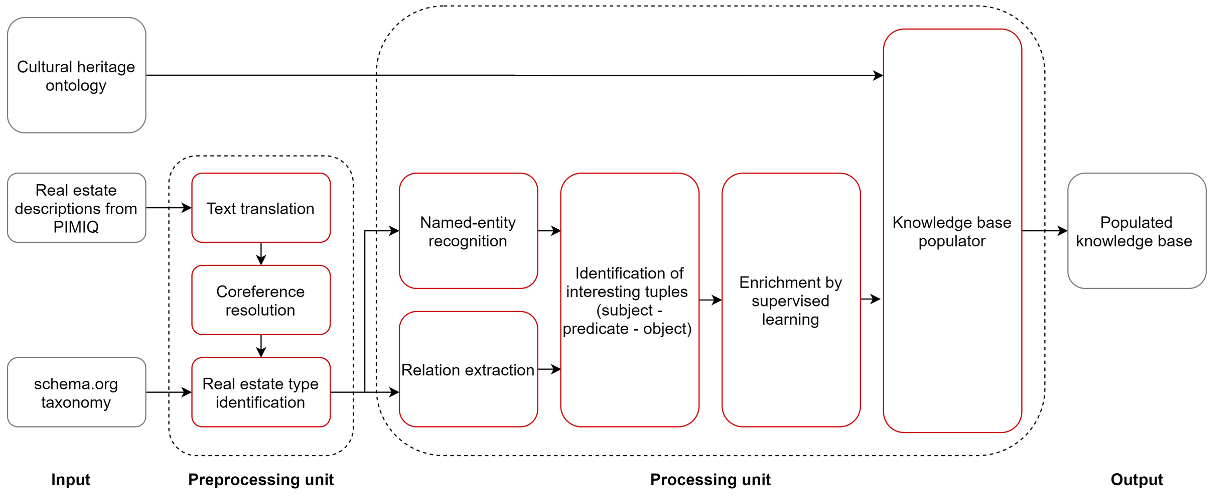 Figure 1: The proposed architecture featuring the Pre-processing and Processing units.
Experiments & Results: The Power of Context
The impact of the supervised learning module was most visible in Recall. In the cultural heritage domain, it is better to find more potential links and verify them than to miss them entirely.
| Relation | Precision (Baseline) | Recall (Baseline) | Precision (Proposed) | Recall (Proposed) |
|---|---|---|---|---|
| Real Estate "was built by" Person | 0.977 | 0.765 | 0.904 | 0.970 |
| Person "built" Real Estate | 0.916 | 0.738 | 0.855 | 0.971 |
The F1-score for identifying relations between people and historical buildings jumped from 0.85 to 0.93. By using the relational context (Property Maps), the system "learned" to recognize entities that standard NER tools simply skipped.
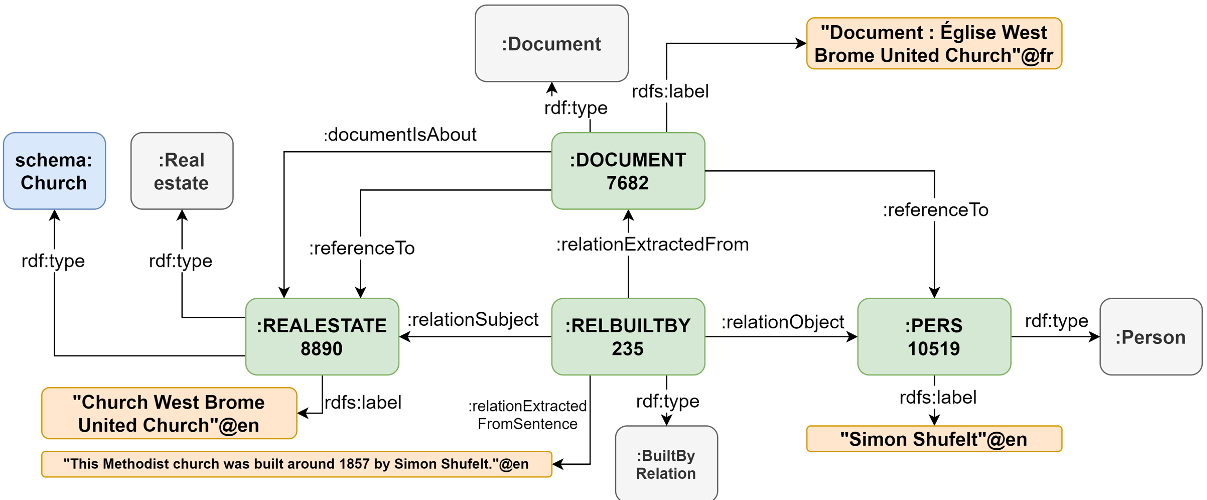 Figure 2: RDF representation/Reification of an extracted "was built by" relation.
Critical Analysis & Conclusion
Takeaway
The paper successfully demonstrates that relational roles are as informative as the text itself. By looking at how a noun is used in a sentence (as the author of a book or the builder of a house), we can categorize it with high precision even if automated translation or generic NER tools are uncertain.
Limitations
- Translation Dependency: The system relies on English APIs. Any nuance lost in translation (French gender markers, specific architectural terms) might propagate through the pipeline.
- Granularity: While the system identifies "Real Estate," it doesn't always distinguish between a "Church" and a "House" effectively in the final supervised stage; it treats them as a broad category.
Future Work
The authors intend to move toward a mixed model that identifies all types simultaneously and aims to re-link English-extracted knowledge back to the original French labels to preserve linguistic heritage.
For researchers in low-resource settings, this paper provides a blueprint: don't reinvent the wheel for your language—translate, extract, and then use your domain's unique logic (via Property Maps) to refine the result.