
Humanity-Inspired AI: Why Personalized Knowledge Graphs are the Key to Socially Intelligent Systems
Knowledge Graphs to Empower Humanity-Inspired AI Systems
This paper proposes a framework for "Humanity-Inspired AI" that moves beyond task-oriented automation toward socially adaptive interaction. It introduces the use of Personalized Knowledge Graphs (KGs) to represent complex sociocultural values and norms, enabling AI to reason within human ethical and social contexts.
TL;DR
Current AI is technically proficient but socially "tone-deaf." This paper argues for Humanity-Inspired AI systems that don't just process data but understand the fabric of human life—values and norms. By utilizing Personalized Knowledge Graphs (KGs), the authors propose a hybrid neuro-symbolic architecture that allows AI to navigate the delicate balance between medical necessity, personal privacy, and cultural expectations.
Beyond the "Black Box": The Motivation for Humanity-in-the-Loop
Most modern AI systems operate at the Symbol Level (mechanistic execution) without a true grasp of the Knowledge Level (the "why" behind rational behavior). When an Alexa or Siri suggests a medication reminder, it treats the task as a binary notification. It doesn't understand that a reminder delivered in front of guests might violate a user's value of Privacy, or that skipping a dose to enjoy a family dinner might be a trade-off for Quality of Life.
The authors argue that the "Human-in-the-loop" paradigm is insufficient. We need "Humanity-in-the-loop"—a core requirement where representation and reasoning span the entire spectrum from individual quirks to collective cultural norms.
The Framework: Three Dimensions of Human Knowledge
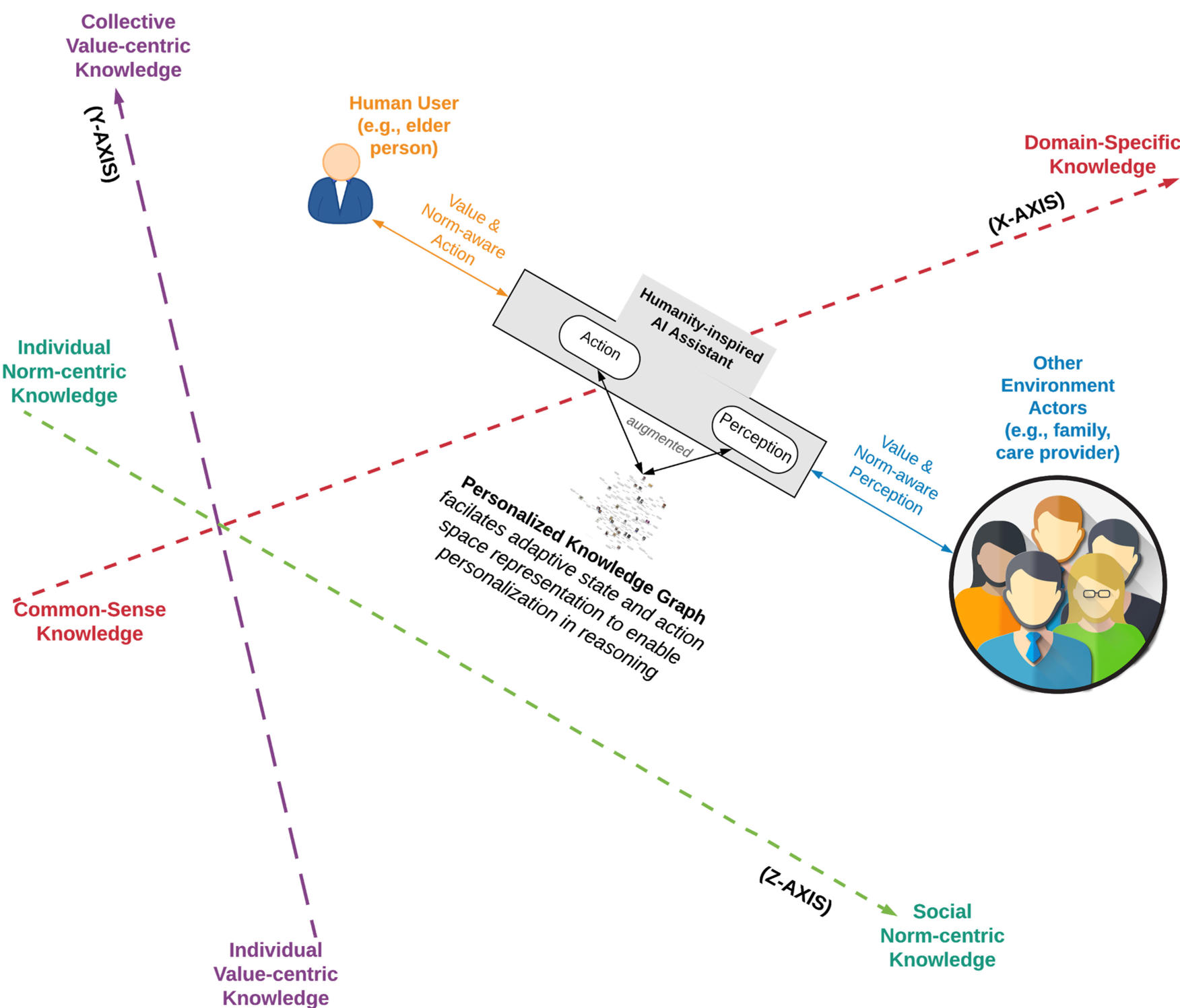
To build such a system, the authors define a three-axis coordinate system for Knowledge Graphs:
- X-Axis: Common-sense to Domain-specific: Validating facts from "the sky is blue" to "Metformin treats Type 2 diabetes."
- Y-Axis: Individual to Collective Values: Understanding abstract concepts like independence vs. safety.
- Z-Axis: Individual to Sociocultural Norms: Knowing the "unwritten rules," such as acceptable personal space or appropriate times for persuasion.
Methodology: The "Top and Bottom Brain" Architecture
The most compelling technical insight in this paper is the integration of symbolic and statistical computing.
- Top-Brain (Symbolic): Uses the Knowledge Graph to enforce hard constraints. If a social norm or a medical safety rule is violated, the top-brain intervenes. It provides the logic and structure.
- Bottom-Brain (Statistical): Uses deep learning to handle the "messy" real-world data—perceptions, voice tone, and emerging patterns. It provides the flexibility and intuition.
By combining these, the AI can achieve contextualized reasoning. For example, it can learn through statistical observation that a user is stressed, but use its symbolic KG to decide that the "polite" action is to delay a non-urgent medical alert.
Case Study: The Complexity of Eldercare
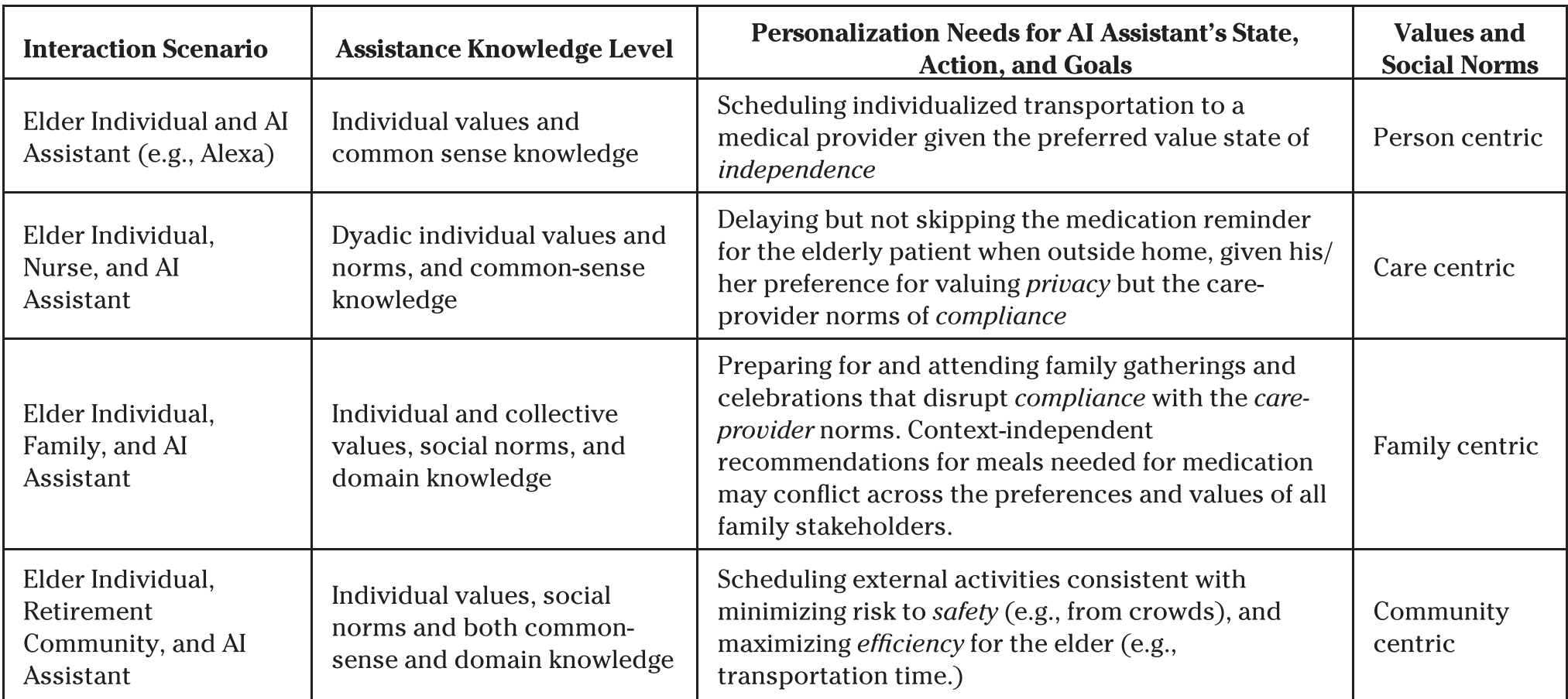
The paper illustrates this through four scenarios of an elder individual interacting with an AI assistant.
| Interaction Scenario | Assistance Knowledge Level | Goal/Action |
|---|---|---|
| Elder & Alexa | Individual values | Balancing independence with medical transport. |
| Elder, Nurse & AI | Dyadic norms | Privacy vs. medical compliance. |
| Elder, Family & AI | Collective values | Socialization vs. medication schedules. |
Critical Challenges & Future Work
The transition to Humanity-inspired AI isn't easy. The authors identify two massive hurdles:
- Representing "Incoherent" Values: Humans are inconsistent. We value health but eat junk food. We value privacy but post on social media. Encoding these contradictions into a KG requires advanced techniques like RDF Reification (making statements about statements).
- Rapid Adaptation: AI must learn a user's changing values from very few interactions (Few-shot learning). If an elder's health declines, their value for "safety" might suddenly outweigh "independence." The AI must adapt its KG in real-time.
Conclusion: A New North Star for AI
This paper serves as a manifesto for the next decade of AI research. It moves the goalpost from "making models bigger" to "making models more human." By grounding AI in the structured, value-laden world of Knowledge Graphs, we can create assistants that don't just serve us, but actually understand us.
Final Takeaway: The future of AI isn't just about better algorithms; it's about better knowledge representation that respects the nuances of the human experience.