
Harnessing the Hive Mind: The Evolution of Knowledge Management in Web 2.0
Towards Knowledge Management Based on Harnessing Collective Intelligence on the Web
The paper introduces a paradigm for Personal Knowledge Management (PKM) that leverages "Collective Intelligence" on the Web. It proposes a framework to transform the "Web 2.0" conversational mess into structured social knowledge using "The Wisdom of Crowds" and mathematical semantic models.
TL;DR
This seminal work redefines Knowledge Management (KM) by shifting the focus from organizational silos to the Collective Intelligence of the Web. By treating the Web not just as a library, but as a "conversational mess" of social consensus, the authors propose a technical framework to extract "The Wisdom of Crowds" through semantic subspaces and horizontal-vertical search integration.
Problem & Motivation: The Death of Static Knowledge
In the early days of the Web, knowledge was treated as objective truth stored in hyperlinked documents. However, as we moved into the Web 2.0 era, knowledge became socially constructed. The authors argue that:
- Search is Iterative: Users rarely know exactly what they want at the start of a query.
- Context Matters: A document's value isn't just in its text, but in how the "crowd" refers to it (Referential Context).
- Organizational Boundaries are Blurred: Modern knowledge workers operate across multiple virtual communities, requiring a personal rather than institutional approach to KM.
Methodology: The Architecture of Participation
The core of the paper lies in its approach to Knowledge Identification and Organization. Instead of a "one-size-fits-all" ontology, the authors suggest that knowledge exists within a Subspace of Meaning.
1. The Mathematical Model of Meaning
This is the technical heart of the proposal. Instead of simple keyword matching, the authors propose mapping knowledge elements into a normed semantic space.
- Contextual Projection: Depending on the user's current intent (the "conceptualization"), the system selects a specific subspace.
- Dynamic Aggregation: Knowledge is projected onto these subspaces to evaluate similarity relative to the current context.
2. Integration of Horizontal and Vertical Search
The authors propose a four-step framework to bridge the gap between "broad Web search" and "specialized utility":
- Horizontal Search: Vague query to a general engine (e.g., Google).
- Mining Search Results: Clustering topics to find major themes.
- Vertical Search: Routing modified queries to specialized databases (e.g., travel or shopping).
- Presentation: Explaining the "Why" behind the results to the user.
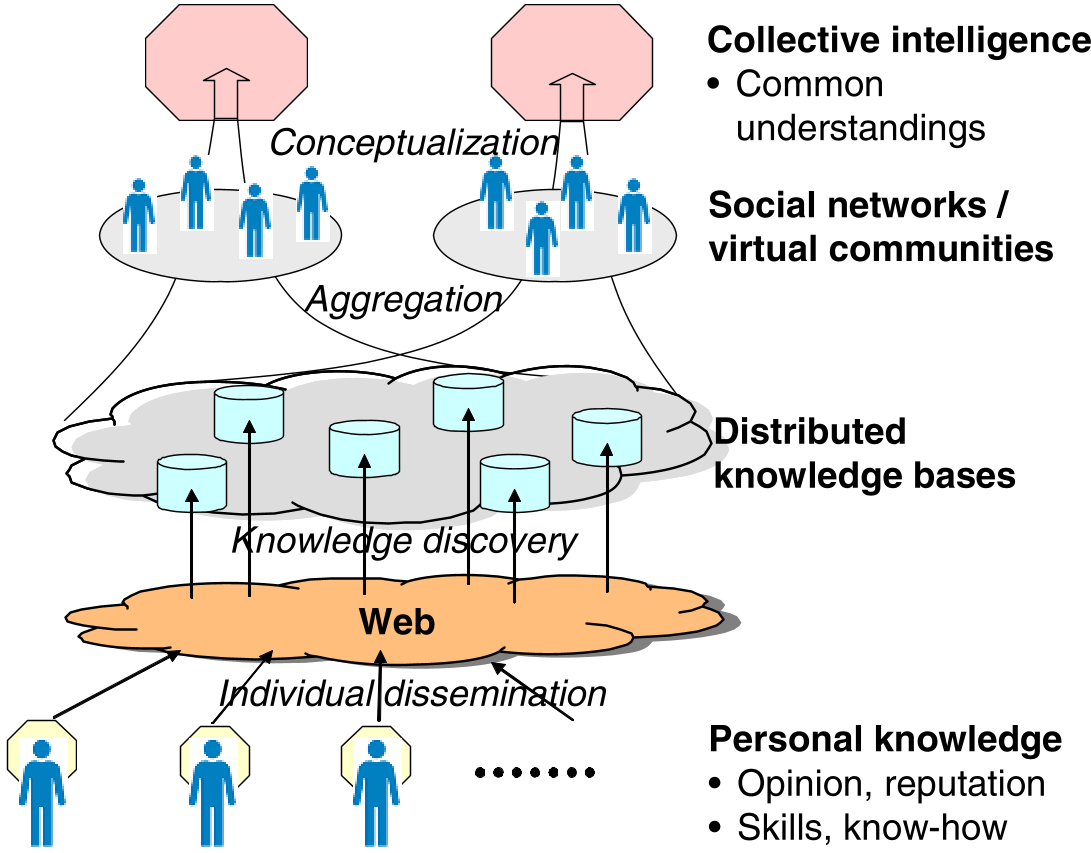
Just-in-Time Knowledge Discovery
The authors identify the "blogosphere" as a live medium. Unlike static databases, the Web 2.0 environment requires Stream Data Mining. They emphasize Opinion Mining, which goes beyond simple sentiment (positive/negative) to identifying diverse perspectives—what they call Aspect Mining.
Experiments & Results: Shifting the Paradigm
While the paper is primarily conceptual and architectural, it references the success of Folksonomies (like Flickr and del.icio.us) and Wikipedia as proof-of-concept for bottom-up consensus.
- Knowledge Evolution: They argue for a "natural selection" mechanism for knowledge, where the "reuse rate" determines what information survives in the collective consciousness.
- Contextual Filtering: By extracting viewpoints from link source pages, their "Aspect Mining" method allows users to see not just what a page says, but how the world perceives it.
Critical Analysis & Conclusion
Takeaway
The true value of this work is the realization that users select for value. A successful KM system shouldn't just store data; it should facilitate an "Architecture of Participation" where the acts of searching and sharing naturally refine the global knowledge base.
Limitations
- Computational Complexity: The mathematical projection into semantic subspaces in real-time was a massive challenge in the mid-2000s.
- Data Noise: Harnessing the "mess" of the web risks capturing misinformation or "groupthink" rather than actual "wisdom."
Future Outlook
This paper laid the groundwork for what we now see in AI-powered Knowledge Graphs and Retrieval-Augmented Generation (RAG). The transition from "finding documents" to "extracting intelligence" remains the north star of the information age.