
Beyond Efficiency: How Social Software and Thought Leadership Drive Business Performance
Effect of Knowledge Management on Organizational Performance: Enabling Thought Leadership and Social Capital through Technology Management
This paper explores how social software-enabled networks influence overall business performance by fostering thought leadership and social capital. Using the concepts of "user-autonomy" and "user-fun," the study validates a framework across 120 Mediterranean and Gulf entities where social exchange systems significantly enhance organizational outcomes.
TL;DR
This research challenges the traditional view of Enterprise Resource Planning (ERP) as the sole driver of performance. By analyzing 120 companies, it proves that "user-autonomy" and "user-fun" through social software—blogs, wikis, and social networks—are not distractions but essential tools for building Social Capital and Thought Leadership, directly boosting growth and profitability.
Contextual Positioning
In the academic landscape of Knowledge Management (KM), this work serves as a bridge between rigid information systems and the organic nature of human networks. It shifts the focus from data processing to intellectual exchange, positioning social software as a prerequisite for modern competitive advantage.
The Core Conflict: ERP vs. Human Connection
For decades, businesses relied on ERPs to integrate manufacturing, finance, and distribution. However, these systems are often "dry" and disconnected from the iterative, brainstorming-heavy reality of daily work. The author identifies a critical gap: employees want to connect, share experiences, and innovate in ways that are both intellectual and fun.
The research intuition here is profound: for a company to practice Thought Leadership, it must provide systems that support the spontaneous development of social capital, rather than just transaction recording.
Methodology: The Six Dimensions of Social KM
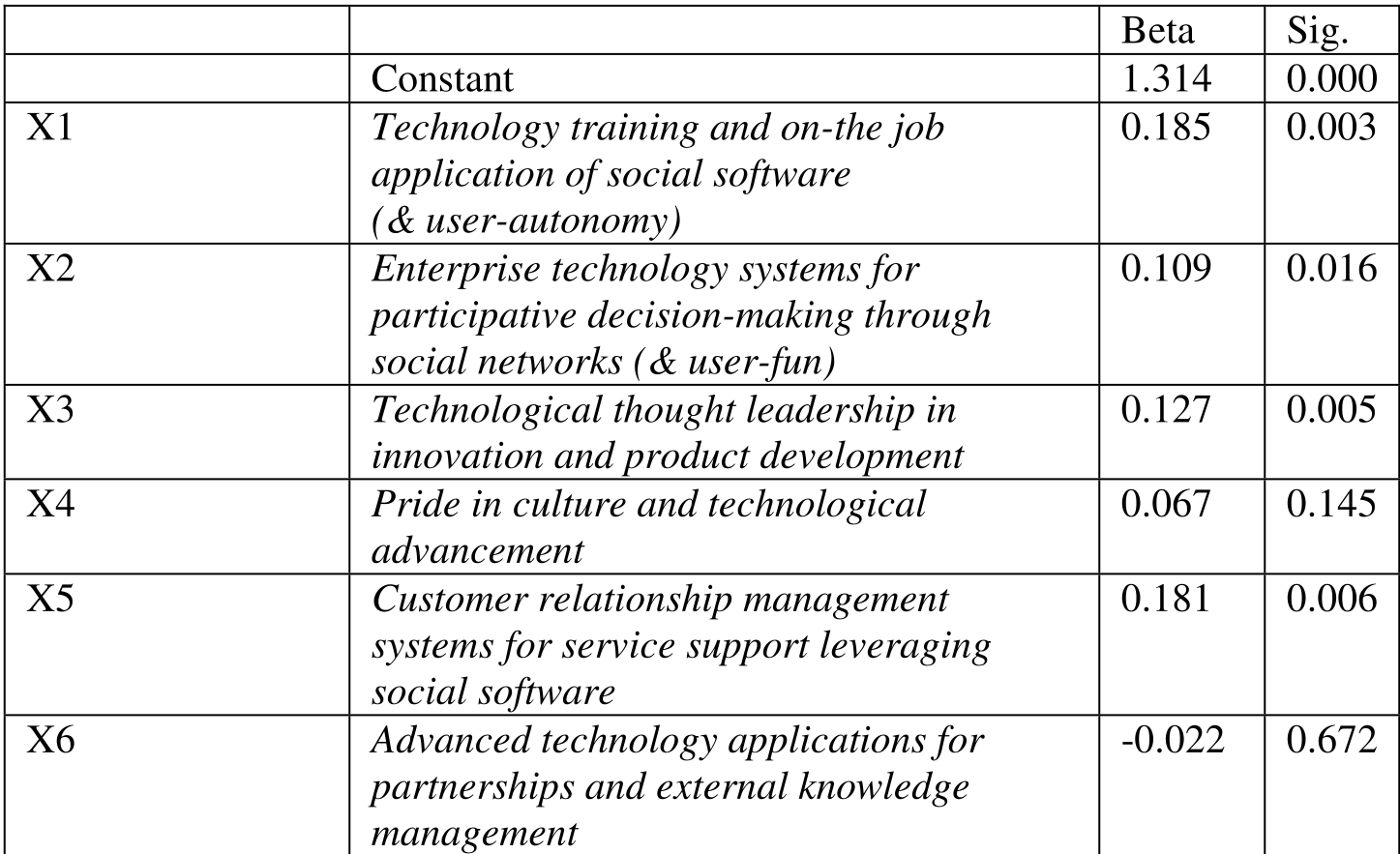
The author proposes a linear regression model based on six key technological initiatives (X1-X6) to measure their impact on a performance index (Y).
The Framework
- Technology Training (X1): Moving beyond basic literacy to empower "user-autonomy."
- Participative Decision-Making (X2): Using social networks to decentralize power.
- Innovation/NPD (X3): Leveraging the free flow of ideas for new product development.
- Digital Culture (X4): Fostering organizational pride through tech adoption.
- Customer Intimacy (X5): Using social tools (wikis/blogs) to build closer client relationships.
- External KM (X6): Managing partnerships through advanced digital search and social systems.

Key Results & Critical Insights
The study’s findings provide a reality check for management:
- The "User-Fun" Factor: Technology that allows for autonomy and enjoyment (X1, X2, X3) correlates strongly with performance. Productivity rises when the interface feels natural and social.
- The Power of Customer Intimacy: CRM systems enhanced by social software (X5) were among the strongest predictors of success, proving that "social" isn't just internal—it's the new front line of sales and support.
- The Regional Anomaly: Interestingly, X4 (Pride) and X6 (External KM) were insignificant. The author suggests that in the Mediterranean and Gulf regions, external networking is still dominated by face-to-face interaction rather than digital tools, highlighting a cultural boundary for KM systems.
Critical Analysis & Conclusion
Takeaway
True Thought Leadership stems from a culture that values the brainstorming mode. Social software is the "ergonomic" bridge that allows this to happen. Managers should stop viewing social media as a productivity killer and start integrating its collaborative DNA into the enterprise stack.
Limitations
The study is geographically specific (Mediterranean/Gulf). The insignificance of external digital networking (X6) might not hold true in more digitally-native tech hubs like Silicon Valley or Shenzhen, where digital partnerships are the norm.
Future Outlook
As we move toward 2026 and beyond, the integration of AI into these social frameworks will likely redefine "Thought Leadership" again. The next frontier is not just "user-fun," but "user-augmented"—where social software doesn't just connect humans, but enhances their collective intelligence.