
Semantic Social Networks: Bridging Knowledge Management and Automated Reasoning
Knowledge management in semantic social networks
This paper introduces an object-oriented model for Semantic Social Networks (SSN), integrating social network analysis with formal automated reasoning. Using Frame Logic (F-logic) and the niKlas wiki language, it establishes a framework for dynamic organizational management, achieving automated role and team selection based on trust and skill metadata.
TL;DR
This research presents a formal bridge between the fluid world of social networks and the rigid world of semantic reasoning. By mapping social interactions onto Frame Logic (F-logic), the author creates a system called niKlas (built on the ᵀ A OPI S framework) that can automatically identify project leaders, assemble minimal teams based on skills, and manage roles in a "Fishnet" organization where hierarchy is dynamic, not fixed.
The Motivation: Moving Beyond Static Metadata
Most Knowledge Management (KM) systems are either "dumb" social tools (blogs, wikis) or overly rigid ontologies (FOAF). The author argues that knowledge is a "justified true belief." In a corporate environment, how do we know if a user's self-proclaimed skill in "Python" is true? The solution: Trust-Annotated Semantic Social Networks. By using social network metrics, we can assign a probability to the truthfulness of any metadata statement.
Methodology: F-Logic Meets Social Graphs
The core innovation lies in treating every actor and relationship in a social network as an object in a formal logic system.
1. The Object-Oriented Framework
The system uses the ᵀ A OPI S framework where every entity is an extensible set of objects: These are mapped to F-logic molecules, allowing for metadata to become "reason-able."
2. Trust and Centrality
To solve the problem of unreliable data, the author introduces a trust level , calculated via PageRank. This transforms a simple graph into a weighted evidence base where a statement is only as strong as the reputation of the person making it.
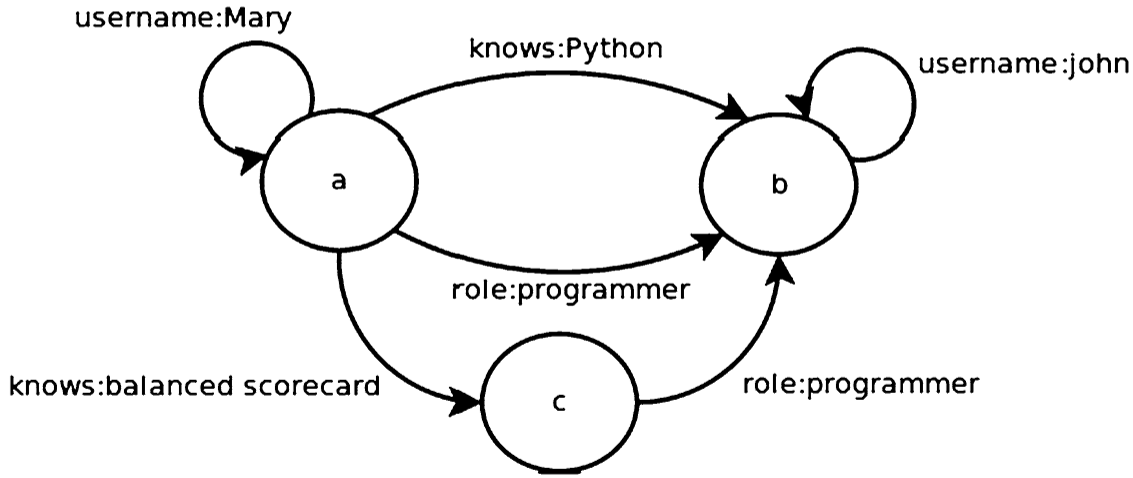 Fig. 1: A sample semantic social network where nodes store metadata like 'username', 'role', and 'skills'.
Core Applications: Automating the Organization
Role Management
How do you find the best "Sales Manager"? The system queries the knowledge base for actors who possess the required skills (Communication, Finance) and then selects the candidate with the highest eigenvector centrality within the specific project context.
Minimal Team Management
Given a complex task requiring three different skills, the algorithm identifies the minimal set of actors whose combined knowledge covers the requirements.
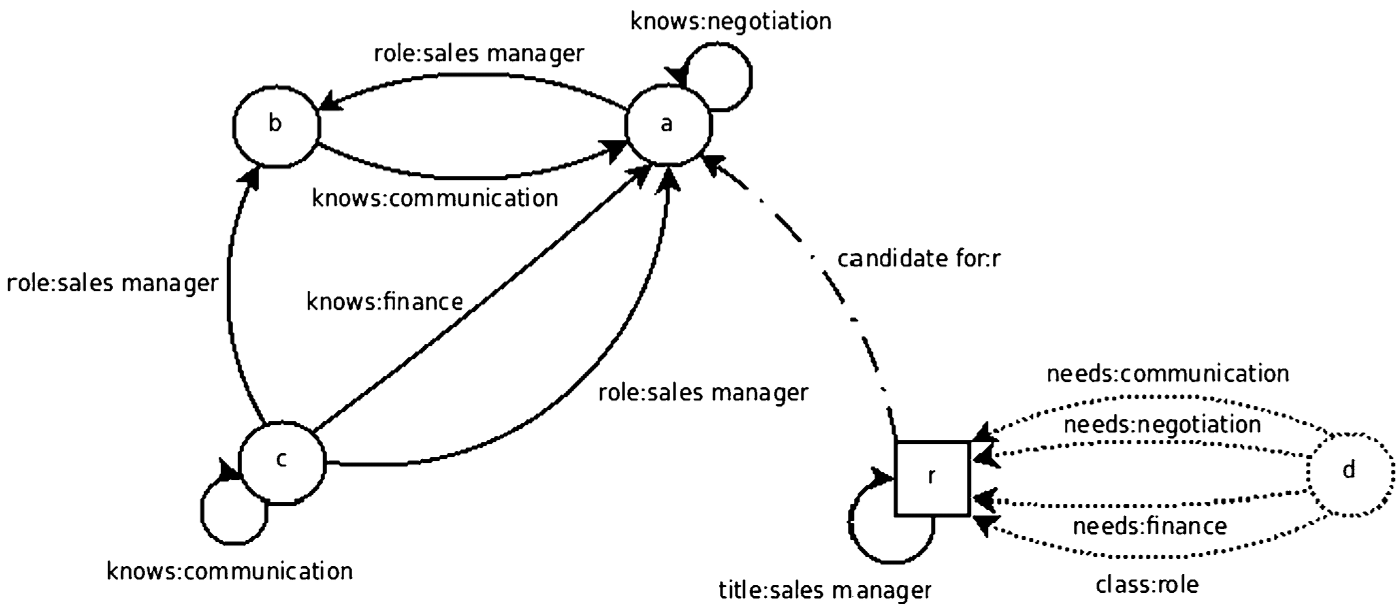 Fig. 2: The system inferring candidate suitability for organizational roles based on skill overlap.
Experimental Results & Scalability
The author tested the system using the Watts-Strogatz "small-world" algorithm to simulate organization sizes up to 1,000 members.
| Network Size | Role Query CPU (s) | Team Query CPU (s) | Memory (MiB) |
|---|---|---|---|
| 50 (Small) | 0.65 | 0.66 | 1.86 |
| 1000 (Very Big) | 1.93 | 17.32 | 5.05 |
The results indicate that while compile times are high (~127s for 1,000 nodes), query times for role management are remarkably fast. However, "Minimal Team" queries start to struggle with "combinatorial explosion" as the network grows, suggesting the tool is best suited for SME (Small to Medium Enterprise) environments.
Critical Analysis & Conclusion
The Takeaway: This work effectively turns an organization into a "programmable entity." By emulating the Fishnet Organization—where a hierarchy exists only when you "lift" a node—the system allows for extreme flexibility.
Limitations:
- Computational Cost: Deductive logic systems like Flora-2 are famously sensitive to scale.
- Inconsistency Handling: While there is a trust metric, the system still struggles with natural language variation (e.g., "Python Programmer" vs "Python Coder").
Future Outlook: The作者 suggests moving this logic into Multi-Agent Systems (MAS), such as smart energy grids or mobile resource networks, where agents can negotiate and form teams autonomously.
Senior Editor's Note: This paper is a significant bridge between 2000s-era Semantic Web ambitions and modern agentic workflows, providing a rare mathematical grounding for "Social KM."