
Knowledge Mining in Big Data: The Algebraic Geometry Perspective
Knowledge mining in big data — A lesson from algebraic geometry
This paper proposes a mathematical framework for knowledge mining in Big Data using Granular Computing (GrC) inspired by Algebraic Geometry. It models data as algebraic rings (e.g., the integers ), identifies prime ideals as basic information granules, and maps the resulting structure to the Zariski Topology to extract hidden geometric knowledge.
TL;DR
This research bridges the gap between abstract mathematics and Big Data. By treating massive data sets through the lens of Algebraic Geometry and Granular Computing (GrC), the authors demonstrate that mining "knowledge" is equivalent to transforming the algebraic properties of data into a geometric "topological" map. They use the ring of integers as a model to show how prime ideals (fundamental building blocks) can form a Zariski Topology, providing a structured way to navigate complex information.
Problem & Motivation: Beyond Brute Force
In the era of Big Data, we are dealing with sets so vast that traditional combinatorial analysis fails—what the authors call the "brute force" limit. The challenge is: How do we find meaningful structures in seemingly infinite data without checking every single pair of data points?
The authors' insight is inspired by Algebraic Geometry. In mathematics, if you want to understand a complex ring, you look at its "Spectrum"—a geometric space that represents its internal logic. They argue that Big Data should be treated similarly: not as a collection of points, but as a mathematical universe (Universe ) that can be "granulated" into manageable pieces of knowledge.
Methodology: The GrC Framework
The paper introduces a Covering Granular Computing Model which follows a process analogous to the MapReduce paradigm but fueled by mathematical rigor:
- Modeling (The Universe): Big Data is modeled as a ring (e.g., ).
- MAP (Granulation): The data is divided into Information Granules. In their example, these are the Prime Ideals.
- REDUCE (Quotient Structure): The "entanglement" or intersections between these granules are calculated. This forms the Quotient Structure, which is the geometric heart of the data.
- Interpret (Knowledge Structure): The geometric structure is assigned meaningful labels to become a functional Knowledge Structure.
Core Architecture: From Algebra to Geometry
The transition is best visualized by how algebraic operations (like the intersection of ideals) create a topology (the Zariski Topology).
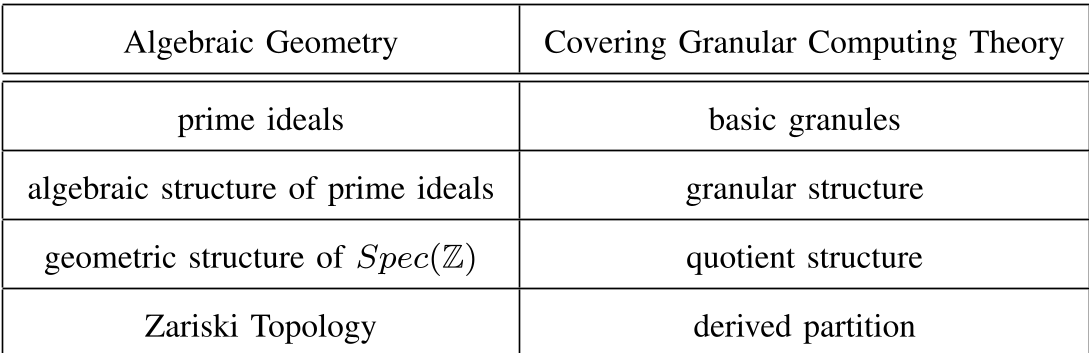
The Neighborhood System is the critical engine here. It allows each point in the universe to be associated with a family of subsets (granules). When multiple points share the same maximal neighborhood system, they form a Center Set, leading to a Derived Partition—essentially clustering the data based on its topological "shape."
Experiments: Revisiting the Integers
The authors validate their theory by "mining" the set of integers . They treat prime numbers as the sources of basic granules.
- Algebraic Input: Prime ideals like .
- Interaction: Intersecting and yields , creating a link between the "point 2" and "point 3."
- Geometric Output: The result is a Zariski Topology on .
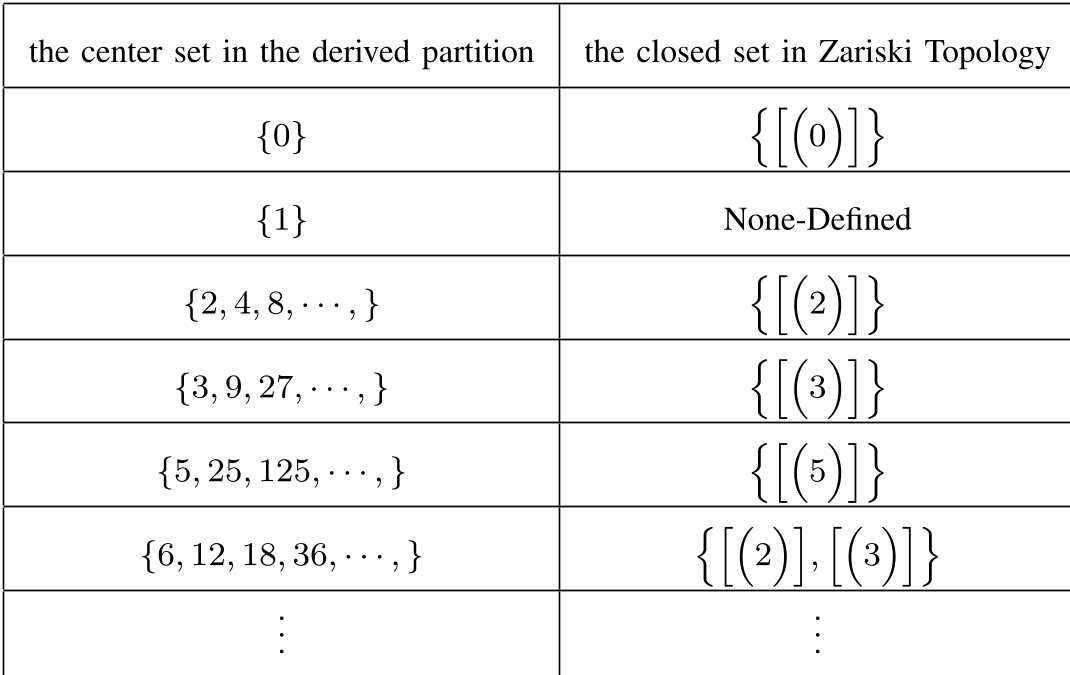
In their Results Table, they show a direct one-to-one mapping between the Center Sets of their Granular Computing model and the Closed Sets of the Zariski Topology.
Critical Analysis & Conclusion
Takeaway
The paper successfully argues that Knowledge is Structure. By using Granular Computing, we can avoid the computational explosion of Big Data by shifting the focus from "counting items" to "analyzing the topology of granules."
Limitations & Future Work
While the theoretical mapping is elegant, the paper focuses heavily on the ring of integers . In real-world Big Data (like Social Networks or Genomics), the "Algebraic Ring" isn't always obvious. The next frontier for this research is the Automatic Discovery of Generators: how can an AI automatically identify the "Prime Ideals" of a messy, unstructured dataset?
Ultimately, this work points toward a future where "Data Scientist" roles might require as much knowledge of General Topology as they currently do of Python.