
NSGAIII-GBFE-RS: Balancing the Five Pillars of Recommendation via Many-Objective Optimization
A many-objective optimization recommendation algorithm based on knowledge mining
This paper introduces NSGAIII-GBFE-RS, a many-objective hybrid recommendation algorithm that optimizes accuracy, recall, diversity, novelty, and coverage simultaneously. By integrating a generation-based fitness evaluation and partition-based knowledge mining, the model achieves superior recommendation performance on the MovieLens dataset compared to standard many-objective evolutionary algorithms (MaOEAs).
Executive Summary
TL;DR: The paper presents a sophisticated hybrid recommendation model that doesn't just chase accuracy but simultaneously optimizes five conflicting objectives: Accuracy, Recall, Diversity, Novelty, and Coverage. It introduces a modified NSGA-III algorithm enhanced with "Generation-Based Fitness Evaluation" and decision-space partitioning to solve the efficiency bottleneck in many-objective optimization.
Positioning: This work sits at the intersection of Evolutionary Computation and Information Retrieval. It moves beyond the simple "Accuracy vs. Diversity" trade-off, positioning recommendation as a many-objective optimization problem (MaOP) and utilizing internal algorithm metadata (knowledge mining) to guide the search.
Problem & Motivation: The "More than Three" Challenge
Most recommendation systems (RS) are optimized for a single metric or a simple weighted sum. However, a "perfect" system must be inclusive:
- Accuracy/Recall: Is it what the user wants?
- Diversity: Is the list monotonous?
- Novelty: Are we only recommending "blockbusters" (popular items)?
- Coverage: Is the system utilizing the "long-tail" of the product catalog?
When we try to optimize all five, we hit a wall. Standard Multi-Objective Evolutionary Algorithms (MOEAs) like NSGA-II fail when objectives exceed 3 because most solutions become "non-dominated," leading to a lack of selection pressure—the algorithm essentially stops "learning" how to improve.
Methodology: Knowledge-Driven Evolution
The authors solve this by proposing a hybrid model that linearly combines User-based CF, Item-based CF, and Content-based techniques. The "magic" lies in how the weights () are tuned.
1. Generation-Based Fitness Evaluation (GBFE)
The authors realized that the importance of convergence and diversity changes over time.
- Early Stage: Prioritize convergence to find the Pareto Front quickly.
- Late Stage: Prioritize diversity to fill the gaps in the solution set. The GBFE formula uses a generation influence parameter () to adaptively shift this focus, ensuring the algorithm doesn't get stuck early or waste time late.
2. Partition-Based Knowledge Mining (PBKM)
A major headache in hybrid models is the constraint: . Random mutations often break this. Instead of discarding "illegal" solutions, PBKM divides the decision space into four regions. By mining the historical "success" of population trends in these regions, the algorithm can intelligently regenerate solutions that stay within the valid bounds while pushing toward optimal performance.
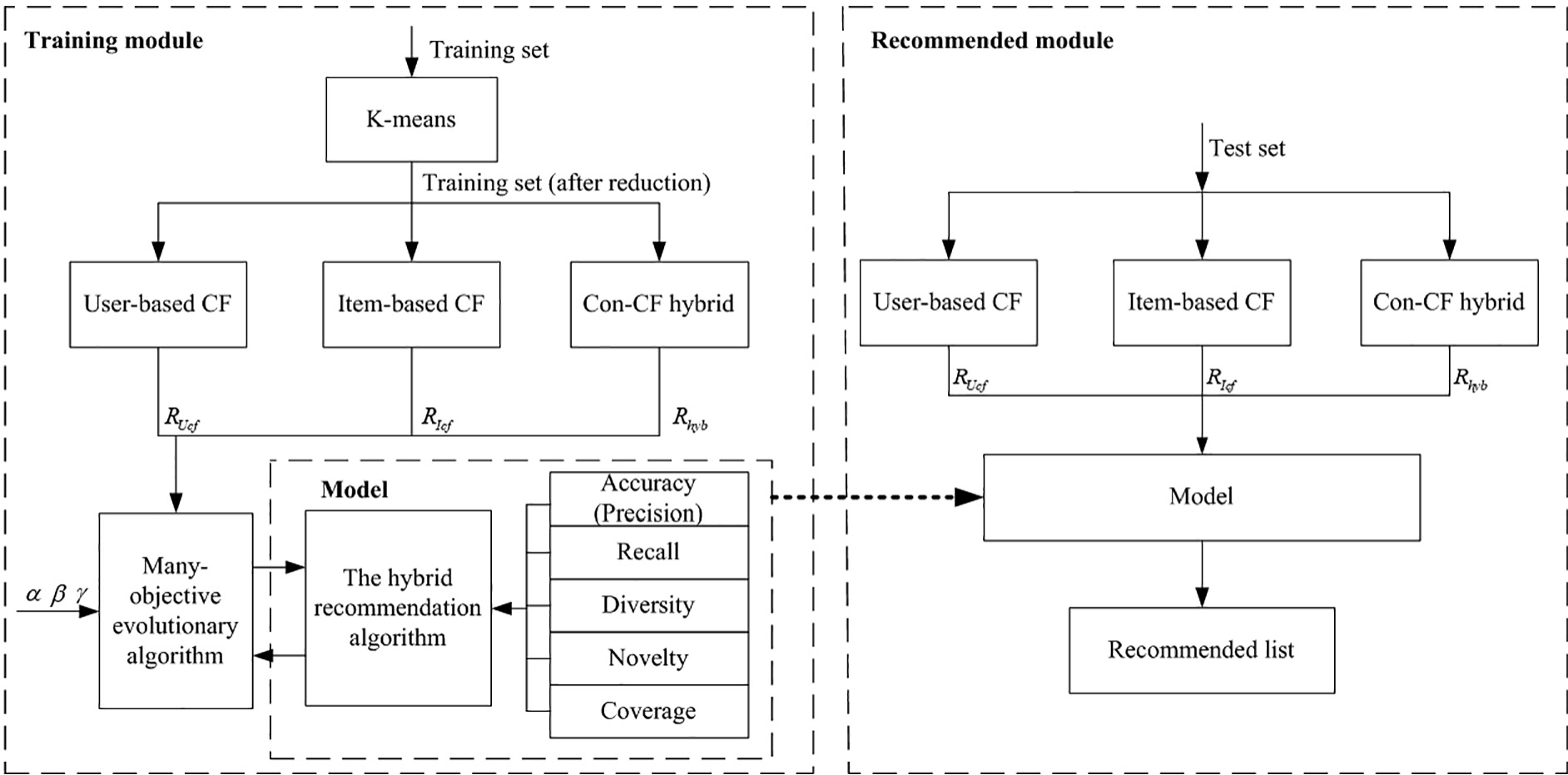 Figure 1: The dual-module framework: Training (Optimization) and Recommendation.
Experiments & Results
The researchers tested their algorithm against heavyweights like GrEA, RVEA, and KnEA.
Benchmark Success
On DTLZ and WFG test suites, the NSGAIII-GBFE maintained higher Hypervolume (HV) scores, especially in 8 and 10-objective configurations. This proves the fitness evaluation strategy is robust across different mathematical landscapes.
Real-World Impact: MovieLens 1M
When applied to movie recommendations:
- F-measure: Reached 93.7%, beating individual CF methods.
- Novelty & Coverage: The model successfully pushed more "non-popular" items (novelty) and covered a wider range of the movie catalog (coverage) without sacrificing accuracy.
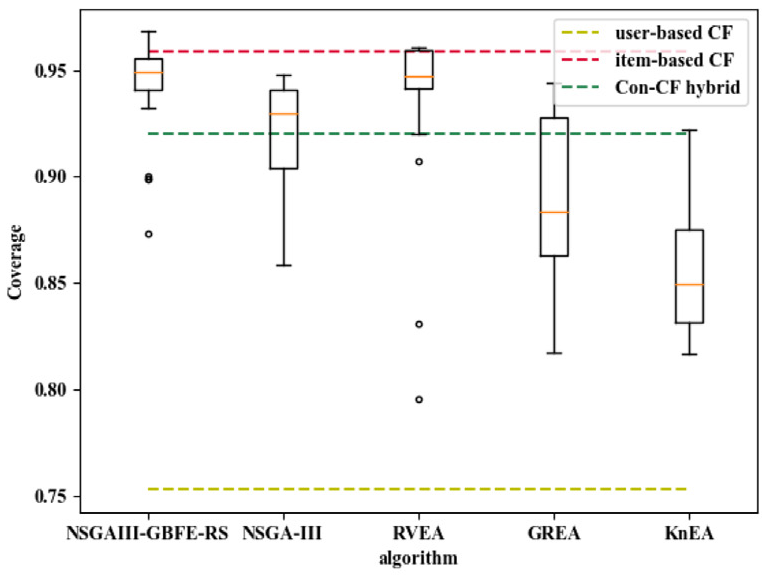 Figure 2: Performance distribution of different MaOEAs. NSGAIII-GBFE-RS consistently shows tighter, higher-performing clusters across metrics.
Critical Insight & Conclusion
The true value of this paper isn't just the "hybrid" recommendation, but the PBKM strategy. By treating the evolutionary process as a source of "knowledge" to be mined, the authors turn a blind search process into a guided one.
Limitations: The computational overhead of running many-objective optimizations remains higher than simpler gradient-based methods. While effective for offline "weight tuning," real-time adaptation might require further distillation of the model.
Future Work: This framework is highly extensible. Tomorrow's "Basic Techniques" could be LLM-based embeddings or Graph Neural Networks, while the MaOEA framework continues to manage the high-level trade-offs between business goals and user satisfaction.