
Beyond Process: Building Collective Intelligence in Dynamic Virtual Enterprises (DVEs)
Knowledge sharing in dynamic virtual enterprises: A socio-technological perspective
The paper introduces a human-centered, socio-technological architecture for knowledge sharing in dynamic virtual enterprises (DVEs). It utilizes Multi-agent Systems (MAS) and Semantic Ontologies to bridge the gap between explicit and tacit knowledge across organizational boundaries.
Executive Summary
In the modern global economy, success is often determined by how quickly a firm can assemble a Dynamic Virtual Enterprise (DVE)—a temporary alliance of independent partners pooling core competencies to seize a market opportunity. However, these temporary structures face a massive bottleneck: Knowledge Silos.
This paper proposes a socio-technological framework that moves away from rigid, process-centered systems toward a human-centered agent society. By combining Semantic Ontologies with intelligent software agents, the authors have developed a method to bridge heterogeneous knowledge types (explicit vs. tacit) and ensure that the right expertise finds the right person at the right time.
The Core Challenge: The Flaws of Process-Centricity
Most Knowledge Management Systems (KMS) are built into the "business process." While this works for static environments, DVEs are inherently volatile. The paper identifies four critical pain points:
- Heterogeneity: Different partners use different data formats and terminologies.
- Impermanence: Members join and leave, making stable infrastructure nearly impossible.
- Security vs. Openness: The risk of losing core competencies to partners-turned-competitors.
- Tacit Knowledge: Most valuable experience resides in human brains, not manuals.
Methodology: The Socio-Technological Layering
The authors propose a three-layered knowledge sharing model that mimics human social behavior:
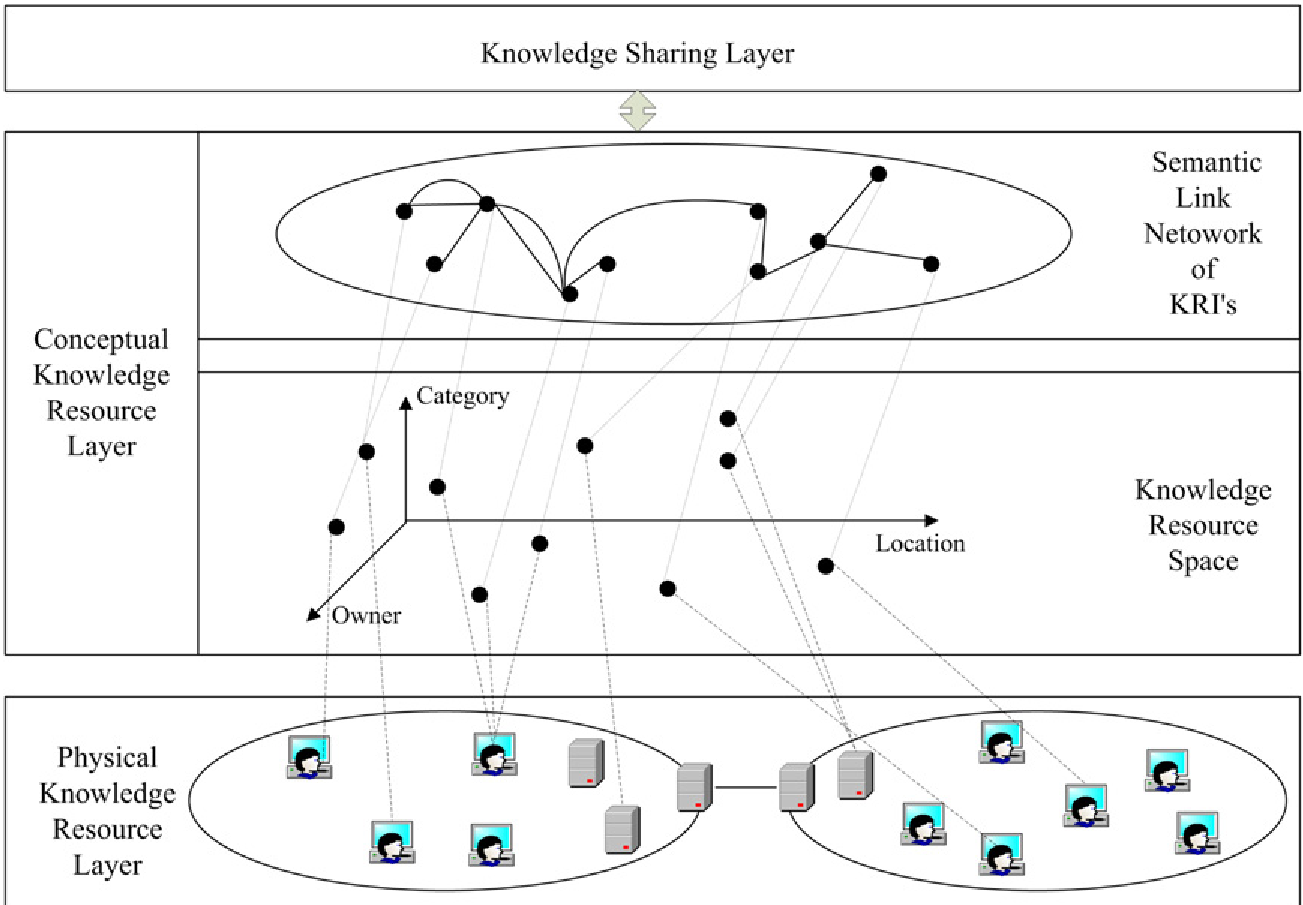
1. The Knowledge Resource Space (KRS)
Instead of a flat folder structure, knowledge is mapped into a 3D space: KS (Owner, Category, Location).
- Semantic Links: Items aren't isolated; they are connected via links like
Subclass,Part-Of,Sequence, andReference. This allows for a "Semantic Link Network" that can infer hidden relationships through predefined reasoning rules.
2. The Agent Society Architecture
Every node in the enterprise network is represented by a software agent. These agents don't just "search"—they infer.
The agent architecture consists of:
- Semantic Explorer: A visual interface for humans to navigate the knowledge graph.
- Knowledge Recommendation: A mechanism that uses "Pulling" (on-request) and "Pushing" (proactive interest matching).
- Contribution Evaluation: A feedback loop where users score the quality of knowledge, helping the agent calculate the Agent Contribution Degree (ACD).
3. Social Discovery Mechanism
How does one agent find another in a sea of data? The authors use a specialized formula to calculate Agent Preference Similarity: This ensures that search queries are forwarded to agents with "similar taste," significantly reducing network noise.
Case Study: Cementing Collaboration
The system was validated at CNBMEEC, a company managing massive cement-plant construction projects.
- The Setup: High-stakes projects requiring collaboration between designers, equipment suppliers, and installation subcontractors.
- The Outcome: When an installer struggled with a "Plate Feeder" setup, the agent-based system successfully bypassed organizational silos to find relevant documentation and human expertise hosted by a different subcontractor, brokered through the core enterprise’s agent.
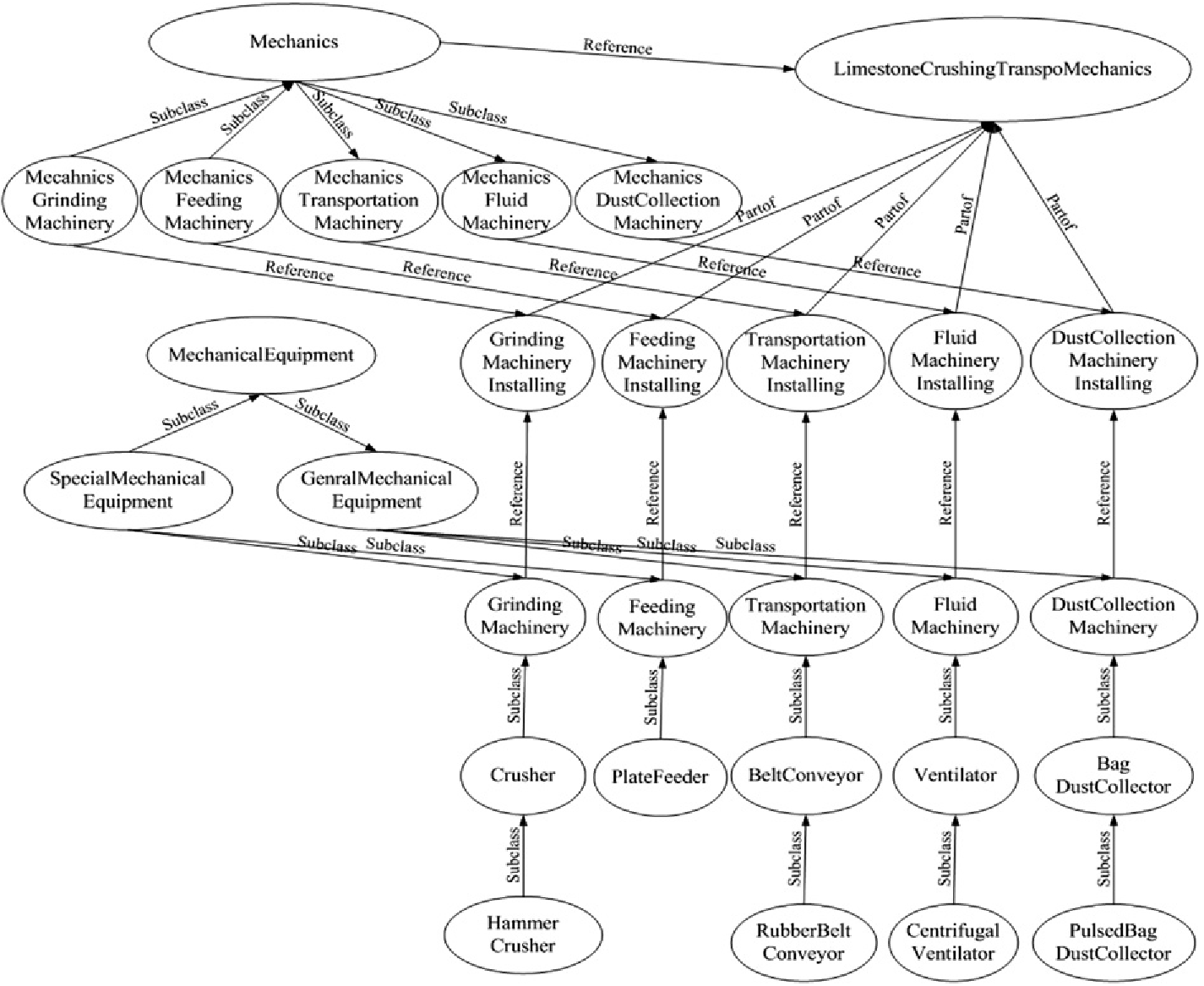 Figure: The domain ontology utilized to map the relationships between "Major," "Task," and "Mechanical Equipment."
Critical Insights & Limitations
The Collective Intelligence Evolution The most striking argument of this paper is the accumulation effect. Even when a project ends and the DVE dissolves, the "agent-to-agent" ties endure. This means the next time a DVE is formed, the agents are already smarter, having mapped out the global landscape of expertise.
Limitations: The authors admit that pure topic-based searching can still lead to "information overload" if too many items fall under one category (e.g., thousands of instances of "Hammer Crusher"). They suggest moving toward Attribute-based matching to further refine results.
Conclusion
This work serves as a blueprint for the future of decentralized collaboration. By treating knowledge as a dynamic social network rather than a static database, enterprises can achieve true agility. For managers and architects, the takeaway is clear: Stop building silos; start building networks.