
Beyond the Subsidy: Rational Stimulating for Knowledge Sharing in Social Networks
Knowledge Sharing in Social Network Using Game Theory
This paper proposes a Rational Stimulating Mechanism for Knowledge Sharing (KS) in Social Networks by integrating Game Theory with traditional stimulating policies. By leveraging the KMRW reputation model and incomplete information, the authors derive a Perfect Bayesian Equilibrium that achieves a near 100% KS rate with optimized, lower stimulating costs compared to standard static models.
TL;DR
Knowledge is power, but sharing it often feels like a loss. This paper addresses the "Prisoner's Dilemma" of Knowledge Sharing (KS) in social networks. By combining Game Theory (specifically the KMRW reputation model) with a Stimulating Mechanism, the authors prove that we can achieve a 100% sharing rate without the social network coordinator having to pay an exorbitant "subsidy" for every action.
The Problem: The High Cost of Cooperation
In any social network or virtual community, we encounter a classic friction:
- The Individual's View: Sharing knowledge costs time and effort (), while the benefits () often go to others. Rationally, it's better to "free-ride."
- The Coordinator's View: To stop free-riding, the coordinator provides a stimulus (). In a static world, if , people still won't share. If , the coordinator goes broke.
This "Prisoner's Dilemma" is the death of many enterprise wikis and professional networks. Static games of complete information simply don't offer a way out unless the coordinator pays the full price of the effort.
The Insight: Incomplete Information as a Catalyst
The authors shift the perspective from a one-time transaction to a finitely repeated game of incomplete information.
The psychological "hook" here is reputation. If there is even a tiny probability () that a user is "non-rational" (someone who just likes to echo or follow others), a rational user has an incentive to pretend to be that person to encourage others to share back.
Methodology: The Rational Stimulating Mechanism
The core of the paper is the integration of the KMRW (Kreps-Milgrom-Roberts-Wilson) model. The authors propose that the coordinator doesn't need to cover the entire cost of sharing (). Instead, by setting a "Rational Stimulus," they create a environment where:
- Rational players mimic "sharers" to build reputation.
- This leads to a Perfect Bayesian Equilibrium.

The paper evolves from a simple 2-person static model to a complex M-person T-stage dynamic game.
Key Results: Lower Costs, Higher Rates
The mathematical derivation for the optimal stimulus () is the paper's "smoking gun." In the multi-person environment, the stimulus only needs to satisfy:
Because (the expected benefit from others' types) is positive, is strictly less than .
Key Findings:
- Efficiency: The KS rate approaches 100% over enough rounds ().
- Economy: The coordinator saves money because they are leveraging the members' own mutual interests and uncertainties.
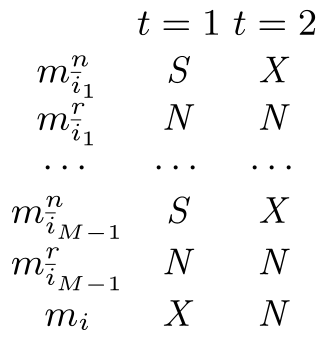
Academic Insight: Why This Matters
Most game theory models for social networks either assume people are perfectly rational (leading to no sharing) or use infinite horizons (which don't exist in the real world). This paper bridges the gap by using finite stages—acknowledging that every project or community has an end—and shows that "faking it" (reputation building) is actually a viable path to "making it" (universal knowledge sharing).
Critical Analysis & Conclusion
While the math is robust, the model assumes players know the probability distribution of "types" (). In real networks, estimating this probability is the true challenge.
Takeaway: If you are building a platform for collaboration, don't just throw money at users. Build a system where their reputation carries value across rounds. A little bit of uncertainty about who is a "true believer" and who is a "rational actor" actually makes the whole system more efficient.
Future Work: Integrating this with actual social network topologies (like Scale-Free or Small-World graphs) would be the next step to see how "clustering" affects the cost of stimulating.