
K-S Tree: Tackling Imbalanced Data by Reducing Problem Complexity
A Kolmogorov–Smirnov statistic based segmentation approach to learning from imbalanced datasets: With application in property refinance prediction
The paper introduces a novel classification framework for imbalanced datasets using a Kolmogorov–Smirnov (K–S) statistic-based decision tree for data segmentation and feature selection. By dividing a complex imbalanced problem into simpler sub-problems, the method achieves SOTA performance on property refinance prediction tasks.
Executive Summary
TL;DR: This paper challenges the conventional wisdom that class imbalance is the root cause of poor model performance. Instead, it posits that data complexity (class overlap) is the fundamental driver. By introducing the K-S Tree, the authors segment complex datasets into simpler sub-problems, achieving a remarkable 98.78% AUC on property refinance prediction—a task where the target class is only 1% of the population.
Background: While most research focuses on balancing the data (external) or modifying the loss function (internal), this work falls into a unique category of segmentation-based learning. It treats imbalance not as a distribution problem to be smoothed, but as a complexity problem to be partitioned.
1. The Core Insight: Complexity vs. Imbalance
The author's simulation study reveals a critical nuance:
- Easy Data: If classes are well-separated, logistic regression yields 100% AUC regardless of whether the minority class is 1% or 50%.
- Difficult Data: When classes overlap significantly, even a 50/50 balanced dataset yields poor results (AUC ~50%).
- The Interaction: Class imbalance only becomes a "blocker" when data complexity is moderate to high.
Insight: Breaking down a complex, overlapping problem into several relatively "easy" sub-problems can mitigate the impact of imbalance.
2. Methodology: The K-S Tree Framework
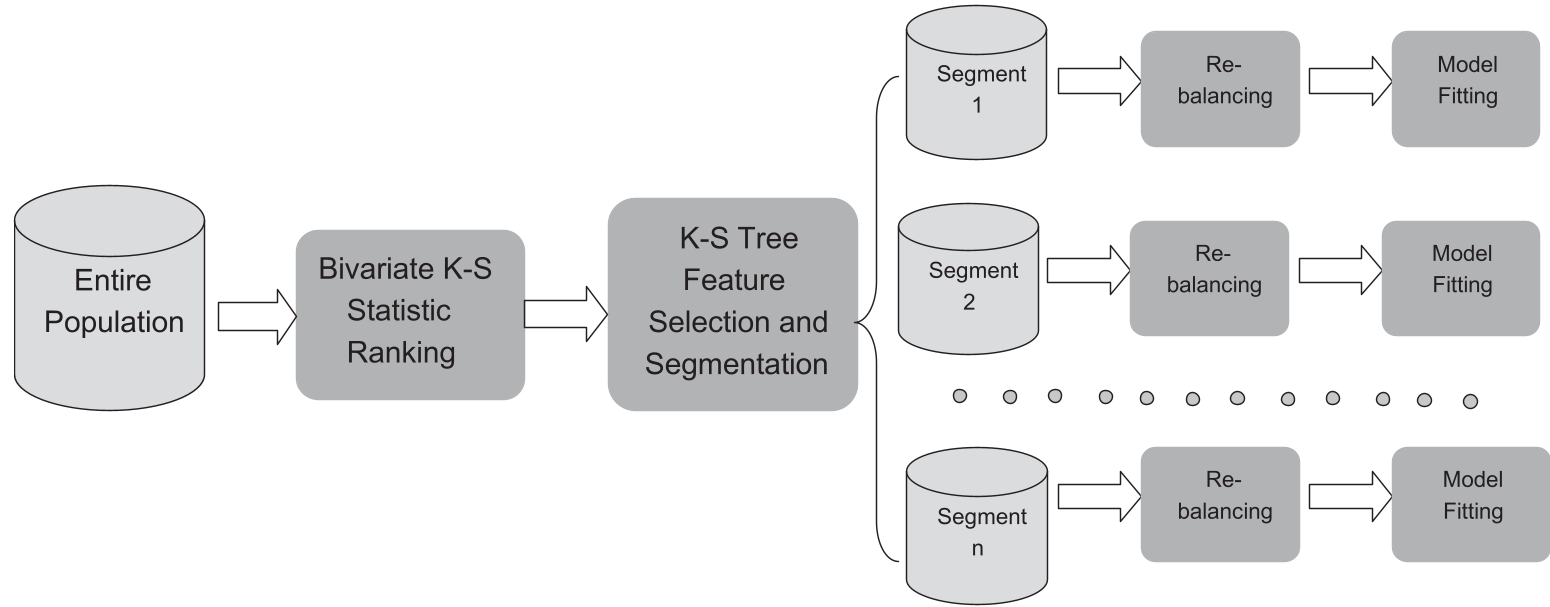
The proposed method follows a three-stage pipeline: Feature Selection Segmentation Local Modeling.
A. The K-S Statistic as a robust Metric
Unlike Gini Impurity or Entropy used in CART/C4.5, the Kolmogorov–Smirnov (K–S) statistic measures the maximum distance between the Cumulative Distribution Functions (CDFs) of two classes.
- Formula:
- Why it works: It uses relative frequencies, making it completely invariant to the skew of the class distribution.
B. Segment-Level Resampling
Instead of global resampling, the authors use a two-way resampling strategy (jointly performing under-sampling and over-sampling) optimized via a search algorithm for each specific segment.
3. Case Study: Property Refinance Prediction
The task involves predicting mortgage refinancing in a dataset where only 1% reach the "Positive" state.
Feature Selection & Segmentation
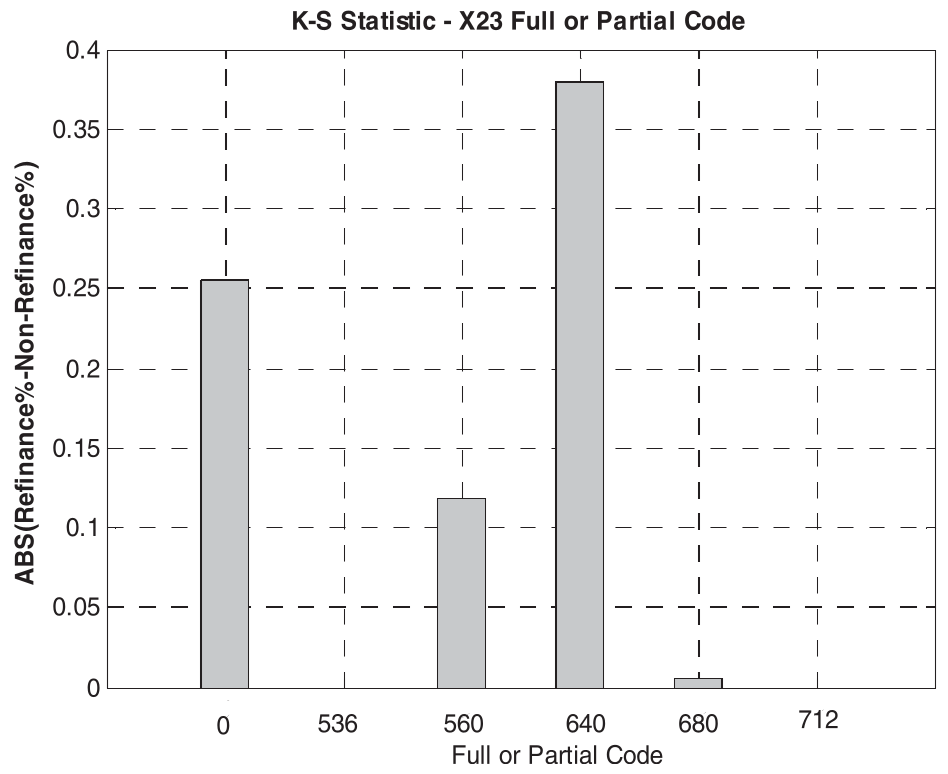
The K-S Tree identified that Loan Amount (X25) and Document Date (X21) were the most critical segmentors.
- Segment A: Customers with missing loan amounts and old document dates had a 0% refinance rate.
- Segment C: Customers with valid loan amounts had a 4.07% refinance rate.
By isolating Segment A (65% of the data) where the target never occurs, the model can focus its energy on the remaining, more "dense" segments.
4. Experimental Results
The K-S Tree approach significantly outperformed traditional resampling and global models.
| Model | AUC (%) |
|---|---|
| Logistic Regression (Baseline) | 93.96 |
| Logistic + SMOTE | 93.81 |
| Proposed K-S Tree Method | 98.78 |
Ablation Insight: Using the K-S Tree solely for feature selection already improved AUC from 91% to 93%; adding segmentation and local resampling provided the final leap to 98%.
5. Critical Analysis & Future Outlook
Takeaway
This research proves that "Divide and Conquer" is particularly potent for imbalanced learning. The K-S statistic provides a mathematically robust way to define these divisions without being "blinded" by the majority class.
Limitations
- Model Interpretability: While local logistic regression models are interpretable, managing multiple models across segments increases operational overhead.
- Unimodality Assumption: The split-point logic assumes the underlying probability density functions (PDFs) are unimodal. While usually true in finance, this might fail in multi-modal physical sensor data.
Future Work
The concept of "Segmentation before Re-balancing" could be extended to Neural Network Architectures, where a "Routing" layer (similar to Mixture of Experts) handles different segments of an imbalanced manifold.
Editor's Final Note: If you are dealing with financial or medical data where the "signal" is buried in 1% of the noise, stop trying to over-sample the whole dataset. Segment it first with a K-S Tree to find the "active" regions.