
DED-KO: Bridging Modern Machine Learning and Power System Stability
Solving the Dynamics-Aware Economic Dispatch Problem with the Koopman Operator
The paper introduces a machine learning-based operator-theoretic approach to solve the Dynamics-Aware Economic Dispatch (DED) problem. By employing a novel domain-aware Koopman Operator (KO) formulation, the authors transform nonlinear, non-convex swing dynamics into a computationally tractable linear program (DED-KO) that preserves high-fidelity approximations of generator physics.
TL;DR
High-fidelity power grid management requires accounting for generator dynamics, but the resulting "Dynamics-Aware Economic Dispatch" (DED) is a non-convex nightmare for real-time optimization. Researchers at PNNL have utilized the Koopman Operator to linearize these dynamics. By embedding physical equilibria into the model, they achieved a 2x speedup in solving dispatch problems with a negligible 0.09% loss in efficiency.
The Collision of Volatility and Physics
Traditional Economic Dispatch (T-ED) treats the power grid as a steady-state system, solving optimization problems every 5 minutes. This worked in the age of massive, sluggish coal and gas turbines. However, the surge of renewable energy introduces rapid fluctuations that "blind" T-ED.
The solution is Dynamics-Aware Economic Dispatch (DED), which incorporates "swing equations" to model how frequency changes when power set-points move. The catch? Swing equations are nonlinear and non-convex. Solving them at scale is often too slow for the 2-to-4-second windows required for modern grid stability.
The Method: Linearizing Reality with Koopman
The core innovation lies in the Koopman Operator (KO). Traditionally, dynamical systems are analyzed in their state space (e.g., angles and frequencies). The KO "lifts" these states into a higher-dimensional space of "observables" where the nonlinear dynamics appear linear.
1. Domain-Aware Architecture
Unlike generic "black-box" neural networks, the authors' Deep-DMD approach forces the model to respect the laws of physics. They embedded the system's equilibrium points (where frequency deviation is zero) directly into the matrix structure of the operator.
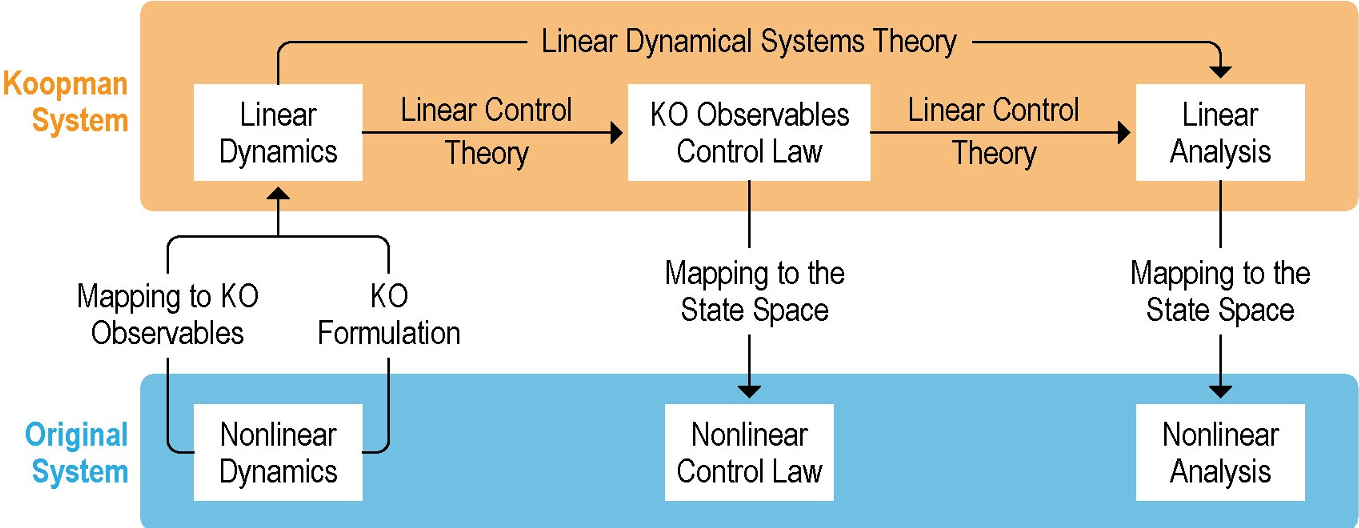 Figure 1: The Koopman workflow mapping state space to a linear observable space for optimization.
2. Stability by Design
To ensure the model didn't "explode" during long-term simulations, the training loss function included an eigenvalue penalty. By restricting the spectral radius of the Koopman matrix to be less than one, they guaranteed that the approximated system remains asymptotically stable—a critical requirement for power grid reliability.
Experimental Results: Speed without Sacrifice
The team tested the system on the WSCC 9-bus grid model. They compared the DED-KO (Linear) against DED-S (Nonlinear Swing Dynamics).
- Efficiency: DED-KO solved nearly twice as fast as the nonlinear baseline.
- Accuracy: The cost difference was less than 0.1%, even in "Tightened Operating" regimes where frequency limits were pushed to the edge.
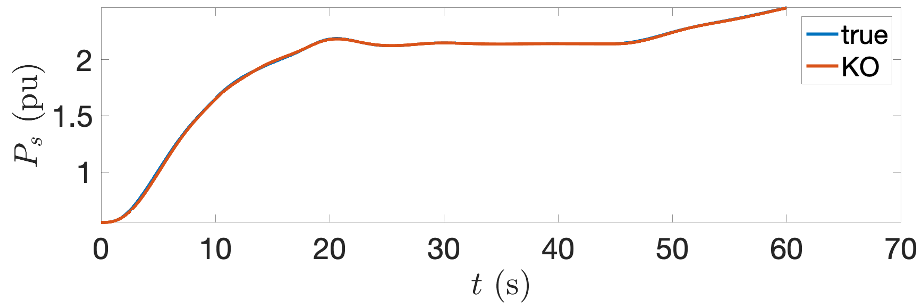 Figure 2: Tracking performance showing that the Koopman Operator (KO) follows the true swing dynamics (True) with high fidelity over time.
Why This Matters
The real value of this work isn't just the 9-bus result; it's the extensibility. Linear programs (LPs) scale far better than nonlinear ones. As we move toward larger grids, the ability to replace complex ODE constraints with a single linear matrix multiplication () could be the difference between a stable grid and a regional blackout.
Critical Insight & Future Outlook
While the 2x speedup is impressive, the authors acknowledge that scalability remains the "final boss." As the number of buses increases, the size of the Koopman matrix grows quadratically.
However, the Dimensionality Reduction potential of the Koopman framework remains untapped. Future work could potentially represent thousands of phase angles with just a few dozen "latent observables," making real-time, dynamics-aware control of national-scale grids a mathematical reality.
Takeaway: This paper proves that ML isn't just for predicting the next word; when constrained by physical invariants, it can solve some of the hardest optimization problems in infrastructure.