
Kwaabana: Bridging the Digital Divide via Localized Cloud Sharing
Kwaabana: file sharing for rural networks
The paper presents Kwaabana, a localized file-sharing system designed for rural African networks to enable efficient content exchange. Built on the ownCloud platform, it optimizes bandwidth by keeping local traffic within the village while using a smart synchronization engine to bridge local and global servers (SOTA in rural ICTD).
TL;DR
Internet users in rural Zambia often pay exorbitant prices for satellite connections that fail 75% of the time when uploading photos or videos. Kwaabana solves this by creating a "Village Intranet" shared storage system. It keeps local traffic local, synchronization "invisible" to users, and successfully facilitates social sharing where traditional platforms like Facebook fail due to infrastructure constraints.
The Problem: The High Cost of Being Online
In rural communities like Macha, Zambia, the Internet is not just slow; it is a financial burden. With 1GB vouchers costing $30, uploading a high-resolution video is both a technical impossibility and a financial risk.
The authors identified a critical Locality of Interest: over 60% of Facebook messages and image views in these villages occur between users within the same village. Despite being feet apart, their data travels thousands of miles to servers in the US and back, clogging the expensive 2Mbps satellite link.
Methodology: Keep it Local, Make it Smart
Kwaabana's architecture is a masterclass in adapting high-end tech for low-resource environments. It consists of two main pillars:
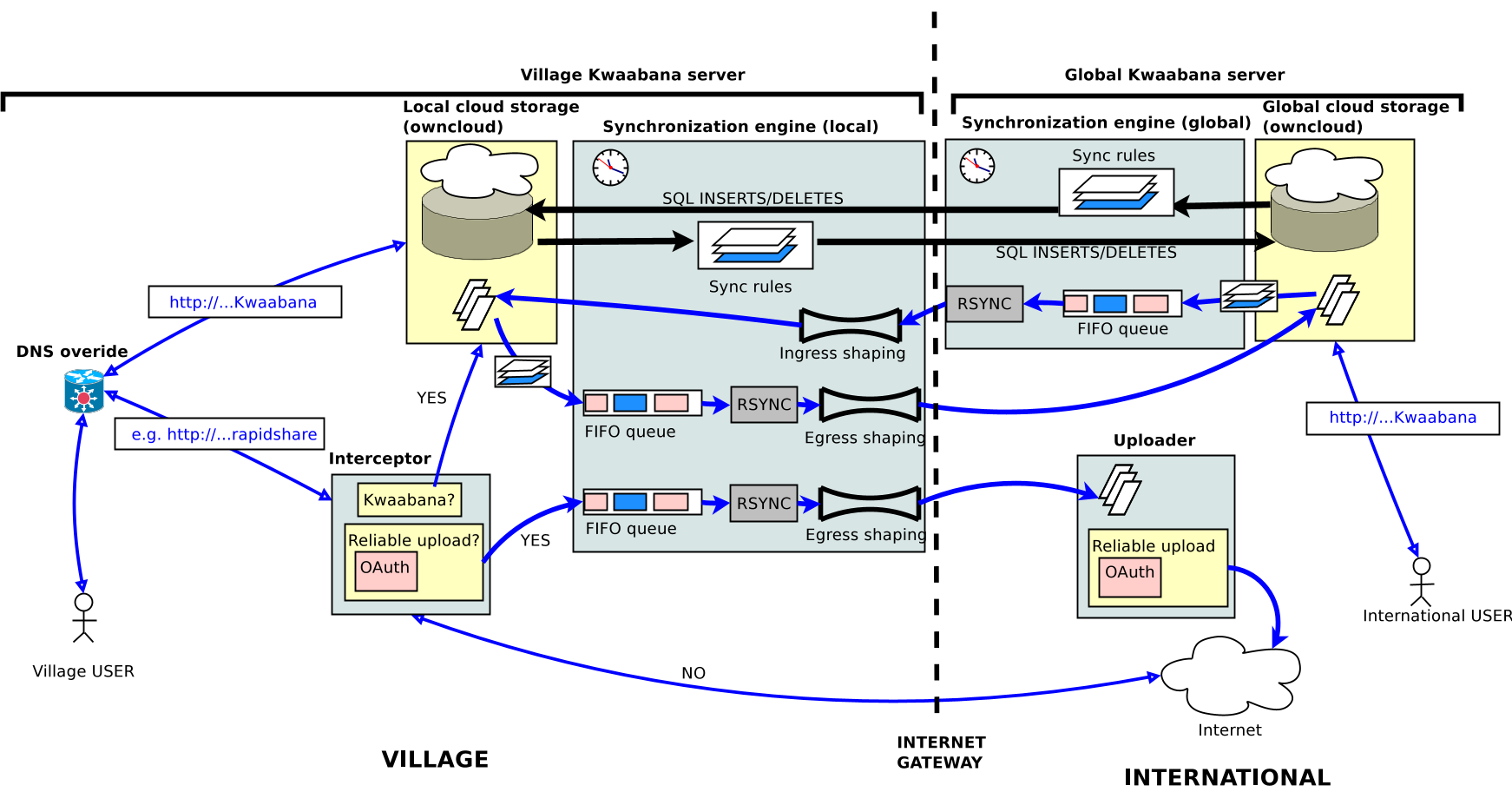
- Architecture of Locality: Using DNS overrides, requests for
www.village-net.orgare intercepted and served by a local village server. This means sharing a 500MB video costs $0 and happens at LAN speeds. - Smart Synchronization: When a user wants to share a file with someone outside the village, the system doesn't just try to upload it immediately. It places the file in a queue managed by a Traffic Control (TC) subsystem.
The "Trickle" Strategy
The core technical innovation is the use of Hierarchical Token Buckets (HTB). Instead of competing with a student trying to search Google (interactive traffic), Kwaabana "borrows" bandwidth. As shown in the architecture below, it utilizes a stochastic fair queue for web traffic and a "trickle" rate for sync. If the link is idle, the sync speed ramps up; the moment a user opens a web page, the sync backs off to near-zero.

Real-World Impact in Macha
The deployment revealed fascinating social insights. Residents used the system not just for sharing, but as a backup service for mobile phone photos.
- Video Success: A single 600MB video shared via a local link saved the community over $72 in bandwidth costs compared to everyone downloading it from an external host.
- Resilience: The system survived Macha's frequent "brown-outs" and power failures (15% downtime) by using
rsync, which allows file transfers to pick up exactly where they left off.
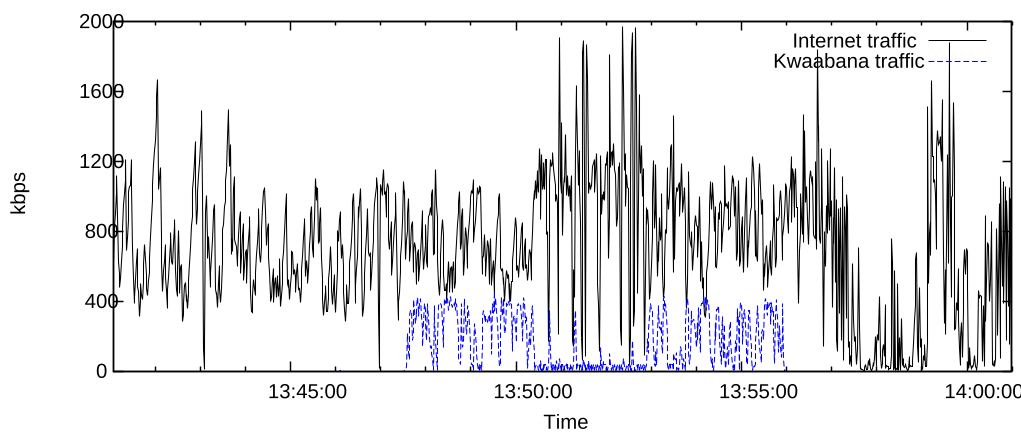 The chart above illustrates how the synchronization (shaded area) intelligently fills the gaps in normal Internet traffic, maximizing link utility without slowing down users.
Critical Insight: The Ubuntu of Design
The most important takeaway isn't the TCP ports or the SQL schema; it's the participatory design. By renaming the system "Kwaabana" (Tonga for "share") and involving local leaders, the researchers ensured the system reflected the community's Ubuntu culture—where collective access is prioritized over individual profit.
Conclusion
Kwaabana proves that the "Digital Divide" isn't just about lack of cables—it's about the inefficiency of current global protocols in local contexts. By creating "digital islands" that can periodically sync with the "mainland," we can empower the next billion users to become content creators, not just consumers.
Future Work: The authors suggest a P2P storage solution to further distribute files across village computers, reducing the single point of failure and scaling with the community.