
Laban Descriptors: Bridging the Gap Between Motion Kinematics and Emotional Expressivity
Laban descriptors for gesture recognition and emotional analysis
This paper introduces a novel set of 3D gesture descriptors based on the Laban Movement Analysis (LMA) model, utilizing 81 features to characterize the qualitative aspects of motion. Integrating these descriptors into a machine learning framework with SVM and Random Forests, the authors achieve SOTA results in action recognition (97%+ F-score on MSRC-12) and significant advancements in emotional analysis of orchestra conductors' gestures.
TL;DR
Researchers have long struggled to move beyond the "what" of a gesture (e.g., "the arm moved up") to the "how" (e.g., "the arm moved aggressively"). This paper introduces 81 specialized 3D descriptors based on Laban Movement Analysis (LMA). By quantifying qualitative aspects like "Flow," "Weight," and "Shape," the authors achieved a staggering 97%+ accuracy on standard action datasets and pioneered a system to recognize the complex emotional intentions of orchestra conductors.
Background: Why Most Gesture Recognition Fails at Nuance
Most computer vision systems treat human movement as a series of coordinate changes. While this works for simple action recognition (like "sitting" vs. "standing"), it fails to capture expressivity. An orchestra conductor’s gesture isn't just a path in 3D space; it carries a metaphoric weight—tension, serenity, or wrath.
The authors argue that we need a "Mid-level" representation. Just as HOG or SIFT descriptors revolutionized static image recognition, we need descriptors that encode the quality of motion.
Methodology: The LMA Framework
The researchers turned to the work of Rudolf Laban, a dance theorist. They focused on three core LMA components:
- Space: Movements relative to the "Kinesphere" (the space reachable by the body).
- Effort: The most "expressive" part, subdivided into Time (sudden vs. sustained), Flow (constrained vs. free), and Weight (heavy vs. light).
- Shape: How the body changes its form (rising/sinking, spreading/enclosing).
From Physics to Descriptors
To turn these abstract concepts into data, the authors used 3D skeleton joints from Kinect sensors. They calculated:
- Jerk (3rd order derivative): To quantify "Flow."
- Kinetic Energy Phases: To distinguish between "active" and "pause" states for "Time."
- Dissymmetry Measures: To capture the "verticality" and "symmetry" of complex artistic gestures.
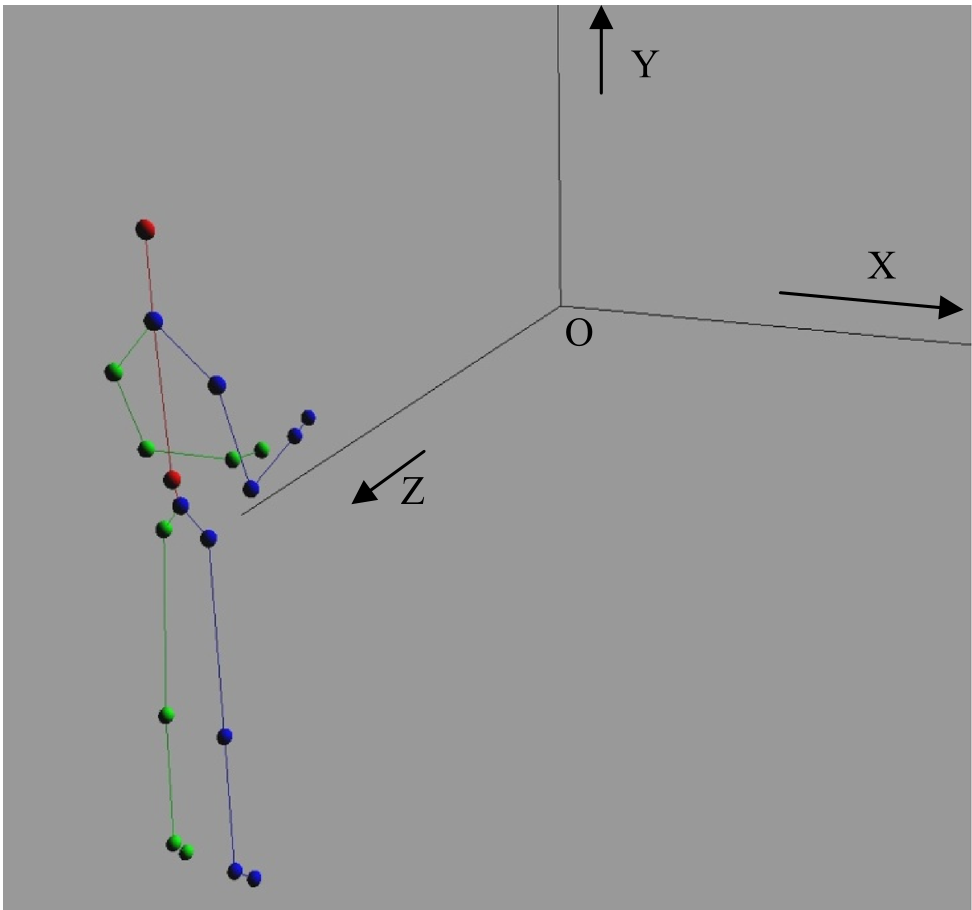 Fig. 1: The 20-joint skeleton model and the translation-rotation process used to normalize the coordinate system into sagittal, vertical, and horizontal planes.
Experiment I: Smashing the SOTA in Action Recognition
Using the MSRC-12 dataset (which includes both iconic actions like "shooting" and metaphoric ones like "protesting music"), the LMA descriptors were tested using Support Vector Machines (SVM) and Random Forests (Extra Trees).
- Result: The Extra Trees classifier achieved an F-score of 97.7%.
- Comparison: This significantly outperforms previous benchmarks that hovered around 81% for metaphoric gestures.
Experiment II: The Conductor's Baton
The true "stress test" was recognizing emotions in orchestra conductors. The authors recorded 892 segments from 8 rehearsals and had professional musicians annotate them with 17 emotional categories.
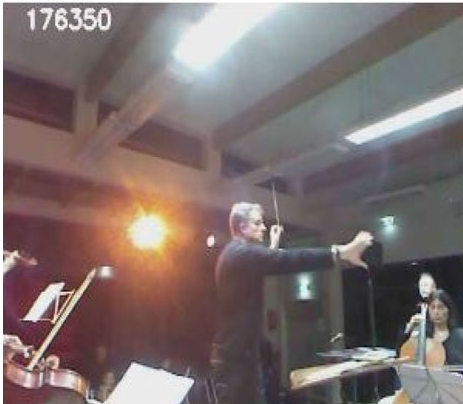 Fig. 2: The annotation interface used by musicians to map gestures to the emotional lexicon.
Recognizing "magical" or "mysterious" is inherently harder than recognizing "crouching." Despite the subjectivity, the LMA-based SVC achieved:
- Calm: 76.2% F-score
- Dynamic: 79.1% F-score
- Overall Mean: 57.0% F-score
While 57% might seem low compared to action recognition, in the realm of unconstrained, multi-label emotional analysis, it is a remarkably robust result, proving that LMA qualities are indeed grounded in physical features that machines can learn.
Critical Insight: The "Why" behind the Success
The power of this paper lies in its feature engineering. By using "Jerk" and "Body Dissymmetry," the authors captured the acceleration profiles and postural shifts that human observers subconsciously use to judge emotion.
The transition from "Iconic" (actions) to "Metaphoric" (intentions) is the final frontier in Human-Computer Interaction. This work suggests that the vocabulary of dance and choreography may provide the best mathematical dictionary for this transition.
Conclusion
This research confirms that expressivity and intentionality are not just abstract "vibes"—they are quantifiable patterns in velocity, acceleration, and spatial occupation. Future work will likely see these LMA descriptors integrated into real-time systems for affective computing, allowing AI to not just see what we do, but feel what we mean.
Limitations: The model currently requires pre-segmented gestures. The next logical step is "in-the-wild" detection where the system must simultaneously segment and recognize the emotional flow.