
EW-TSK-CS: Enhancing Crowdsourcing Label Quality through Interpretable Fuzzy Ensembles
17900_Label Quality Improvement in Crowdsourcing with Ensemble TSK Fuzzy Classifier.
The paper proposes EW-TSK-CS, an ensemble Takagi-Sugeno-Kang (TSK) fuzzy classifier designed for label quality improvement in crowdsourcing. It leverages a parallel learning mechanism and a dictionary-based label correction scheme to outperform traditional methods in noisy, uncertain environments.
TL;DR
Crowdsourcing is a double-edged sword: you get massive data quickly, but the labels are often riddled with noise. This paper presents EW-TSK-CS, a novel ensemble fuzzy classifier that doesn't just "filter" noise but actively improves label quality using an interpretable dictionary-based approach. By running multiple TSK fuzzy sub-classifiers in parallel, it achieves SOTA accuracy while remaining transparent enough for humans to understand why a label was corrected.
Problem & Motivation: The "Noise" in the Crowd
Current crowdsourcing platforms (like Amazon Mechanical Turk) rely on anonymous workers. The result? Noise. Prior solutions typically fall into two camps:
- Iterative Estimation (e.g., EM): Highly accurate but computationally expensive and slow for real-time applications.
- Standard Ensembles (e.g., Adaboost): Fast, but they treat the labels as "black boxes" and often lack robustness against high-uncertainty data where workers are unsure ().
The authors' insight was to use Fuzzy Logic. Unlike crisp classification, fuzzy systems excel at handling "uncertainty." By modeling the ambiguity of a crowd-worker's response directly into the math, they can navigate the gray areas of data labeling.
Methodology: The EW-TSK-CS Architecture
The core of the method is a two-stage process: Feature Augmentation and Dictionary Correction.
1. The TSK-noise-LSS Sub-model
The researchers improved the classical TSK fuzzy system by integrating it with Structural Risk Minimization. They formulated a new objective function that specifically accounts for "uncertain" samples (labeled as 0):
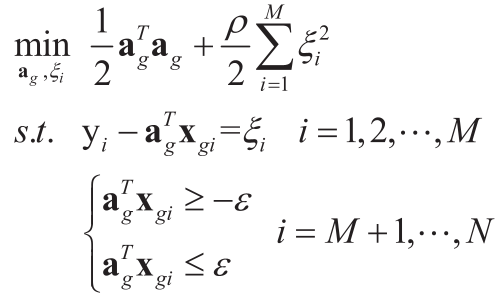
In this formula, represents certain samples, while the inequality constraints handle the uncertain samples within a small error bound .
2. Parallel Ensemble & Dictionary Building
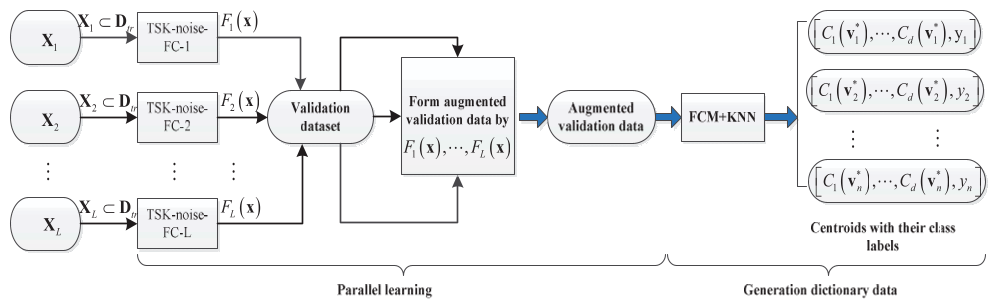
Instead of one massive model, the system trains multiple TSK sub-classifiers in parallel.
- Augmentation: Each sub-classifier generates a "soft prediction" that serves as an augmented feature.
- Clustering: These features are clustered using K-means to form a "dictionary" of representative samples.
- Correction: When a new noisy label arrives, the system uses KNN to find the nearest entry in the dictionary and corrects the label accordingly.
Experiments & Results: Robustness Reimagined
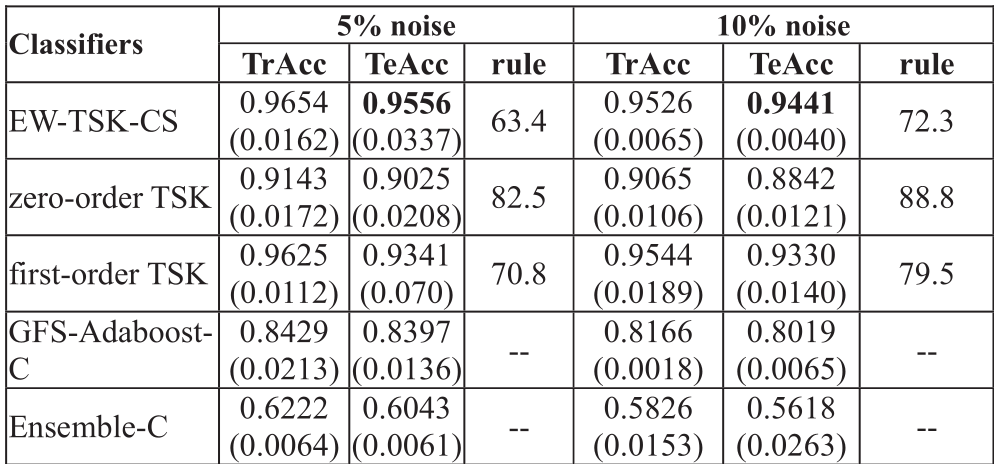
The researchers tested their model against classical TSK systems and strong ensemble baselines like Adaboost and Ensemble-C.
Key Findings:
- Higher Accuracy: On the Chess dataset with 5% noise, EW-TSK-CS reached 95.56% testing accuracy, significantly higher than GFS-Adaboost's 83.97%.
- Efficiency: It uses fewer fuzzy rules (e.g., 63.4 rules vs 132.8 for zero-order TSK), making the model lighter and faster.
- Interpretability: Because it uses Gaussian membership functions, each "decision" can be traced back to an IF-THEN rule that a human can read.
Critical Analysis & Conclusion
The true value of this work lies in its Interpretability. In many industrial applications, we cannot trust a black box to clean our data. EW-TSK-CS provides an "audit trail" via its fuzzy rules:
```text
IF x1 is High AND x2 is Low ... THEN label is -0.5331
```
Limitations
Currently, the model is optimized for binary classification. While the authors mention extending this to multi-class problems, the current dictionary mechanism might face a "curse of dimensionality" as the number of classes and worker categories grows.
Future Prospect
Connecting this fuzzy ensemble logic with Foundation Models could be a game-changer. Imagine a system where an LLM provides the initial "crowd" labels, and an EW-TSK-CS layer sits on top to prune and interpret the noise of the model's outputs.