
Bridging the Data Gap: Automated Labeling for Modern Intrusion Detection
Generating Labeled Flow Data from MAWILab Traces for Network Intrusion Detection
The paper introduces a systematic framework to generate high-quality, labeled network flow datasets for Network Intrusion Detection Systems (NIDS). Leveraging the backbone traffic traces from MAWILab and the SiLK traffic analysis suite, the authors transform raw packet data into NetFlow-compatible records enriched with granular anomaly labels.
TL;DR
In the world of Network Intrusion Detection (NIDS), a model is only as good as the data it’s trained on. This paper addresses the "data drought" by presenting a robust method to extract NetFlow-compatible data from real-world backbone traces (MAWILab) and automatically labeling them using existing IDS logs. The result is a high-volume, realistic dataset that bypasses the need for expensive manual labeling or artificial lab simulations.
Background: The Problem with Artificial "Gold Standards"
For decades, the NIDS community has leaned heavily on the KDD Cup 1999 dataset. While revolutionary at the time, it is now an antique—reflecting network behaviors from a world before Wi-Fi was standard and before the explosion of IoT. Newer datasets like UNSW-NB15 and IDS 2017 attempt to modernize, but they are often generated in "sandbox" environments. The gap between a controlled lab and the raw complexity of a backbone link (like those monitored by the MAWI project) remains significant.
The core challenge is Labeling. How do you take Terabytes of raw packet headers and accurately tell a Machine Learning model: "General traffic" vs. "DDoS Attack" vs. "Port Scan"?
Methodology: The Two-Step Enrichment Pipeline
The authors solve this by treating labeling as a Join Problem between two distinct data sources: raw traffic and expert-curated logs.
1. Flow Construction (The SiLK Stage)
Raw packet captures (pcap) are too granular and bulky for efficient ML. The authors use SiLK (System for Internet-Level Knowledge) to aggregate these packets into Flows. A flow represents a logical conversation between two endpoints (5-tuple: Source/Dest IP, Source/Dest Port, Protocol).
2. Intelligent Labeling (The Heuristic Match)
The real innovation lies in how they map IDS logs back to these flows. Since IDS logs might have "null" values (e.g., alerting on an IP but not a specific port), the authors developed a Precedence Rule:
- L-Value Specificity: A log entry that matches all 4 flow attributes (Source/Dest IP and Ports) is given higher priority than an entry matching only 2.
- Tie-breaking: If multiple logs match, the system prioritizes the "Victim" (Destination) and the "Host" (IP) over the service (Port).
 Note: The metadata extraction process involves aligning time windows and flow tuples to ensure label accuracy.
Key Insights from the Data
The authors validated their method on traffic from late 2018. Their findings highlight the "heavy-hitter" nature of modern attacks:
- Volume Imbalance: While only 20% of flows were anomalous, they consumed nearly 40% of total bandwidth.
- Attack Taxonomy: "Multipoint-class" anomalies (attacks hitting multiple targets) and "Network Scanning" were the dominant threats, representing over 95% of detected anomalies.
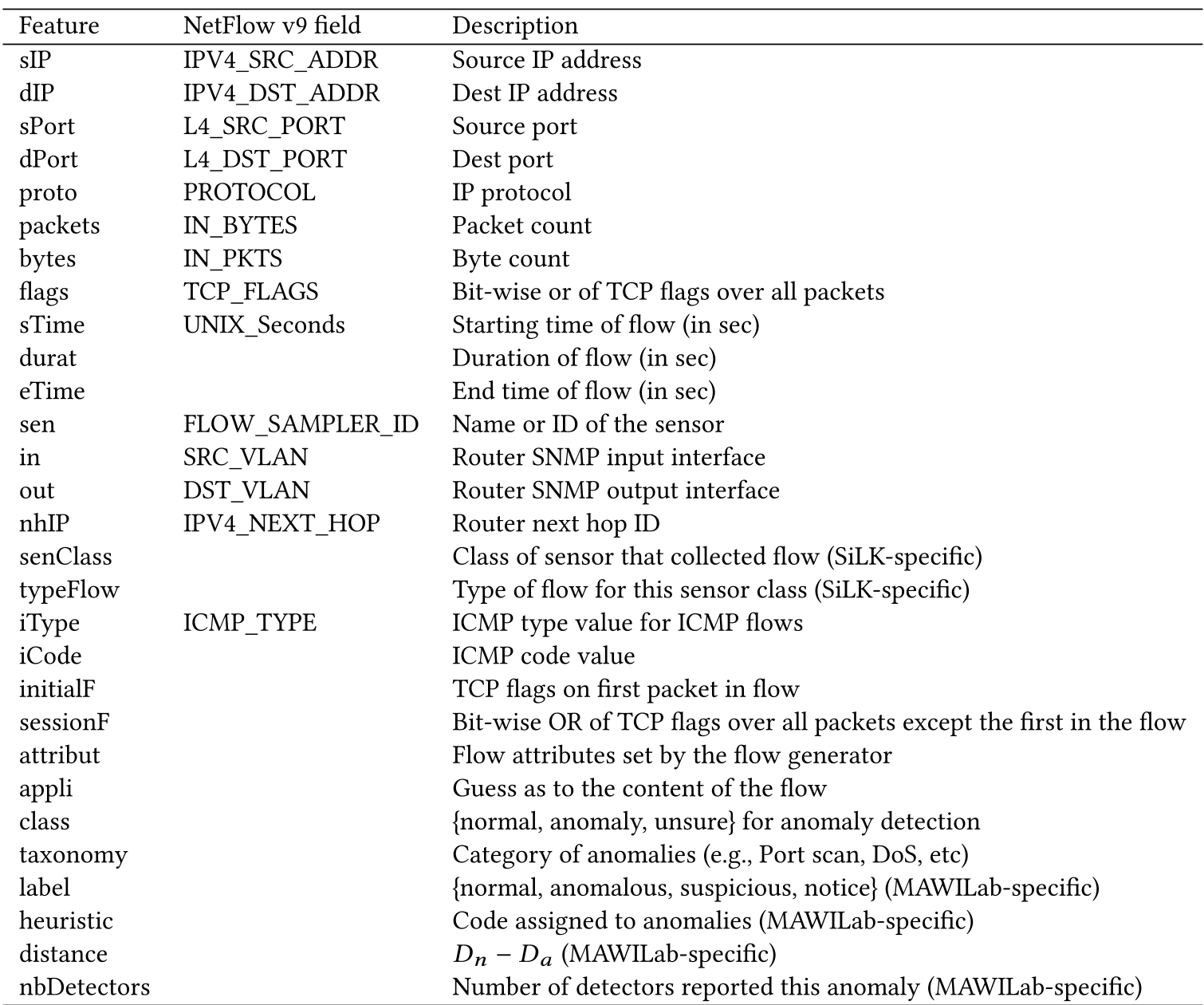 Table: The final output is mapping-aligned with NetFlow v9, making it ready for integration into existing corporate SIEMs and ML pipelines.
Critical Analysis & Conclusion
This paper provides a pragmatic solution to a bottleneck in AI security. By leveraging MAWILab’s 20-year history of traffic, researchers can now generate "ground truth" labels without starting from scratch.
Limitations: The reliance on "L=1" (single attribute) matches remains a gray area. The authors classify these as "unsure," correctly identifying that labeling 16 million flows as "malicious" just because they use Port 443 (HTTPS) would be a recipe for catastrophic False Positives in any ML model.
Future Outlook: The next logical step is applying Temporal Traffic Analysis. How do these flows change over 5-second or 60-second windows? By moving from static flow analysis to temporal pattern recognition (e.g., using LSTMs or Transformers), the community can move closer to real-time, zero-day threat detection.
For those interested in the implementation, the authors have open-sourced their toolset: FlowDataGen on GitHub.