
Beyond "Knows": Labeling the Evolution of Social Connections via ODP and Markov Chains
Labeling Categories and Relationships in an Evolving Social Network
The paper proposes a framework for constructing and labeling "Evolving Social Networks" by iteratively mining person names from web snippets. It introduces a Markov Chain Stationary Distribution (SD) approach to map entity pairs to Open Directory Project (ODP) categories and extract descriptive relationship labels.
TL;DR
This research tackles the challenge of identifying and naming the relationships between people as they appear on the web. By combining web-scale search, the Open Directory Project (ODP) hierarchy, and a Markov Chain-based ranking algorithm, the authors move beyond simple connectivity to provide rich, semantic labels—such as "hottest feud" or "charitable organization"—for evolving social networks.
Background: The Problem with Implicit Links
Most social network analysis depends on explicit metadata (e.g., "Friend-of-a-Friend" tags or co-authorship). However, the vast majority of human relationships are buried in the "cyberspace" of news, blogs, and snippets. The challenge is two-fold:
- Discovery: How do we grow a network from a single name "seed"?
- Semantics: If X and Y co-occur, are they rivals, partners, or just mentioned in the same list?
Existing methods like Jaccard coefficients often capture accidental co-occurrences. This paper proposes the CODC (Co-Occurrence Double Check) metric to ensure the relationship is mutual and strong before adding a node to the "Evolving Social Network."
Methodology: Ranking Contexts via ODP
The core innovation lies in how the authors label these discovered pairs. Instead of reinventing a taxonomy, they leverage the Open Directory Project (ODP), a massive human-edited directory.
1. Building the Directed Graph
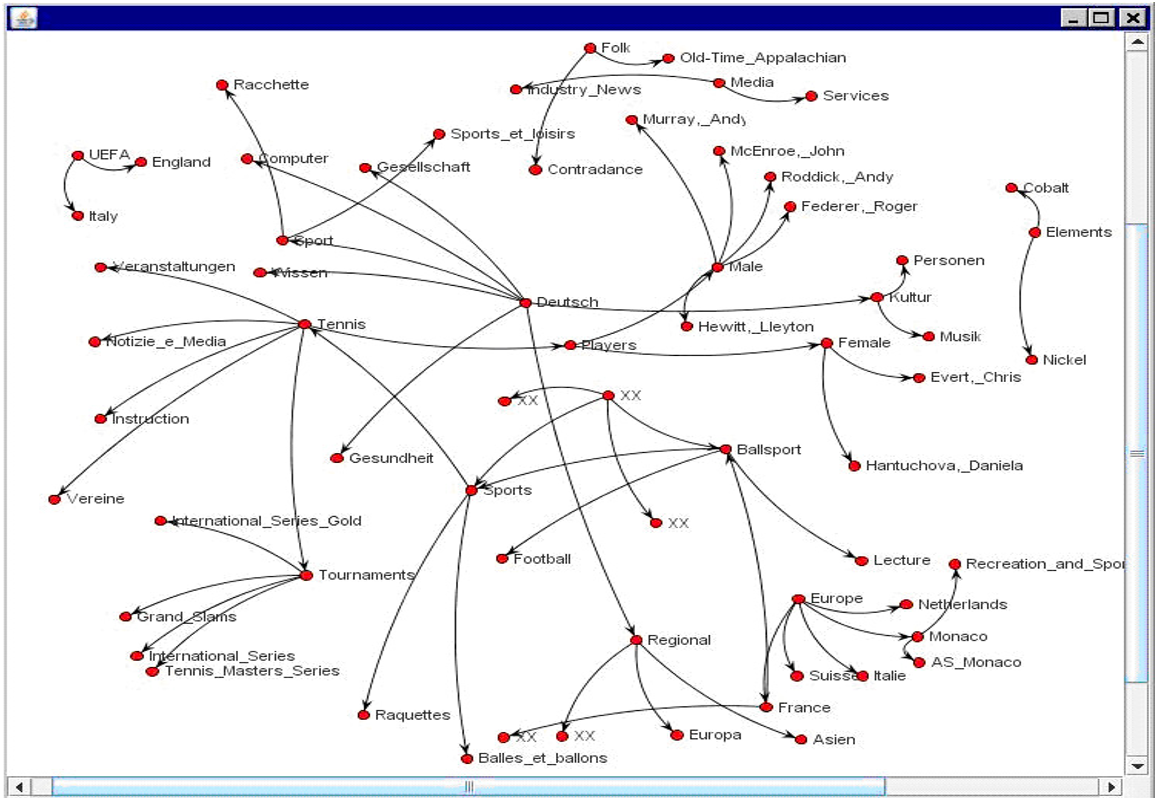
For every pair of entities (e.g., Roger Federer and Rafael Nadal), the system extracts "cue patterns" (noun phrases, organizations, locations). These patterns are queried against ODP to retrieve taxonomy paths like Sports > Tennis > Tournaments. These paths are then woven into a directed graph where nodes are ODP categories and edges represent the taxonomic hierarchy.
2. Markov Chain Ranking (The SD Algorithm)
To find the most representative category, the authors treat the category graph as a Markov Chain. While PageRank and HITS are common, they can be biased toward "absorbing states" (leaf nodes). The authors propose using the Stationary Distribution (SD) of a Markov process that filters out trivial absorbing nodes, focusing on the expected number of times a transient category state is visited.
The formula for the expected number of visits is derived from the stochastic matrix :
Experiments and Insights
The researchers tested their approach on six diverse seeds, spanning sports (Federer, Jeter) and tech pioneers (Gates, Brin).
Key Findings:
- The Power of Person Names (PN): In most cases, using other person names found in snippets (the "0001" combination) was the most effective cue for identifying the correct category.
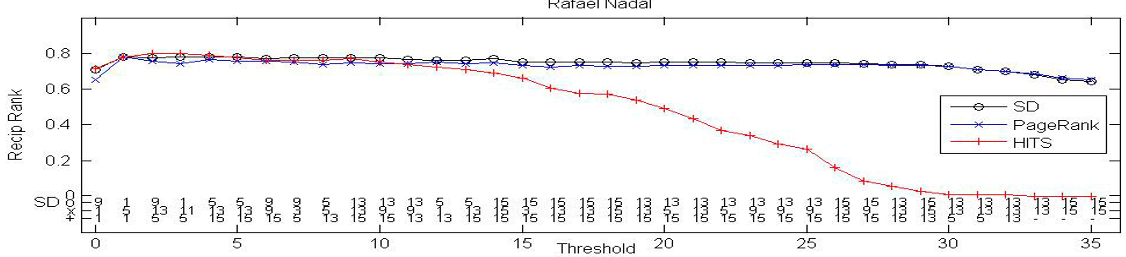
- SD vs. The Rest: The Markov Chain SD method consistently yielded higher reciprocal rank scores compared to HITS and PageRank, proving more robust when link thresholds were increased.
Real-World Labels
The system doesn't just categorize; it extracts noun phrases to describe the relationship. For Bill Gates vs. Melinda Gates, it identified the "Gates Foundation" and "charitable organization" as primary descriptors, successfully distilling the essence of their public relationship.
Critical Analysis & Future Outlook
While the ODP-based approach is ingenious in its use of structured human knowledge, it faces limitations:
- Named Entity Errors: The system still struggles if the NER parser misidentifies a generic noun (like "Micro") as a person.
- Ambiguity: A name like "Lawrence" could be an actor or a researcher; currently, the system does not perform person-name disambiguation.
Future Directions: The integration of modern Knowledge Graphs (like Wikidata) and LLMs could further refine these labels, potentially moving from "category extraction" to "natural language relationship generation." This work provides a fundamental mathematical bridge (via Markov Chains) between raw web co-occurrence and structured semantic understanding.
Conclusion
By treating ODP taxonomy nodes as states in a random walk, the authors have provided a scalable way to name the complex web of human interactions. It is a classic example of using "small" smart algorithms (Markov Processes) to navigate "big" noisy data (the Web).