
Strategic Graph Rewriting: A Formal Blueprint for Social Network Evolution
Labelled Graph Rewriting Meets Social Networks
This paper introduces a formal framework for modeling and generating social networks using strategic port graph rewriting. It utilizes the "Porgy" environment to implement rules and strategies that can simulate complex behaviors like rumor propagation and the generation of small-world networks with SOTA-matching clustering coefficients.
TL;DR
This paper bridges the gap between formal rewriting theory and social network analysis. By treating social networks as Labelled Port Graphs and their evolution as a series of Strategic Rewrite Rules, the authors provide a framework that can generate authentic "Small-World" topologies and simulate information propagation (like viral marketing or pandemics) with mathematical precision.
Background: The Complexity of Connectivity
In contemporary data science, social networks are massive, heterogeneous, and fundamentally dynamic. Most existing analysis tools either focus on static snapshots or use "black-box" stochastic algorithms to simulate growth. The authors argue for a more transparent, logic-based approach using three ingredients:
- Labelled Graphs: To represent complex entities and relations.
- Rewrite Rules: To handle local, concurrent transformations.
- Strategies: To control how, when, and where rules are applied.
Problem: Why Traditional Models Fall Short
Prior generative models like the Erdős–Rényi (ER) model are easy to compute but fail to replicate the "clustering" seen in human society—where the friend of my friend is likely to be my friend. Conversely, manually coding complex growth rules is error-prone and lacks a formal foundation for verification or comparison.
Methodology: The Core Mechanism
The paper utilizes Port Graphs, which differ from standard graphs by introducing connection points (Ports) on nodes. This allows for more granular control over relationships (e.g., distinguishing between a "follower" and a "friend" relation on the same node).
1. Rule Definition
A rewrite rule identifies a pattern () and replaces it with a new structure (). The authors introduce an "Arrow Node" that manages the "rewiring" phase, ensuring that when a node is transformed, its existing connections to the rest of the graph aren't lost (using bridge, blackhole, or wire ports).
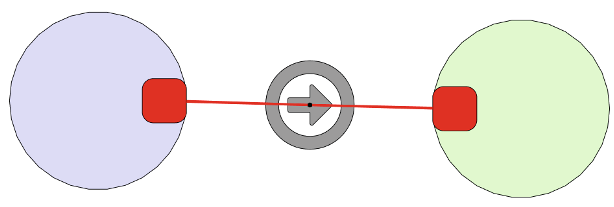 (Example of node activation rule in a propagation model)
2. Strategy Language
The "secret sauce" is the strategy language. Instead of applying rules randomly, the authors use:
- Focusing:
setPosandsetBanto target specific communities. - Probabilism:
ppickto decide which growth rule to apply based on weighted probabilities. - Iterative Logic:
repeatandorelseto build complex workflows.
Experiments: Cultivating a Small-World
The authors demonstrated the framework by generating a social network in three strategic phases:
- Node Generation: Creating a basic Directed Acyclic Graph (DAG).
- Complementary Connections: Adding random or reciprocal edges.
- Community Construction: Closing "triads" (the logic) to increase the clustering coefficient.
Results & Performance
The results match the classical definition of a Small-World Network:
- Characteristic Path Length (): Remained low (~2.5 to 3.3).
- Clustering Coefficient (): Significantly increased from 0.101 (random) to 0.596 (structured).
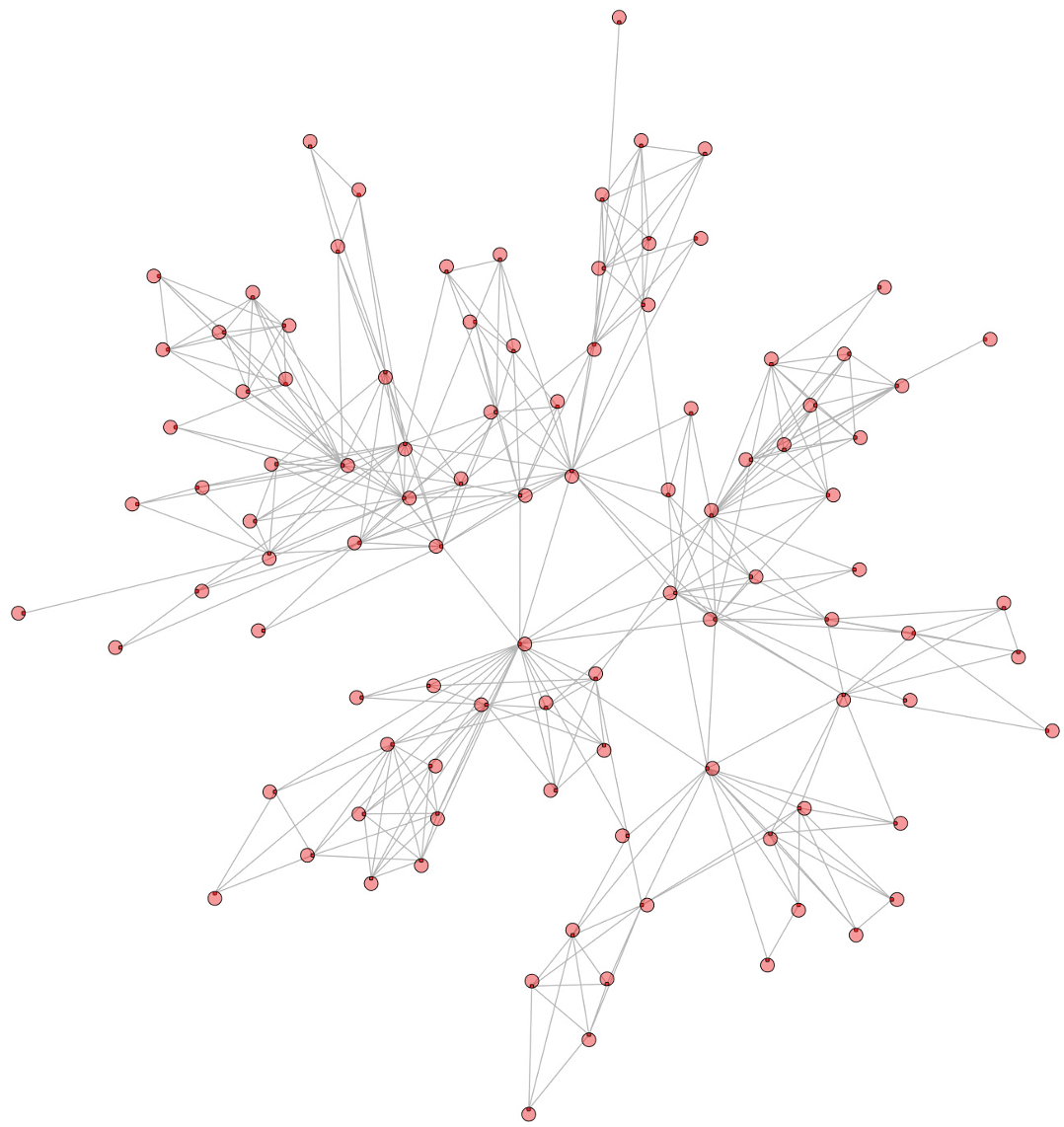 (Visual output from the Porgy environment showing a structured community-based network)
Critical Insight & Future Outlook
The power of this approach lies in its Interpretability. Unlike a deep learning model that predicts a network's growth, this framework provides a "Derivation Tree"—a full history of every single relationship ever formed.
Limitations: The primary bottleneck is Scale. While the logic holds for millions of nodes, the computational cost of subgraph isomorphism (matching the Left-Hand Side of a rule) remains a classic challenge.
Future Work: The authors point toward Multi-layer Networks (e.g., combining family trees, financial flows, and phone records) to track complex phenomena like criminal activity or epidemic spread across different social dimensions.
Conclusion
"Labelled Graph Rewriting Meets Social Networks" is a foundational step toward a formal "grammar" of society. It transforms social simulation from a coding task into a strategic logic puzzle, offering researchers a rigorous sandbox to test how global topologies emerge from local interactions.