
Labenah: Bridging the Arabic Coding Gap Through Visual Edutainment
Labenah: An Arabic Block-Based Interactive Programming Environment for Children. The Journey of Learning and Playing
Labenah is an Arabic-native edutainment application designed to teach children aged 7-12 fundamental programming concepts through a block-based visual environment. It utilizes a User-Centered Design (UCD) approach to combine creative "Stories" and gamified "Challenges," effectively bridging the gap between play and technical education for non-English speaking youth.
TL;DR
Labenah is a pioneering Arabic-native programming environment that uses block-based logic to teach children coding. By moving away from English-centric syntax and toward a gamified, User-Centered Design (UCD), it empowers Arab youth to master logic, creativity, and problem-solving through a mobile-first "learning via playing" philosophy.
Background & Positioning
In an era where technology is the universal language, coding has emerged as a fundamental literacy. However, for the Arab world, a significant "language wall" exists: most tools require English proficiency. Labenah (Arabic for "brick" or "building block") acts as a cultural and technical bridge, positioning itself as a localized alternative to giants like MIT’s Scratch, specifically optimized for the Middle Eastern educational context.
The Language Barrier in Logic
Traditional text-based programming is double-taxing for non-English speaking children. They must learn the symbolic logic of syntax while simultaneously translating foreign vocabulary. This creates a high Cognitive Load, often leading to frustration. The authors argue that by using an Arabic block-based interface, children can focus entirely on Algorithmic Thinking—the ability to sequence events, manage loops, and handle conditional (If-Else) logic.
Methodology: Designing with (Not Just For) Children
The researchers didn't just build an app; they followed a User-Centered Design (UCD) workflow based on the ISO 13407 standard. This involved:
- Requirement Gathering: Interviews at the Riyadh Center for Talented Students and observations of children in their natural learning environments.
- Iterative Prototyping: Moving from low-fidelity sketches to medium-fidelity interactive prototypes.
- Two-Tier Architecture:
- Stories: A sandbox mode where kids drag-and-drop objects and animations to express creativity.
- Challenges: A gamified track where kids solve logic puzzles, such as navigating a character through a maze.
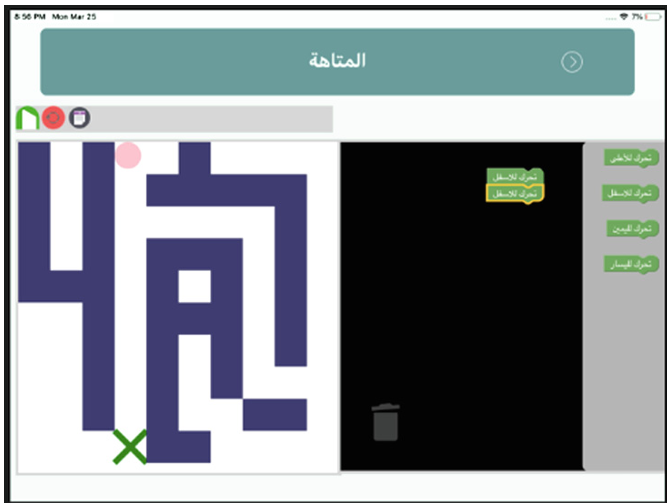 Figure: The "Story" mode allows children to customize objects and visualize their code in real-time.
Gamification and Results
The study highlights that children are 2.5x more likely to stick with a problem when gamified elements like Leaderboards or Level Progressions are involved. The team compared two different UI prototypes; the winning design prioritized high-interactivity and "juice"—visual and auditory feedback that rewards correct logical sequences.
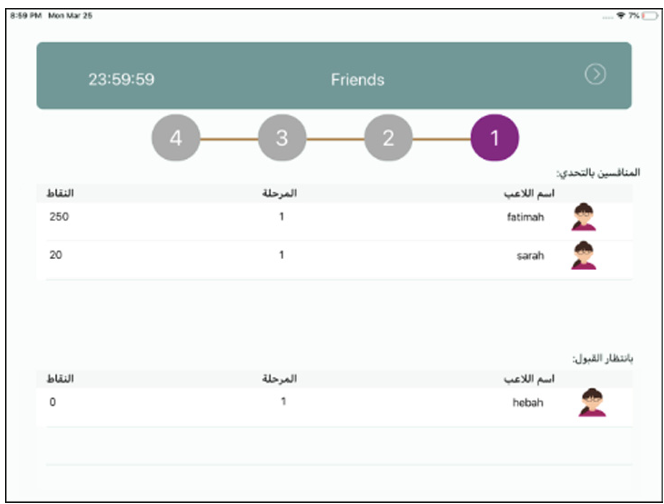 Figure: The Maze Challenge testing the child’s ability to use directional loops and triggers.
Critical Insight & Future Outlook
Labenah successfully demonstrates that localization is more than just translating text; it’s about cultural affordance. However, as the authors note, the jump from "Blocks" to "Text" remains a steep one.
The Takeaway: Labenah is a critical step for Arabic digital sovereignty in education. Future iterations could benefit from a "Dual View" mode where children can toggle between Arabic blocks and Python/JavaScript syntax to prepare them for professional environments.
Key Lessons:
- Inductive Bias toward localized UI: Learning is faster when the UI matches the user's primary language.
- Gamification is Essential: Self-achievement (badges) and social-achievement (leaderboards) are the primary drivers for keeping children engaged in abstract tasks.
- UCD is the Gold Standard: Building for children requires participatory design; adults cannot simply "guess" what a 7-year-old finds intuitive.