
The Asynchrony Paradox: How Network Impairments Mask Lip-Sync Failures in Videoconferencing
Laboratory and Crowdsourcing Studies of Lip Sync Effect on the Audio-Video Quality Assessment for Videoconferencing Application
This paper investigates the end-user perception of lip-sync asynchrony in videoconferencing, determining annoyance thresholds and exploring interactions with video/audio impairments. The authors conducted comparative subjective tests using both formal laboratory settings and crowdsourcing platforms to validate the reliability of remote Quality of Experience (QoE) assessment.
TL;DR
In the era of remote work, "lip-sync" errors are more than just a nuisance—they are a critical component of Quality of Experience (QoE). This study reveals that our perception of audio-video (AV) delay is not static; it is heavily influenced by other network factors. Surprisingly, poor video and audio quality (like packet loss) can actually make us less sensitive to synchronization errors, creating a "masking effect." Additionally, the study confirms that while we can trust the "crowd" to evaluate video quality, audio testing remains the Achilles' heel of remote research.
Context: Beyond the TV Screen
Historically, lip-sync thresholds were defined for television (where audio leading video by 45ms or lagging by 125ms is perceptible). However, videoconferencing is a different beast. It operates over unpredictable IP networks where bitrates drop and packets vanish. The researchers aimed to find the "annoyance threshold" in this specific context and determine if the noisy nature of the internet changes how we perceive the timing between a speaker's lips and their voice.
Methodology: Lab vs. The Crowd
To ensure robust results, the authors split their study into two environments:
- Laboratory (Orange Labs): A controlled environment following ITU-T P.911 standards with 32 participants.
- Crowdsourcing (FouleFactory): A real-world test with 146 participants using their own devices (laptops, headphones, speakers).
The test matrix included:
- Delays: Range from -400ms (audio lags) to +400ms (audio leads).
- Impairments: 3 resolutions (QVGA, VGA, 720p), 3 bitrates, and varying packet loss percentages.
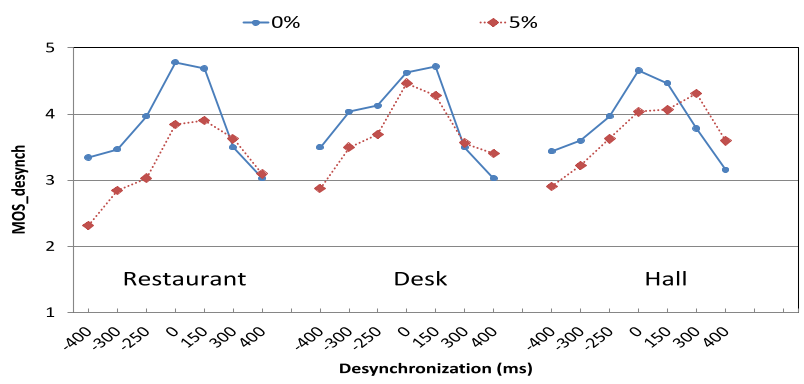 Fig 1: Base perception of asynchrony in reference conditions. Notice the higher tolerance for audio lag compared to audio lead.
Key Insight: The Interaction Effect
The most striking finding is that asynchrony annoyance is not an independent factor. It is deeply coupled with the overall signal quality.
- Visual Masking (Video Packet Loss): When video packet loss occurs, the resulting visual artifacts (glitches/stuttering) make it harder for the human eye to track lip movements precisely. Consequently, users become less sensitive to timing errors. The study found this interaction to be statistically significant (p = 0.018).
- The "Hall" Effect: In scenes with high spatial complexity (like the "Hall" scene), low bitrates make the global video quality so poor that users essentially give up on lip-reading, which ironically lowers the reported annoyance of the asynchrony.
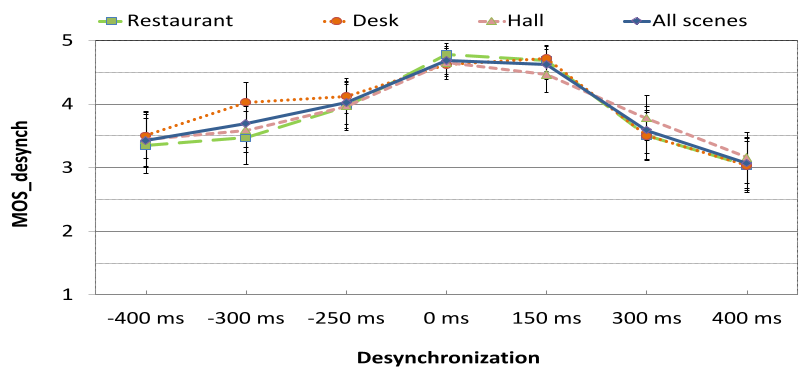 Fig 2: Impact of Video Packet Loss—notice how the MOS_desynch curves shift as network conditions worsen.
The Reality Check for Remote Research
One of the primary goals was to see if crowdsourcing could replace formal labs. The results are a "mixed bag":
- The Green Light: For Video Quality and Global AV Quality, the correlation between the lab and the crowd was excellent (>92%). Crowdsourcing is a massive win here for speed and cost.
- The Red Light: For Audio Quality, the correlation plummeted to 60%. Why? Because while screens are relatively standard, audio setups vary wildly. 59% of crowdsourced users used built-in loudspeakers in non-soundproof rooms, whereas lab users used high-quality headphones. This background noise and hardware variability effectively "broke" the audio quality assessment.
Critical Analysis & Conclusion
This paper serves as both a baseline for videoconferencing QoS and a cautionary tale for researchers.
Takeaway: We can tolerate more delay in a video call (up to 150ms audio lead and 250ms audio lag) than we can in a TV broadcast. However, developers shouldn't take this for granted; as network stability improves, our tolerance for sync errors will likely decrease.
Limitations: The study utilized native French speakers and specific scenes. Whether these thresholds hold across different languages (with different phonetic lip-movements) or for highly interactive tasks (like competitive gaming) remains an open question.
Future Outlook: For future QoE testing, the industry needs better ways to "verify" the crowd's hardware—perhaps through automated audio calibration tones—before allowing them to participate in sensitive audio studies.