
LACore: Bringing Supercomputing DNA to SoC-Based Linear Algebra
LACore: A Supercomputing-Like Linear Algebra Accelerator for SoC-Based Designs
LACore is a programmable linear algebra accelerator designed for SoC integration, leveraging supercomputing architectural features like decoupled access/execute and data streaming. Built as a RISC-V ISA extension, it achieves significant SOTA performance, outperforming x86 CPUs by 3.43x and scaled NVIDIA Fermi GPUs by 12.04x on linear algebra benchmarks within a smaller area footprint.
TL;DR
Linear algebra is the bedrock of modern AI and scientific computing, yet we often force these workloads into two awkward extremes: monolithic GPUs or rigid SIMD units in CPUs. LACore bridges this gap. It is a programmable, supercomputing-inspired accelerator extension for RISC-V that utilizes a decoupled data-streaming architecture. By overlapping execution with memory access and supporting "large-format" vectors, it beats traditional x86 and GPU architectures in both performance and area efficiency.
The "Efficiency Gap" in Linear Algebra
Current hardware architectures face specific architectural "walls" when dealing with high-performance computing (HPC) kernels:
- The GPU Bottleneck: GPUs rely on heavy SIMT (Single Instruction, Multiple Threads) parallelization. For simple reductions (like dot products in DGEMM), GPUs require explicit thread synchronization, which acts as a performance killer.
- The Data Movement Penalty: Discrete GPUs waste cycles and energy moving data over a PCIe bus. On the other hand, CPUs with AVX/SSE extensions often fail to handle arbitrary vector sizes effectively.
- The Rigidness of ASICs: While FPGAs/ASICs are fast, they are specialized. A general-purpose linear algebra solver needs to handle dense matrices, sparse matrices, and vectors interchangeably.
Methodology: The Core Architecture
The LACore's "Secret Sauce" lies in its ability to treat memory like a stream. It integrates directly into the RISC-V pipeline but operates as a decoupled unit.
1. The LAExecUnit and Systolic Datapath
The execution unit consists of VecNodes and ReduceNodes. It isn't just a simple ALU; it's a configurable systolic datapath that can perform 24 different functions, including mixed-precision operations (simultaneous single and double precision).
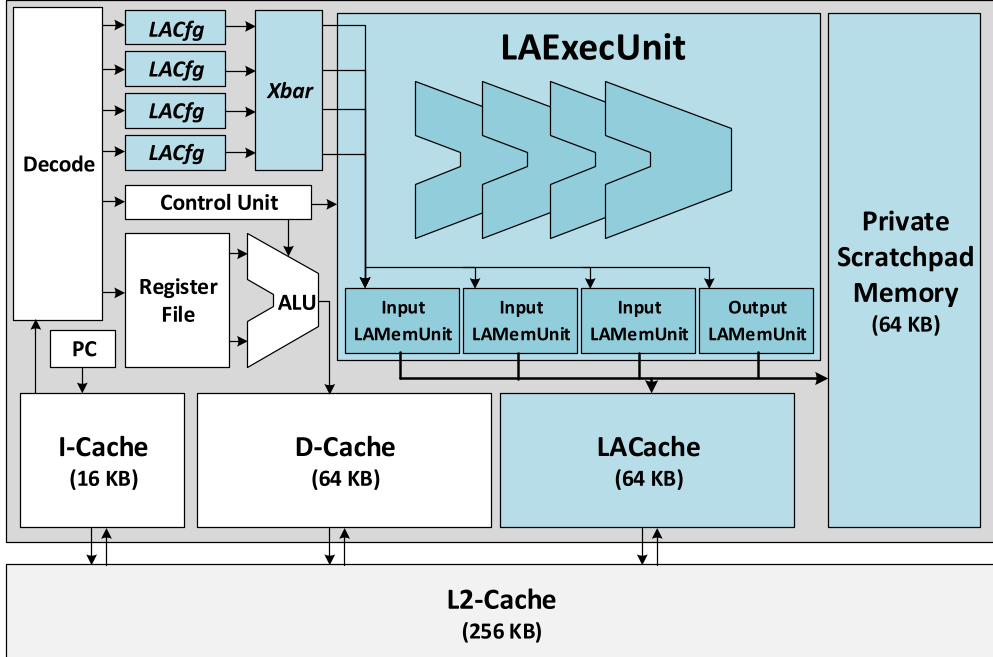 Figure 1: High-level overview of the LACore integrated with a RISC-V Scalar CPU.
2. LAMemUnits: Heterogeneous Streaming
Unlike standard caches that wait for data, LACore uses LAMemUnits. These units act as "intelligent fetchers" that can gather data from regularly strided vectors or even sparse matrices (in Harwell-Boeing format), converting them into a unified stream for the datapath. This abstracts the complexity of data formats away from the execution logic.
Experimental Results: Slaying the Giants
The authors compared LACore against an in-order RISC-V, an out-of-order x86 (with SSE2), and a scaled NVIDIA Fermi GPU using the HPCC (HPC Challenge) suite.
- DGEMM (Dense Matrix Multiply): LACore achieves 14.3 GFLOP/s at a matrix dimension of 128, a staggering 31.7x speedup over RISC-V and 1.6x over the Fermi GPU.
- SpMV (Sparse Matrix-Vector Multiply): For 20% sparsity, LACore hits 17.8 GFLOP/s, showcasing the power of its dedicated sparse-matrix hardware support.
- Area Efficiency: Surprisingly, LACore fits within 13.06 (at 32nm). Even though it's much faster, it uses nearly 40% less area than a scaled-down GPU setup.
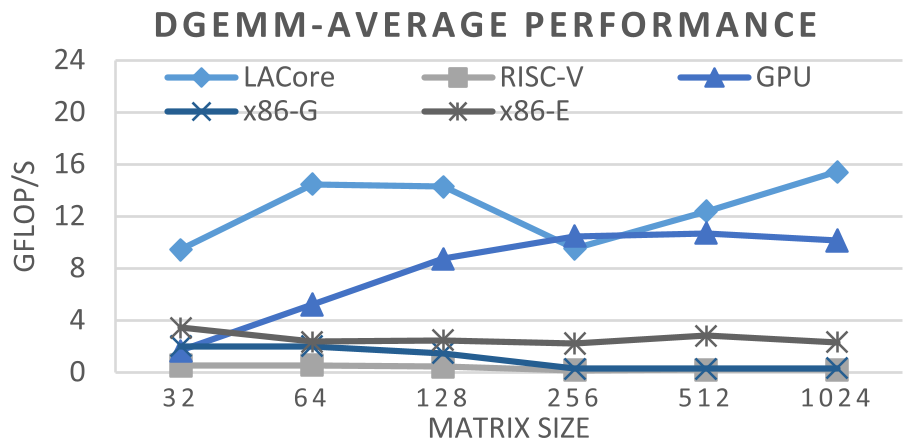 Figure 2: DGEMM results demonstrating LACore's asymptotic performance lead over CPU and GPU implementations.
Deep Insight: Why Does It Work?
The primary reason for LACore's dominance is the reduction of "Instruction Overhead". In a standard CPU, for every few math operations, you have multiple instructions for index updates, branch checks, and memory loads.
LACore replaces this with a Configurable Memory-Memory Interface. You configure the "shape" of your data once (using 294-bit LACfg registers), and the hardware handles the streaming. This is why it excels at STREAM Triad benchmarks (reaching 103 GB/s peak), effectively saturating local memory bandwidth by exploiting high spatial locality without CPU intervention.
Critical Perspective & Limitations
While LACore is a tour de force for linear algebra, its current incarnation has limitations:
- Cache Strain: At very large problem sizes (HPL benchmark), performance dips compared to highly optimized x86 libraries (like Eigen) because row-swapping logic eventually strains the cache hierarchy.
- Single-Core Focus: The current paper focuses on single-threaded performance. The "Future Work" section rightly identifies that scaling this to a many-core SoC design will be the real test of its "supercomputing" claims.
Conclusion
LACore proves that we don't need a discrete GPU for every linear algebra task. By revisiting 1970s supercomputing concepts—like decoupled streaming—and shrinking them onto a modern RISC-V SoC, we can create energy-efficient accelerators perfectly suited for the next generation of IoT, mobile AI, and edge computing.
For more details, check out the open-source implementation: https://github.com/scale-lab/la-core