
Mismatched Crowdsourcing: Decoding the World's Languages through the Lens of Information Theory
Language coverage for mismatched crowdsourcing
The paper introduces "Mismatched Crowdsourcing," a novel framework for transcribing low-resource languages using crowd workers who do not speak the target language. By modeling non-native phoneme perception as a noisy communication channel over phonological dimensions, the authors demonstrate that reliable transcriptions can be aggregated from "mismatched" data.
TL;DR
Building Speech Recognition (ASR) for the world's 6,000+ languages is stalled by a lack of native transcribers. This paper proposes Mismatched Crowdsourcing: using workers who don't speak a language to transcribe it. By modeling phoneme perception as a noisy communication channel and using Weighted Set Cover algorithms, the authors show we can reconstruct accurate text from the "noisy" perceptions of non-native listeners.
Background: The Distributional Expertise Mismatch
The "magic" of modern AI relies on massive human effort (e.g., ImageNet). For speech technology, this means thousands of hours of native-speaker transcriptions. However, there is a fundamental mismatch: the people available on crowdsourcing platforms (like Amazon Mechanical Turk) rarely speak the minority languages that most need preservation.
The authors' core insight? Phonemes are not abstract symbols. They are combinations of physical attributes (voicing, tongue position, etc.). Even if you don't speak Cantonese, your brain can still "detect" certain universal acoustic features—provided your own native language has trained your ears to hear them.
Methodology: High-Dimensional Phonology as a Noisy Channel
The researchers treat a language's segment inventory (its set of sounds) as a binary code. Each phoneme is a vector in a 20+ dimensional space of "distinctive features."
1. The Erasure Channel Model
If a listener's native language uses a specific phonological dimension (e.g., "aspiration"), they can perceive it in a foreign language. If their language lacks it, that dimension becomes "noisy" or "erased."
- Native Dimensions: Low-noise binary symmetric channel.
- Non-native Dimensions: High-noise / Erasure channel.
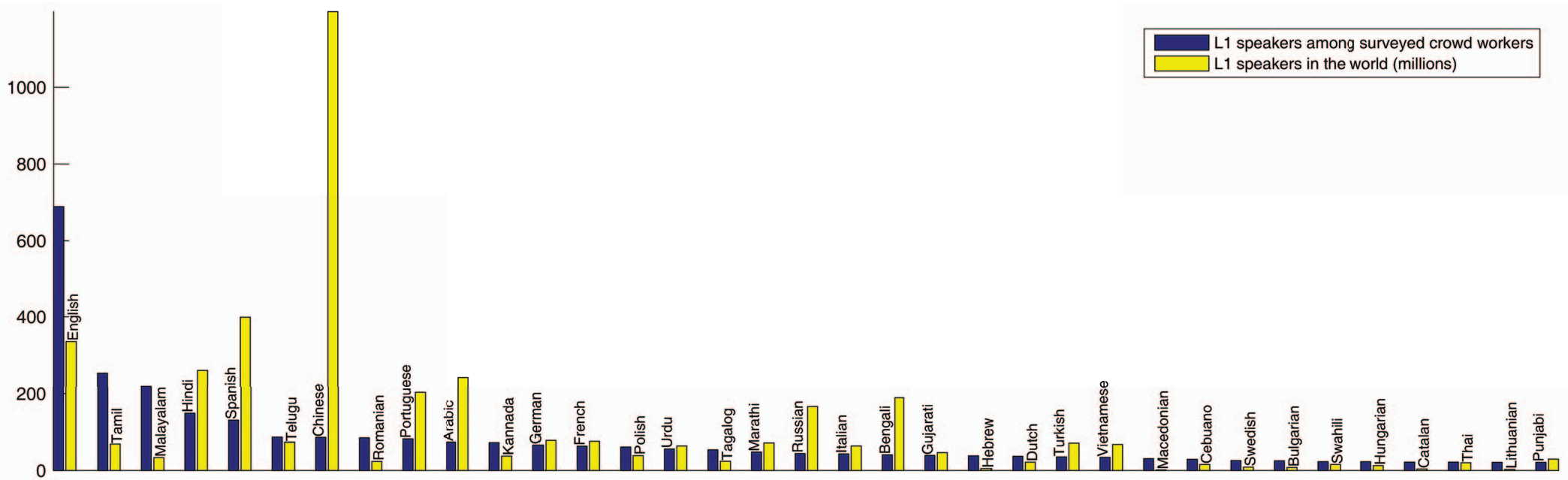 Fig 1: The mismatch between crowd worker populations and global language distributions.
2. Experimental Validation: English and Mandarin vs. Cantonese
The authors tested this by having English and Mandarin speakers transcribe Cantonese.
- Finding: There is a clear positive correlation between the Hamming Distance (how different two sounds are in the feature matrix) and the Perceptual Distinction (how well the workers could tell them apart).
- Insight: Mandarin speakers were better at certain Cantonese distinctions because the phonological "overlap" between Mandarin and Cantonese is higher than that of English and Cantonese.
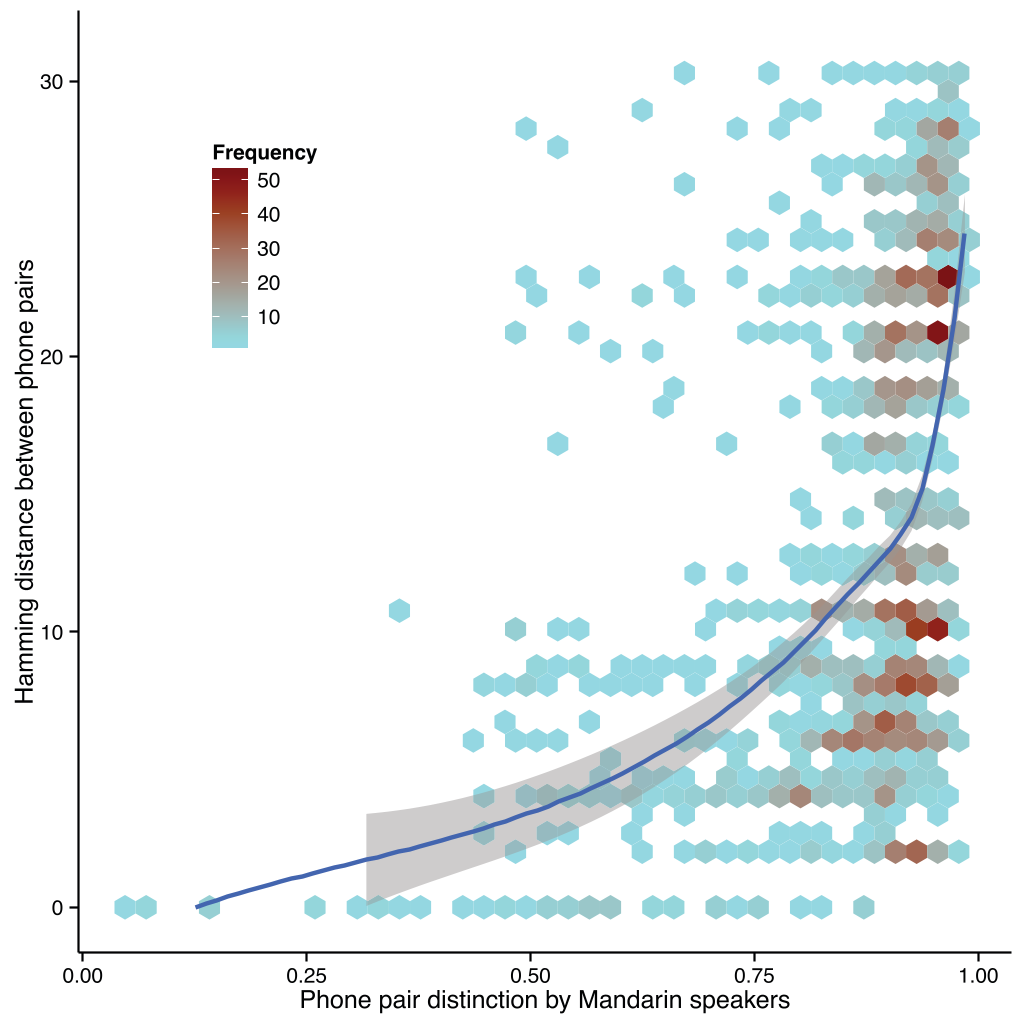 Fig 2: Correlation between Hamming distance and phone pair distinction for English and Mandarin transcribers.
Optimizing the Crowd: The Weighted Set Cover
How do you pick the best workers for a "mystery" language? The authors frame this as a Weighted Set Cover problem.
- Goal: Select a set of transcriber languages that "cover" all the phonological features of the target language.
- Constraint: Minimize the "cost" (scarcity of workers).
For example, to transcribe a language like Hindi, the model might suggest a combination of English and Somali speakers because their combined "perceptual coverage" spans the entire phonological requirement of Hindi.
Critical Analysis & Future Outlook
This paper is a brilliant application of Coding Theory to linguistics. It treats humans as biological sensors with specific "frequency responses" based on their linguistic upbringing.
Limitations
- Unweighted Hamming Distance: The authors admit that unweighted distance doesn't perfectly explain human performance. Some "features" are likely more salient than others.
- Orthographic Mapping: Workers don't just "hear" sounds; they map them to their own alphabet (e.g., an English speaker writing "ba" for a sound they hear). This adds another layer of "transduction noise."
Takeaway
The study suggests a "Universal Law" of phonology that traditional coding theory (like random coding or MD-S codes) cannot yet explain. By viewing the global crowd not as a monolith of "unskilled labor," but as a diverse array of specialized "perceptual filters," we can tackle tasks previously thought impossible without native expertise.
Future Research: Can we apply joint source-channel coding to further refine these transcriptions? The intersection of information theory and human phonology remains a fertile ground for discovery.