
LION: Breaking Language Barriers in Ontologies via Visual "Interlingua"
A Language-Independent Ontology Construction Method Using Tagged Images in Folksonomy
The paper introduces LION (Language-Independent ONtology), a novel method for constructing multilingual ontologies using tagged images from folksonomies (like Flickr). By leveraging visual features as a universal bridge, the method aggregates synonymous concepts across languages and extracts semantic relationships without requiring specialized parallel corpora.
TL;DR
LION (Language-Independent ONtology) is a framework that builds multilingual ontologies from image folksonomies without needing translation dictionaries or parallel corpora. By using images as the universal connector between different languages (e.g., the visual concept of an "Apple" is the same whether tagged in English or Japanese), the system aggregates synonyms and maps hierarchical relationships (Hypernyms/Hyponyms) to enhance image retrieval and tag refinement.
Background & Motivation
An ontology is essentially a map of human knowledge. While WordNet is highly accurate, it is manually curated, making it slow to adapt to new trends. Modern automated methods are faster but suffer from "English-Centricity." In platforms like Flickr, roughly 25% of tags are non-English. Existing systems often discard these as "noise," failing millions of users and losing valuable semantic context.
The core challenge is the Resource Gap: most languages lack the massive parallel textual corpora needed to train cross-lingual models. The authors' insight is simple yet profound: Images are language-independent. A "mountain" looks like a mountain regardless of the language used to describe it.
Methodology: The Three Pillars of LION
The construction of LION involves a sophisticated pipeline that transitions from raw pixels to structured logic.
1. Synonymous Concept Aggregation (Visual Pivot)
Instead of looking for a dictionary entry, the system looks at the visual features of images associated with a tag. If the visual clusters for the English tag "Dog" and the German tag "Hund" overlap significantly, they are merged into a Language-Independent Concept (LIC).
- Tech Stack: AlexNet fc6 features + Locality-constrained Linear Coding (LLC).
2. Relationship Extraction (Textual + Visual Fusion)
Once concepts are merged, the system determines how they relate (e.g., Animal → Dog).
- Canonical Correlation Analysis (CCA): This aligns textual word embeddings (GloVe) from different languages into a shared space.
- Adaptive Modality Selection: The system uses an Empirical Distribution Function (EDF) to decide whether the visual or textual similarity is more reliable for a specific pair of concepts. For abstract concepts, text is often better; for concrete objects, visual features win.
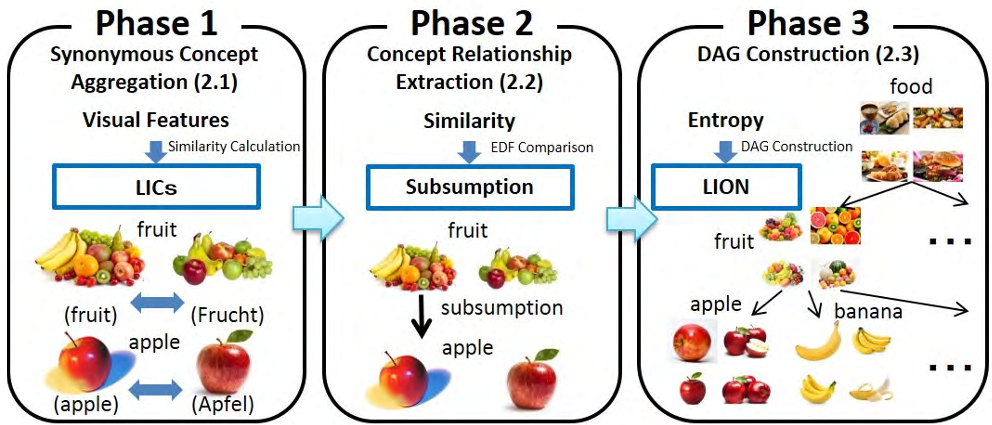 Figure 1: The LION Workflow - From visual aggregation to DAG construction.
3. DAG Construction
The final ontology is a Directed Acyclic Graph. The authors use Entropy to determine hierarchy:
- High Entropy: Broad semantics (e.g., "Entity," "Object").
- Low Entropy: Specific semantics (e.g., "Golden Retriever").
Experimental Results & Impact
The authors tested LION on a dataset spanning English, German, French, Russian, Japanese, Chinese, and Korean.
- Relationship Accuracy: LION outperformed the FBVO baseline in Precision and Recall. By aggregating concepts first, the "Multi" versions of their tests showed consistent gains, proving that multilingual data actually makes the ontology stronger for each individual language.
- Image Retrieval: In user studies, LION achieved higher NDCG scores. Crucially, it could retrieve images tagged only in Japanese even when the user searched in English, effectively deleting the language barrier.
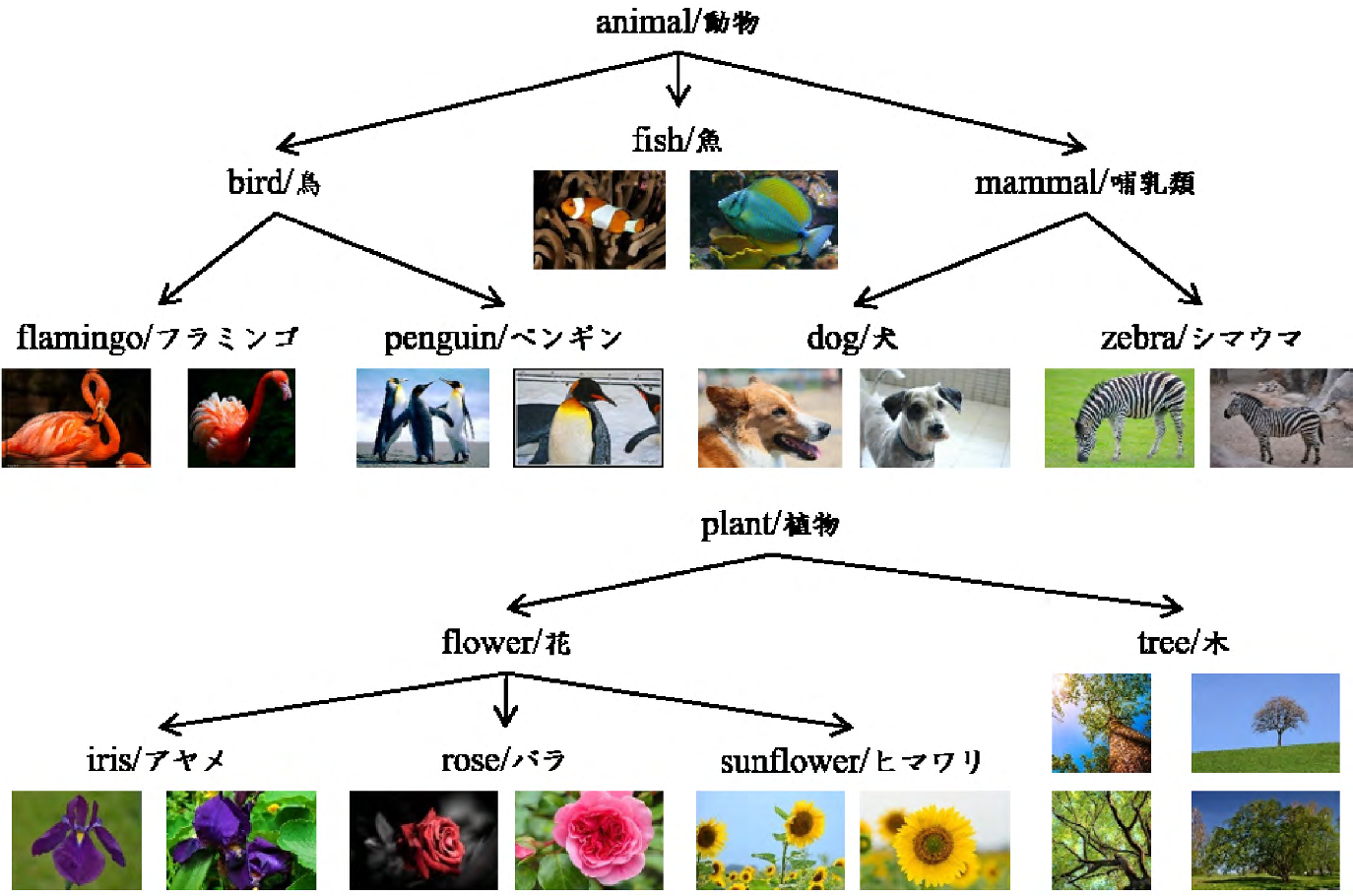 Figure 2: A slice of the generated EN-JA LION. Note how "Animal" correctly subsumes specific species across languages.
Critical Analysis & Future Outlook
Takeaway
LION proves that folksonomies are not just messy datasets; they are rich, multicultural knowledge bases. Leveraging visual similarity as a bridge allows us to build global AI tools that don't require expensive translation assets.
Limitations
- Polysemy: The current model represents each concept with one vector. A "Bank" (river bank vs. financial bank) would likely confuse the visual aggregator.
- Cleanliness: Since it relies on user-generated tags, highly noisy tags (spam) can still skew the visual clusters, though the LLC encoding provides some robustness.
Future Work
The transition from static embeddings to Foundational Models (like CLIP) could supercharge this method, allowing for even more nuanced language-independent understanding and the handling of abstract concepts that are currently difficult to visualize.