
Decoding the Future of Work: A Language Modelling Approach to Discovering Novel Occupations
3195_A language modelling approach for discovering novel labour market occupations from the web.
This paper introduces a Language Modelling (LM) approach to identify novel occupations in the web labour market that are not yet codified in the International Standard Classification of Occupations (ISCO). By utilizing bigram models and smoothing techniques, the system automatically detects job offers describing emerging roles—such as Data Scientists—and ranks existing ISCO classes based on skill similarity.
TL;DR
The labour market is evolving faster than our official taxonomies (like ISCO) can keep up. This paper presents a novel framework that uses Bigram Language Models to detect "non-coded" occupations from web job advertisements. By treating a job offer as a query and existing occupations as document models, the system identifies outliers—roles like Data Scientist or Mystery Shopper—that don't fit the traditional mold, helping experts update official standards with surgical precision.
Problem & Motivation: The Taxonomy Lag
Standard occupational taxonomies (ISCO) are the backbone of European labour policy, but they suffer from a "static bias." Most automated tools use supervised learning, which can only assign a job to a pre-existing label.
The Insight: New professions are rarely entirely unique; they are usually "hybrids." A Data Scientist, for instance, is a fusion of a statistician and a computer scientist. The authors realized that if we can model the "language" of specific ISCO codes, we can use probability thresholds to flag job offers that sound like nothing the system has ever "heard" before.
Methodology: The Core Engine
The researchers developed a three-stage pipeline to turn unstructured job ads into a discovery engine:
1. Linguistic Filtering
Using Part-of-Speech (PoS) Tagging, the system strips away "noise" (e.g., "looking for," "join our team") and focuses strictly on Nouns and Adjectives. These parts of speech carry the highest density of information regarding skills and competencies.
2. The Bigram Language Model
To capture the context of skills (e.g., "Data" + "Analysis"), the authors chose a Bigram Model. Each ISCO occupation is represented by a probability distribution.
The Add-k Smoothing is critical here; it ensures that if a new skill appears that has never been seen in a specific occupation, the probability doesn't immediately drop to zero, allowing for more nuanced comparisons.
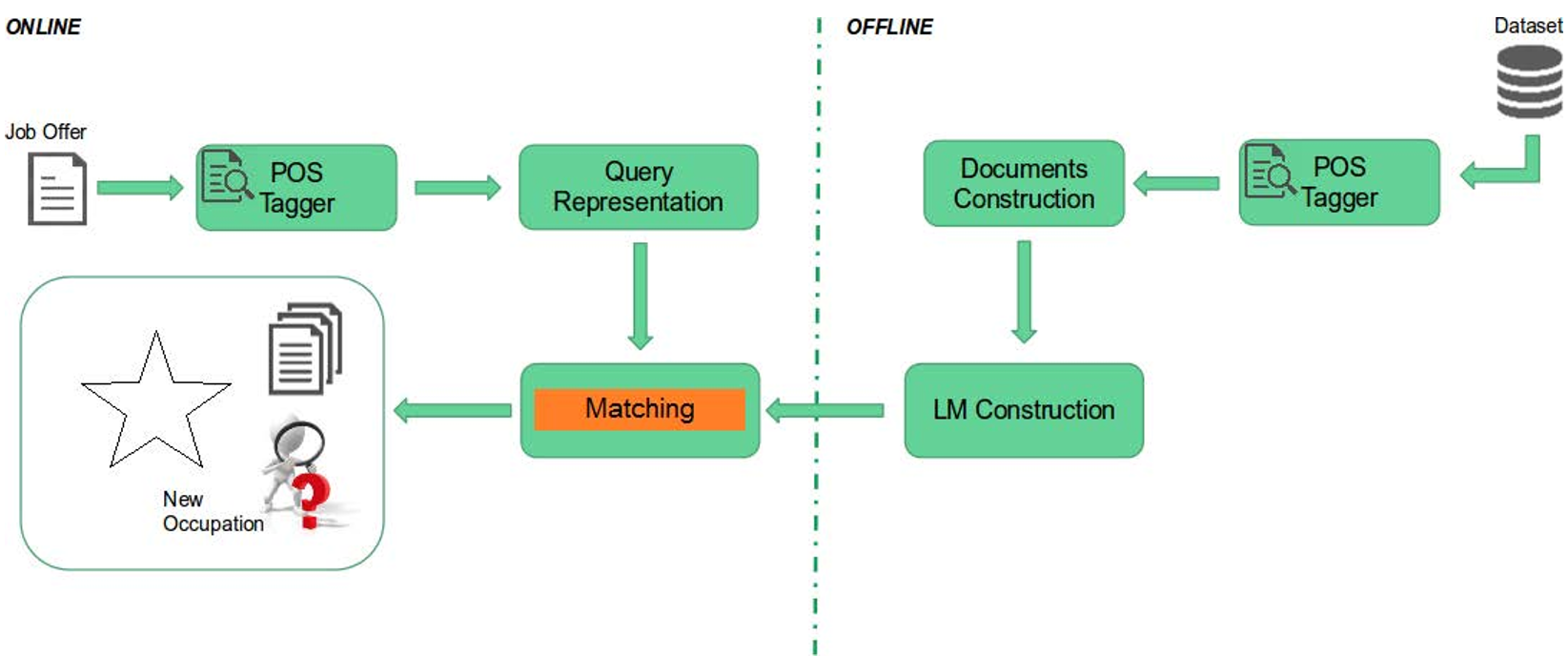
3. Architecture Overview
The system splits into an offline learning module (building models for known jobs) and an online discovery module (testing new ads against those models).
Experiments & Results: Spotting the "Data Scientist"
The model was validated against 117 known "novel" occupations identified by human experts. The results were striking:
- High Sensitivity: The model correctly flagged 92.3% of novel job offers as being outside the standard taxonomy.
- Skill Ranking: For a "Data Scientist" ad, the system didn't just say "unknown." It ranked the most similar models: (1) Systems Analysts, (2) Mathematicians/Statisticians, and (3) Financial Analysts.
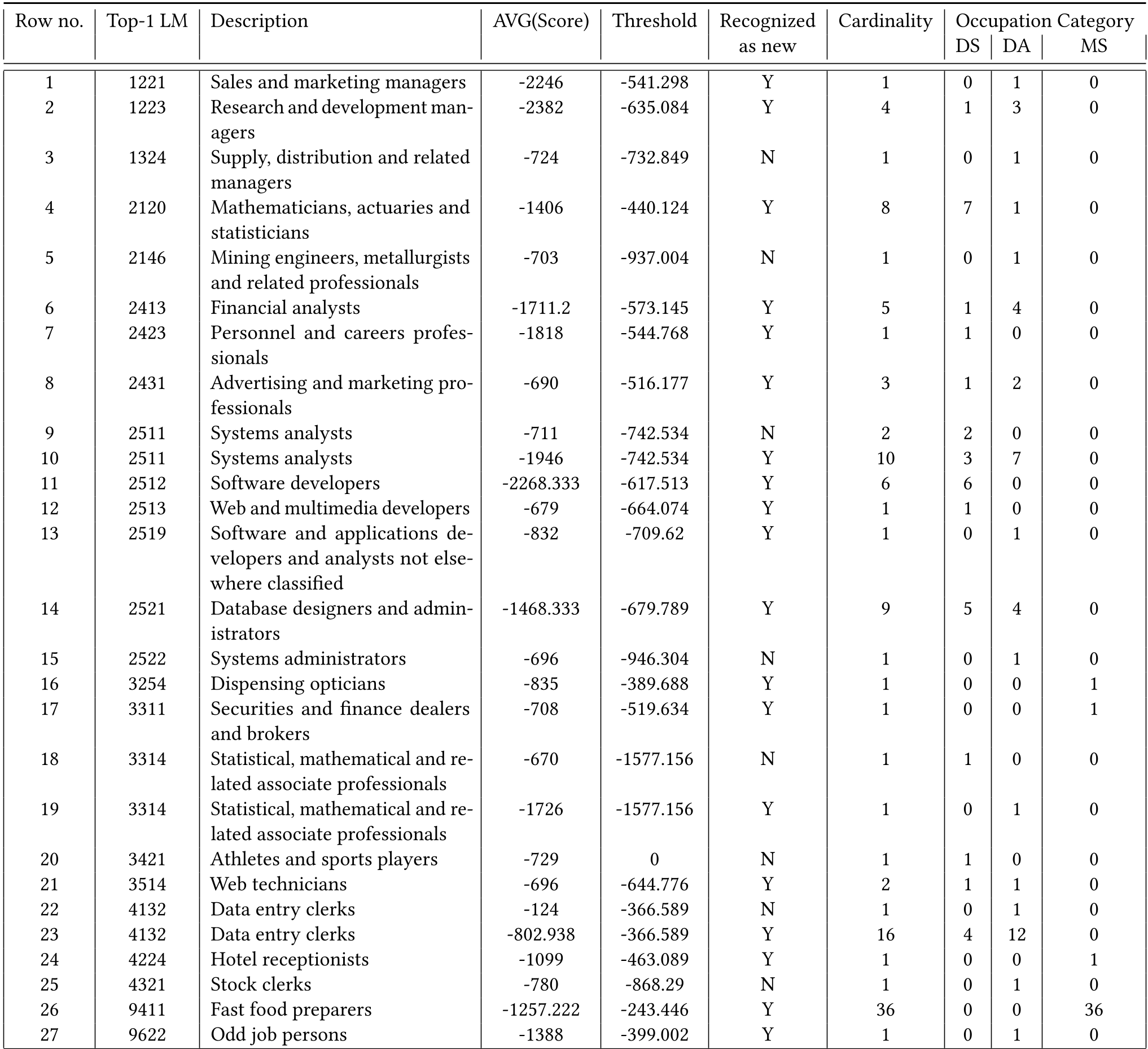
- Thresholding: By setting a 99% confidence interval, the system creates a "safety net" where any score falling below the lower bound is marked as a potential new occupation (indicated by "Y" in the results table).
Critical Analysis & Conclusion
The "Mixture" Breakthrough
The paper’s most profound takeaway is the quantitative proof that new occupations are mixtures of languages. By visualizing the distribution of ISCO codes assigned by experts for these "novel" roles, the authors showed that when the LM score is low (indicating a new job), the human experts are also often split between multiple traditional categories.
Limitations & Future Work
While highly effective, the approach currently relies on frequency-based bigrams. In a modern context, moving toward Latent Semantic Analysis or Deep Embeddings (BERT/LLMs) could further improve the understanding of synonyms (e.g., realizing that "Deep Learning" and "Neural Networks" are related, even if the bigrams differ).
Takeaway for Professionals
For HR tech developers and economists, this work provides a blueprint for dynamic taxonomy management. Instead of waiting years for a manual census to update job codes, we can now "listen" to the web to see where the language of the labour market is shifting in real-time.