
LMs Need Sleep: Breaking the Anterograde Amnesia of Static AI
Language Models Need Sleep: Learning to Self-Modify and Consolidate Memories
The paper introduces the "Sleep" paradigm for Large Language Models (LLMs), featuring a dual-stage process of Memory Consolidation (Knowledge Seeding) and Dreaming. It enables models to continually transform fragile short-term in-context knowledge into stable long-term parametric updates, achieving state-of-the-art results in long-horizon tasks and continual learning.
TL;DR
LLMs currently suffer from a form of digital amnesia—they can "remember" things in their immediate context window, but they can't easily turn those experiences into permanent knowledge without breaking what they already know. Inspired by human neurobiology, the Sleep paradigm introduces a two-stage process: Knowledge Seeding (Memory Consolidation) and Dreaming (Self-Improvement). By periodically "sleeping," models can expand their parameters to accommodate new facts and rehearse synthetic scenarios, achieving stable performance even at 10M token contexts.
The Problem: The "Static" Wall and Catastrophic Forgetting
Existing LLMs are mostly "frozen" after pre-training. While In-Context Learning (ICL) allows them to adapt to new information, this knowledge is volatile—it disappears the moment the session ends. If we try to force this new information into the model's weights via standard fine-tuning, we often trigger Catastrophic Forgetting (CF), where the model loses its original capabilities.
The authors argue that LLMs lack the biological equivalent of Systems Consolidation: the process where short-term hippocampal memories are distilled into long-term neocortical storage.
Methodology: The Sleep Architecture
The paper introduces a lifecycle divided into Active (Wake) and Sleep phases. During Sleep, the model undergoes two distinct biological-inspired stages:
1. Memory Consolidation (The NREM Stage)
The system uses a Continuum Memory System (CMS) where different layers update at different frequencies.
- Knowledge Seeding (Upward Distillation): The model identifies knowledge in "fast" (short-term) modules and distills it into "slow" (long-term) modules.
- Structural Plasticity: Rather than overwriting old weights, the model undergoes Parameter Expansion, adding new low-rank experts to a Mixture-of-Experts (MoE) block.
- Synaptic Pruning: Once the knowledge is safely moved to the stable "slow" layers, the temporary "fast" layers are reset.
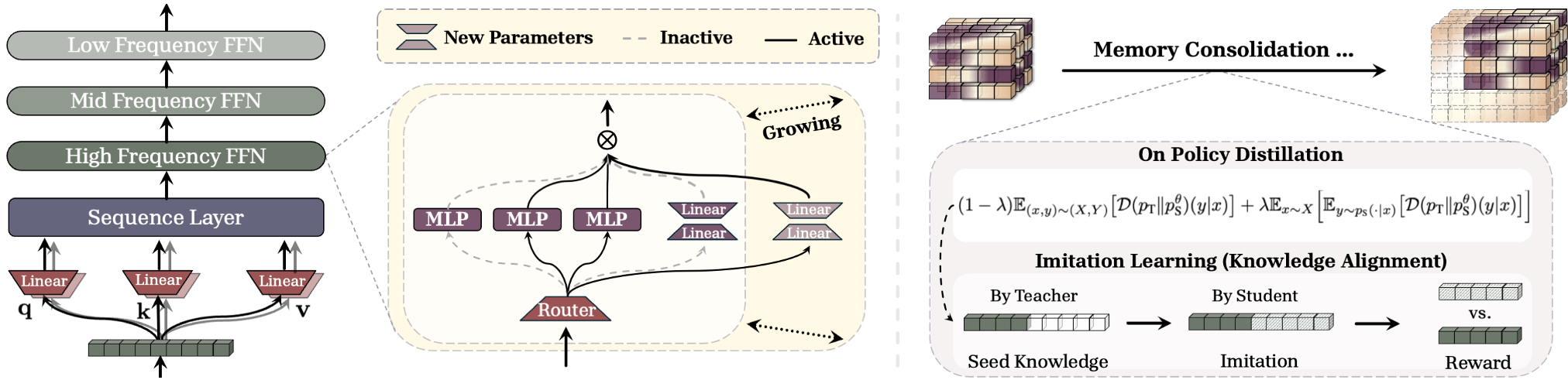
2. Dreaming (The REM Stage)
In this phase, the model generates synthetic data ("dreams") to refine its new knowledge.
- Random Expert Selection: To simulate the creative/associative nature of dreams, the model's MoE router randomly picks irrelevant experts, forcing the model to find novel connections between disparate pieces of knowledge.
- Reinforcement Learning (RL): The model uses a self-rewarding mechanism to keep only the "dreams" that actually improve its performance.
Experimental Breakthroughs
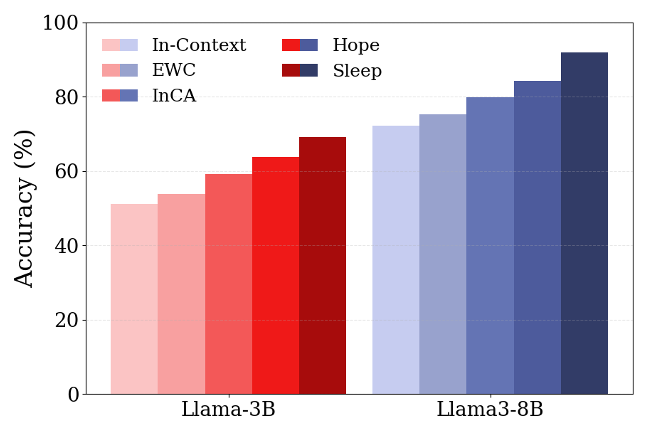
The researchers tested "Sleep" across diverse benchmarks including BABILong, SQuAD, and mathematical reasoning.
- Scaling to Sublimity: While GPT-4 and Llama-3 variants began to fail as contexts reached 128K–256K tokens, the Sleep-enabled model remained stable up to 10 million tokens in the BABILong benchmark.
- Continual Learning Success: On translation tasks for unseen languages (Manchu and Kalamang), traditional ICL models saw sharp performance drops when exposed to languages sequentially. The Sleep model (Hope-3) retained nearly 100% of its single-language proficiency.
Critical Insight: Why This Matters
The most profound takeaway is the efficiency of the Self-Knowledge Seeding (SKS). By combining Imitation Learning with On-Policy Distillation, the model doesn't just copy the teacher's output—it learns to mimic the reasoning process. This explains why reached the same performance as standard Supervised Fine-Tuning (SFT) in roughly 4.8x less wall-clock time.
Conclusion and Future Outlook
The Sleep paradigm proves that the "Knowledge Cutoff" doesn't have to be a permanent limitation. By mimicking the rhythmic consolidation cycles of the human brain, LLMs can move from being static encyclopedias to becoming evolving learners. Future work may explore how "dreaming" could be used to align models with human values without requiring massive human-labeled datasets.
Limitations: Implementing growing sparse modules requires careful engineering of tensor dimensions, and the "Dreaming" phase relies heavily on the quality of the base model's self-evaluation.