
BCCWords: Bridging Human Intelligence and Machine Learning for "In the Wild" NLP
Language Understanding in the Wild: Combining Crowdsourcing and Machine Learning
The paper introduces BCCWords (Bayesian Classifier Combination with Words), a hybrid Bayesian framework that integrates crowdsourced human judgments with automated text feature analysis for large-scale language understanding. By employing a scalable Variational Bayes inference mechanism, it successfully learns both worker reliability and a context-specific language model simultaneously.
TL;DR
Data labeling is a massive bottleneck in NLP. BCCWords is a Bayesian framework that doesn't just aggregate crowd votes; it learns a custom language model from them. By combining the "why" (text features) with the "who" (worker reliability), it achieves SOTA accuracy with 67% fewer human labels and slashes memory usage by 80%.
The Problem: The High Cost of "Human-in-the-Loop"
Crowdsourcing is the gold standard for subjective tasks like sentiment analysis, but it has two major flaws:
- The Sparsity Trap: To get a confident label, you usually need multiple humans to look at the same document. For a million tweets, this is financially ruinous.
- Context Blindness: Standard aggregation methods like Majority Voting ignore the text itself. If a worker is consistently wrong about "sarcastic" tweets, a model that doesn't "read" the tweet can't adjust for that specific bias.
Methodology: Why BCCWords is Smarter
The core insight of BCCWords is to treat human workers and text features as coupled information sources.
1. The Graphical Model
The model (as seen in Figure 1) uses a Confusion Matrix for every worker (). This doesn't just track "is this worker good?"; it tracks "how likely is worker to mistake class A for class B?". Simultaneously, it maintains a Bag-of-Words distribution () for each sentiment class.
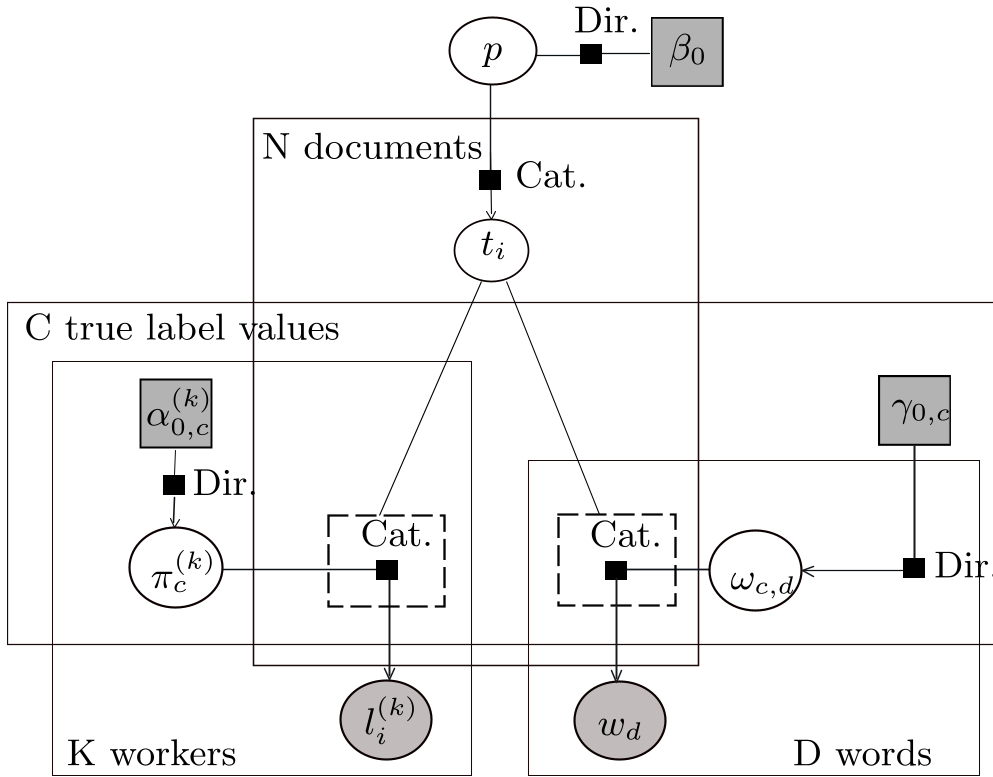 Figure 1: The factor graph showing the interplay between worker confusion matrices (left) and the bag-of-words language model (right).
2. Scalable Variational Bayes
Instead of expensive MCMC sampling, the authors use Variational Bayes (VB). To handle "Big Data," they introduced Inference Decomposition. By partitioning workers into batches, they summarize data into local messages, allowing the model to process 100,000+ documents on a standard laptop without crashing the memory.
Experimental Results: Doing More with Less
The authors tested BCCWords against heavyweights like Dawid-Skene and CBCC on two datasets: CrowdFlower (Weather tweets) and Sentiment Polarity (Movie reviews).
- Accuracy Explosion: With only 4% of the data labeled, BCCWords outperformed the nearest rival by 25%.
- Efficiency: It reached "full-data accuracy" using only 33% of the total labels required by other methods.
- Memory Efficiency: The scalable implementation (blue line in Fig 7) maintains a flat memory profile compared to the exploding demand of standard Bayesian methods.
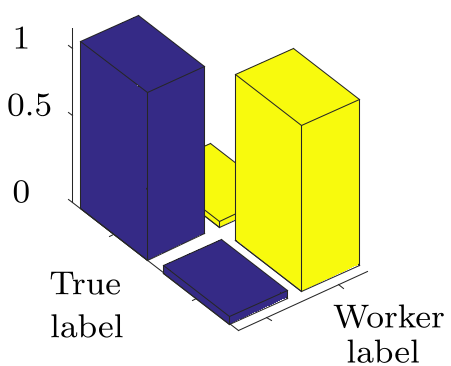 Figure 7: Scalable BCCWords (blue) stays efficient even as the number of labels grows.
Critical Insight: The "Cold Start" Advantage
The most impressive part of this work is how it handles the "Cold Start." When a worker first joins the platform, most models guess their reliability. BCCWords uses the text features to "vet" the worker. If a worker labels a tweet containing "delighted" and "perfect" as "Negative," the model immediately realizes this worker might be biased or unreliable, even without a second human opinion.
Conclusion & Ethical Takeaways
BCCWords proves that we don't need more crowdsourcing; we need smarter aggregation. By treating the language model as a latent variable that learns from humans (and vice-versa), we can deploy NLP systems in specialized domains (disaster response, medical sentiment) much faster and cheaper.
The Future: The authors suggest extending this to ordinal classes (e.g., Star ratings from 1-5 where a mistake between 4 and 5 is less severe than 1 and 5). This opens the door for even more nuanced "Human-Agent Collectives."