
BCCWords: Boosting Language Understanding "In the Wild" by Fusing Crowdsourcing with Machine Learning
Language Understanding in the Wild: Combining Crowdsourcing and Machine Learning
The paper introduces BCCWords (Bayesian Classifier Combination with Words), a hybrid Bayesian framework for sentiment analysis that integrates crowdsourced human judgments with automated text feature analysis. By leveraging a scalable Variational Bayes (VB) inference mechanism, it successfully achieves SOTA performance on social media and movie review datasets.
TL;DR
BCCWords is a novel Bayesian framework that combines the subjective intuition of human crowd workers with the objective statistical patterns of text features. By treating both as parts of a unified probabilistic model, the authors achieved SOTA sentiment analysis accuracy while reducing crowd-labeling costs by 67% and memory overhead by 80%.
Background: The Chaos of "Wild" Language
Social media text—tweets about the weather or H1N1 outbreaks—is messy. It is context-dependent, filled with slang, and highly subjective. Traditional machine learning models struggle with this "wild" diversity because they lack common-sense context. Conversely, human workers are good at context but are expensive, biased, and inconsistent.
The core insight of this paper is that we shouldn't choose between humans and machines. Instead, we should use the crowd's initial labels to "seed" a language model that can then take over for the millions of documents no human has time to read.
Methodology: The BCCWords Architecture
The model extends the Independent Bayesian Classifier Combination (IBCC). It assumes every document has a latent "true class" (). This true class generates two types of observable evidence:
- Human Labels: Modeled via worker-specific confusion matrices () that capture bias and reliability.
- Text Features: Modeled as a mixture of Bag-of-Words (), where each class has its own distribution of terms.
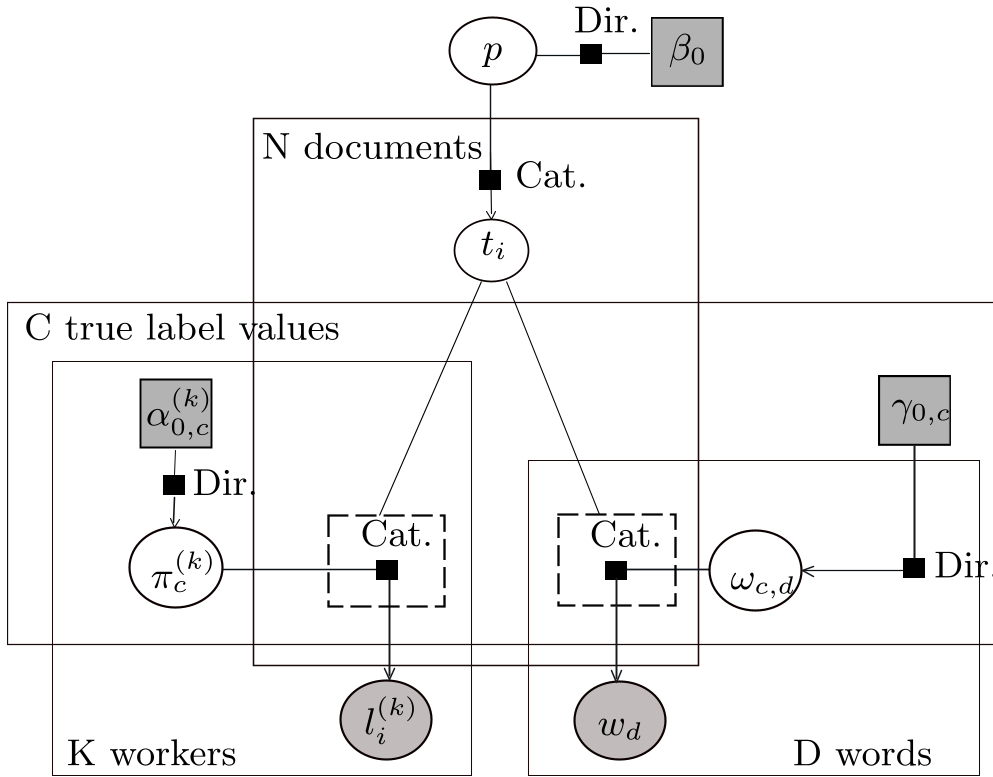
The beauty of this architecture lies in its semi-supervised nature. Even if a document has zero human labels, the model can still classify it by looking at the words and applying the language model it learned from other, human-labeled documents.
Scalability via Inference Decomposition
To handle hundreds of thousands of documents on a standard laptop, the authors introduced ScalBCCWords. By partitioning annotators into batches, the system only loads a subset of confusion matrices into memory at a time, performing "Variational Message Passing" across batches to reach the same mathematical conclusion as the full model.
Experiments & Results: More for Less
The authors tested the model on the CrowdFlower (Weather tweets) and Sentiment Polarity (Movie reviews) datasets.
1. Accuracy with Scarce Data
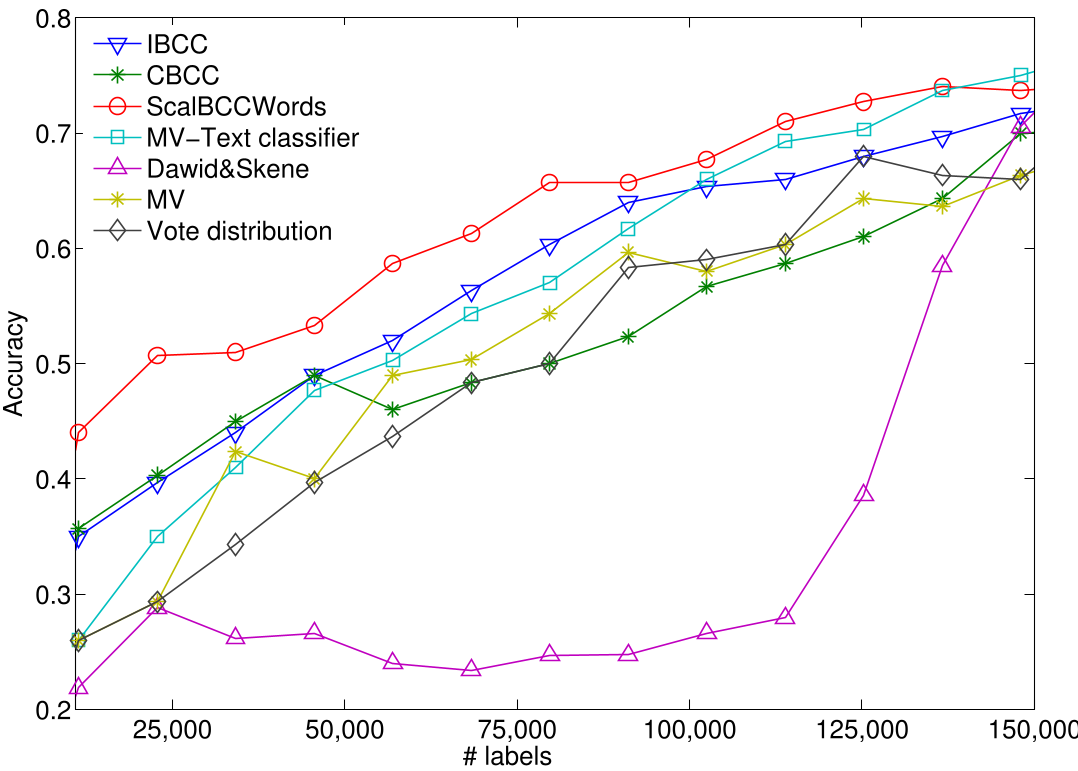
When only 4% of the data was labeled, BCCWords outperformed other methods (like Majority Voting or Dawid & Skene) by up to 25%. This is the "Language Model" effect—the machine learns to generalize from the few labels it has.
2. High-Quality Language Models
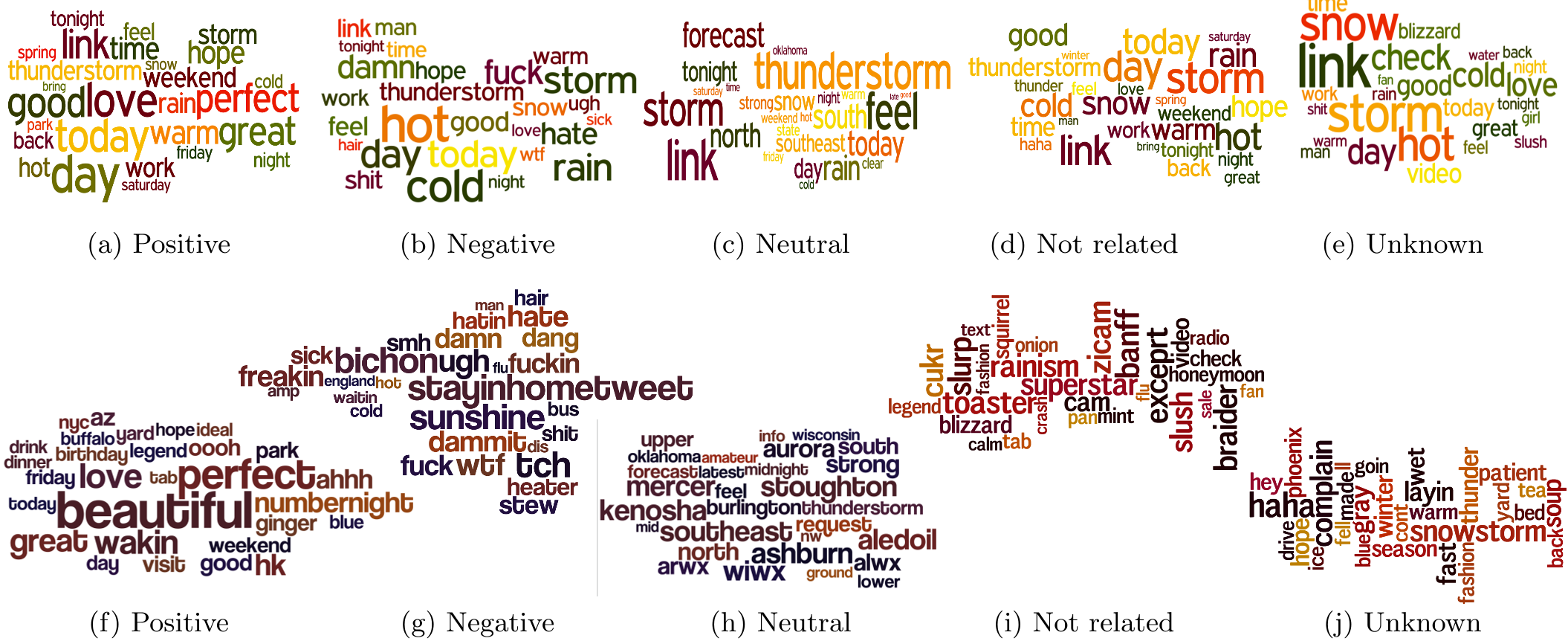
The model correctly identified discriminative terms. For weather sentiment, it associated "perfect" and "love" with positive sentiment, while "cold" and "hate" were strongly negative. Interestingly, common words like "day" were correctly identified as non-discriminative (high likelihood in all classes).
3. Efficiency
The scalable implementation reduced memory consumption from 1GB to a mere 200MB for a 50,000-label dataset, proving that sophisticated Bayesian inference can be run on consumer-grade hardware.
Critical Analysis & Conclusion
Takeaway
The primary value of BCCWords is its data efficiency. In disaster response scenarios (like the Haiti earthquake mentioned in the paper), where time is critical and human resources are finite, being able to achieve high accuracy with 67% fewer labels is potentially life-saving.
Limitations
The current model relies on the Bag-of-Words assumption, which ignores word order and complex semantics (like sarcasm). Modern LLM embeddings (e.g., BERT or GPT) could significantly improve the "machine" side of this hybrid model. Additionally, the model assumes worker errors are independent of the document's difficulty, which may not hold true for very ambiguous text.
Future Outlook
The authors suggest extending this to ordinal classes (e.g., 5-star ratings) and multi-modal features (images and metadata). As we move toward more "Human-Agent Collectives," models like BCCWords provide the mathematical foundation for a future where AI and humans collaborate seamlessly to understand the world's most chaotic data.