
LLMs in Telecommunications: The Architectural Blueprint for AGI-Enabled 6G
Large Language Model (LLM) for Telecommunications: A Comprehensive Survey on Principles, Key Techniques, and Opportunities
This survey presents a comprehensive framework for LLM-enabled telecommunications, covering model architectures, deployment strategies, and specialized use cases. It categorizes LLM applications into generation, classification, optimization, and prediction, establishing a roadmap for AGI-enabled 6G networks.
TL;DR
As we stand on the brink of the 6G era, the complexity of managing heterogeneous, high-density networks is outstripping traditional human-led and task-specific AI methods. This survey explores how Large Language Models (LLMs) are being repurposed as the "brain" of future networks, transforming everything from Verilog code generation for FPGAs to zero-shot time-series traffic prediction.
Problem & Motivation: Beyond the Task-Specific AI Silos
In the 5G era, AI was a "plug-in" used for specific tasks like CSI (Channel State Information) prediction or power control. However, these models are silos—they require massive labeled datasets and lack the reasoning transparency needed for complex network troubleshooting. 6G requires a paradigm shift toward Artificial General Intelligence (AGI) that can understand standard specifications, write control code, and optimize rewards in real-time without starting from scratch for every new scenario.
Methodology: The Core Framework
The researchers propose a multi-layered approach to integrating LLMs into the telecom stack, moving beyond simple chatbots to Agential Systems.
1. Model Adaptation
Instead of training trillion-parameter models from scratch, the industry is moving toward:
- Instruction Tuning: Aligning pre-trained models with telecom-specific grammars and 3GPP standards.
- PEFT (LoRA/LNT): Updating only a fraction of parameters to maintain low-latency inference at the edge.
2. Multi-Step Reasoning (CoT)
Telecom tasks are rarely one-shot. Whether it's designing a 64-point FFT module or configuring a core network, the authors emphasize Chain-of-Thought (CoT) prompting. By breaking tasks into sequential sub-tasks, LLMs overcome the logic gaps that plague monolithic prompts.
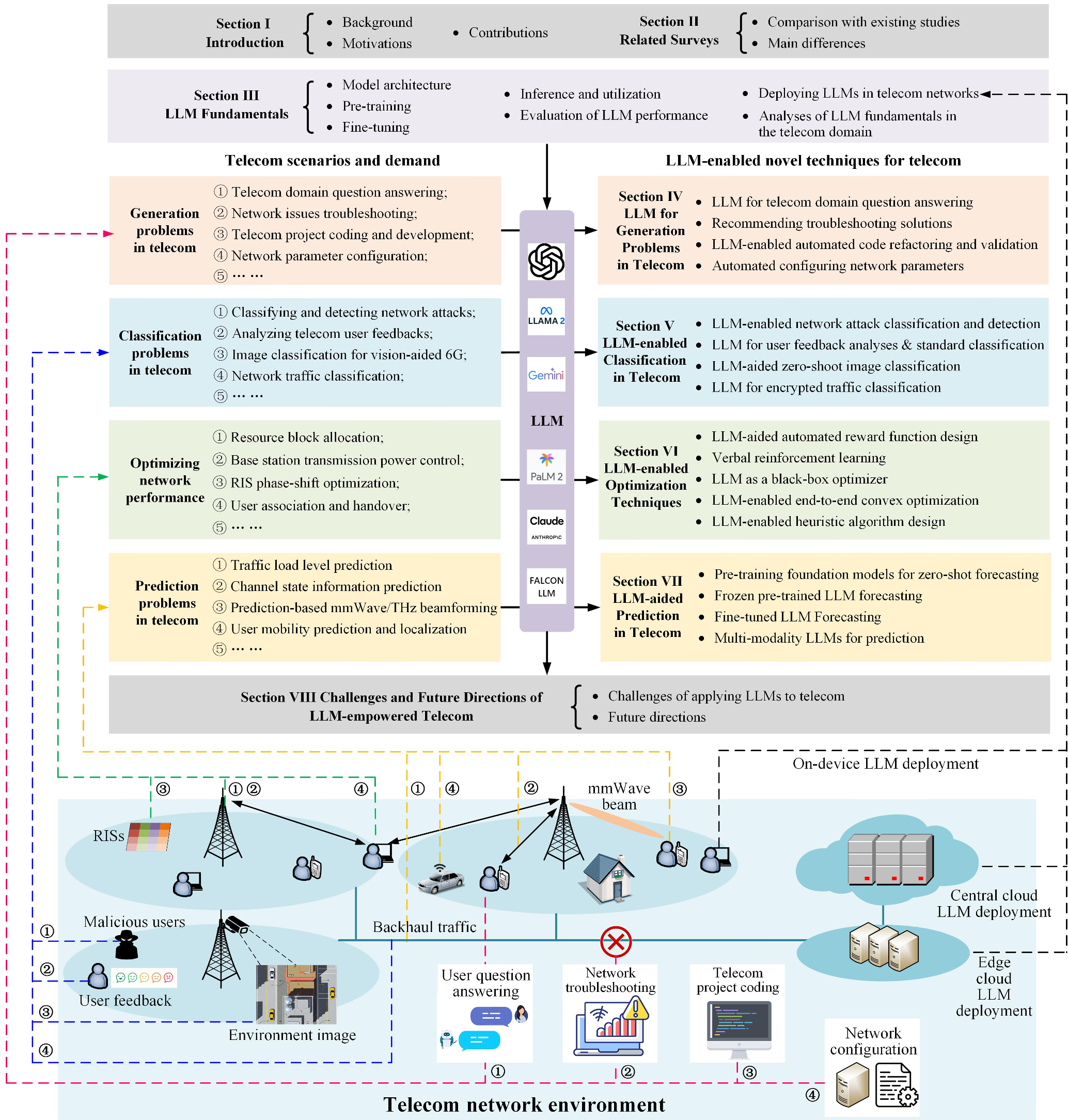 Fig 1. The comprehensive organization of LLM-enabled telecom, spanning from fundamentals to key applications.
Key Technical Applications
Generation: Automated Network Orchestration
The paper highlights a paradigm shift in Network Configuration Generation. By using frameworks like NETBUDDY, high-level natural language intents (e.g., "prioritize URLLC users in Sector A") are automatically translated into vendor-agnostic router configurations and Verilog code.
- Result: Coding efficiency for wireless systems improved by ~65-68% for both junior and senior engineers.
Optimization: LLM as the "Reward Engineer"
One of the most profound insights is the use of LLMs for Automated Reward Function Design. Reinforcement Learning (RL) is powerful but sensitive to reward shaping. LLMs can act as a proxy between human objectives and RL agents, iteratively refining mathematical reward formulas based on environment feedback.
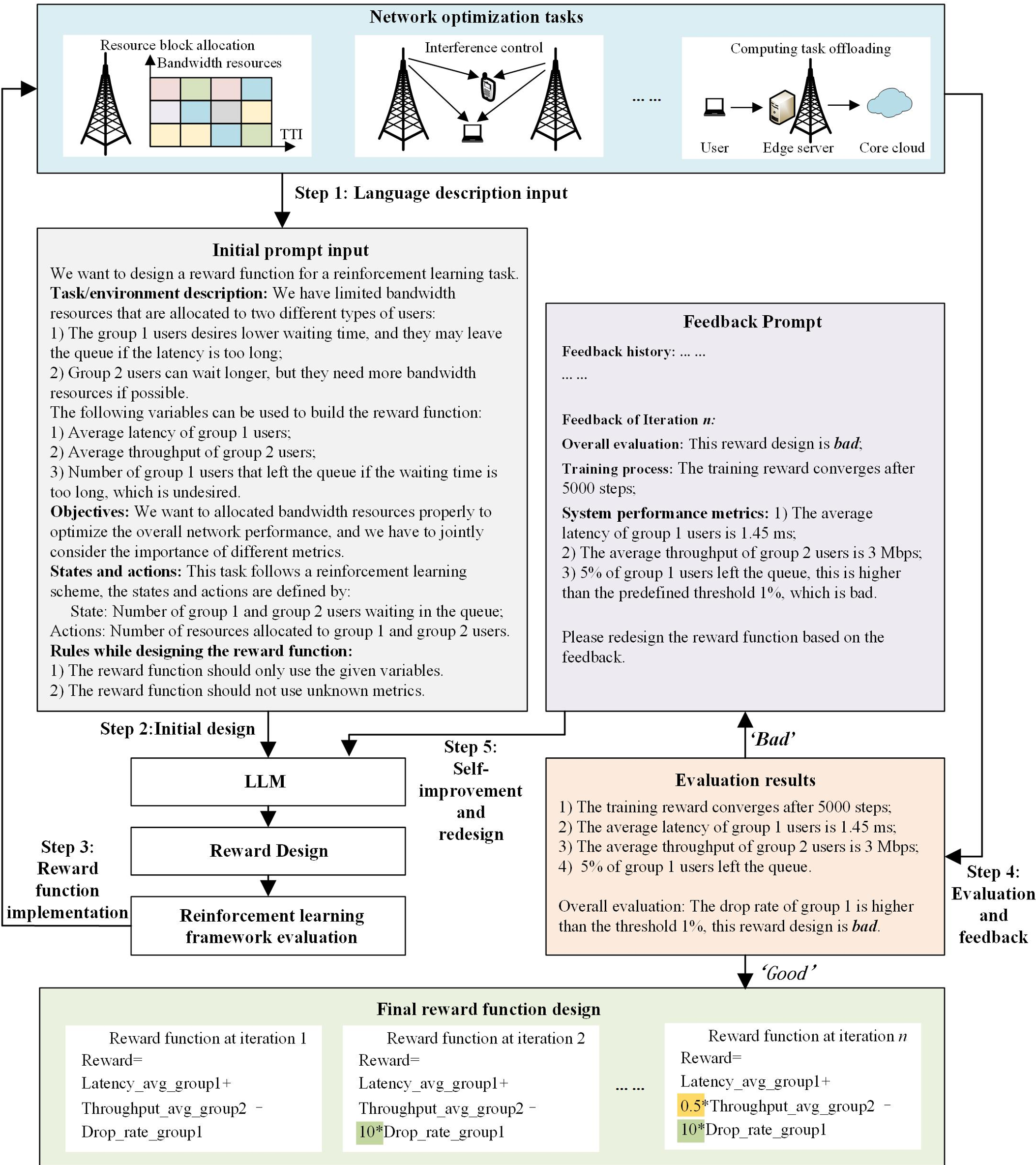 Fig 2. The iterative loop: LLM generates reward code, an RL agent evaluates it, and the LLM self-refines based on performance metrics.
Prediction: One Model for All Time-Series
By treating time-series data as segments (patches) and converting them into tokens, models like TimeGPT and TIME-LLM enable zero-shot forecasting of network traffic load. This removes the need for retraining models every time a new base station is deployed.
Critical Analysis & Future Outlook
While the potential is vast, the "Hallucination Problem" remains a critical barrier. A hallucinated configuration script in a core network could cause millions in losses. The survey suggests Retrieval-Augmented Generation (RAG) as the cure—grounding LLMs in the latest 3GPP technical specifications to ensure factual bedrock.
The Edge Constraint: The future isn't in the cloud; it's at the edge. Techniques like Quantized Training and Mobile LLM (e.g., Gemini Nano or Llama-3-8B on Snapdragon platforms) will be essential for the sub-0.1ms latency requirements of 6G.
Summary Takeaway
The path to 6G intelligence lies in Cooperative Deployment. Large models in the cloud will handle long-term planning and policy optimization, while "Small-Large" models at the edge handle real-time traffic classification and beamforming, creating a hierarchical, self-healing network.