
When LLM Adoption Tips: A Cognitive Virus Model of Autonomous and Dependent Coupling
Large-Language Models as a Cognitive Virus
This paper proposes a dynamical model in which large-language models spread through a population as a cognitive virus by moving people among uncoupled, autonomous coupled, and dependent states. The model central insight is that frequency-dependent reinforcement of autonomous cognition can produce bistability, hysteresis, and technological lock-in. With the reported illustrative parameters, the autonomous stable state persists only while the transmission parameter stays below the transcritical threshold 0.50, and recovery requires reducing it below 0.40.
TL;DR
Solé and colleagues treat large-language model use as a culturally transmitted practice that can push human populations through cognitive-coupling states, much as epidemic models track host states. Their central object is a three-compartment model of uncoupled users, autonomous regular users, and persistently dependent users, with a nonlinear term encoding the idea that independent cognitive practice is easier to maintain when it remains common. The key analytic result is that, under the reported illustrative parameters, a stable autonomous state can coexist with a stable offloading state between transmission values 0.40 and 0.50, and crossing the upper threshold abruptly lowers average cognitive competence from 1 to about 0.425 while reversal requires going down to 0.40, where competence is still around 0.617.
This work is best positioned as a theoretical systems model rather than as an empirical benchmark or a performance-improvement method. It imports tools from epidemiology, cultural transmission, Allee effects, and bifurcation theory, and it uses those tools to make a precise conceptual claim: the danger is not simply that people use LLMs, but that the population-level ecology supporting unaided cognition can itself be destabilized.
Problem and Motivation
The paper addresses a gap that is easy to miss because everyday LLM discourse is dominated by two weaker framings. One treats adoption as a private productivity choice: an individual either uses a model, avoids it, or uses it more skillfully. The other treats diffusion as a smooth curve, similar to classic Bass-type adoption models, where exposure accumulates until a majority is using the new technology. Both framings are incomplete when the object of study is not merely market share, but the persistence of human cognitive capacities that depend on social practice.
The specific failure mode the authors want to capture is this. LLMs can act as scaffolding, reducing immediate effort while preserving or even increasing future competence, or they can act as substitution, taking over synthesis, evaluation, and composition in ways that erode the very operations that maintain skill. If substitution becomes widespread, the social environment can change: institutions, classrooms, workplaces, and peer norms may reorganize around delegated cognition. That change is not just an aggregation of individual preferences. It can alter the conditions under which autonomous reasoning is practiced, supported, rewarded, and recovered. Existing epidemiological or diffusion models can describe contagion, but the authors argue that they need an extra mechanism to describe a population that can become locked into a lower-autonomy attractor.
Their motivation is therefore both conceptual and mechanistic. Conceptually, the LLM case belongs to a longer history of language as a self-propagating cultural system, where forms, conventions, and practices replicate through imitation and are adapted to the cognitive demands of their users. Mechanistically, the authors need a model in which regular use and dependency are different states, recovery is asymmetric, and the strength of autonomous norms depends on the number of people still exercising them. That is where the nonlinear term enters, and it is what generates the paper's central phenomena: tipping points, hysteresis, and a prevention-reversal gap.
Core Chapter: The Three-State Cognitive Virus Model
From Individuals to Host-Coupling States
The model begins by coarse-graining the ecology of LLM use into three population fractions: uncoupled or weakly coupled individuals U, autonomous regular users C, and persistently dependent users D. These categories are not meant to describe fixed personality types or moral statuses; they are operational host states in an epidemiological-style layer of a larger cultural-technological system. An uncoupled individual remains mostly embedded in a heterogeneous cognitive ecology of books, search engines, writing tools, peers, and unaided reasoning. An autonomous regular user uses LLMs but retains reading, writing, verification, and alternative information channels. A dependent user is in the regime where LLM-mediated operations have become strongly substitutive.
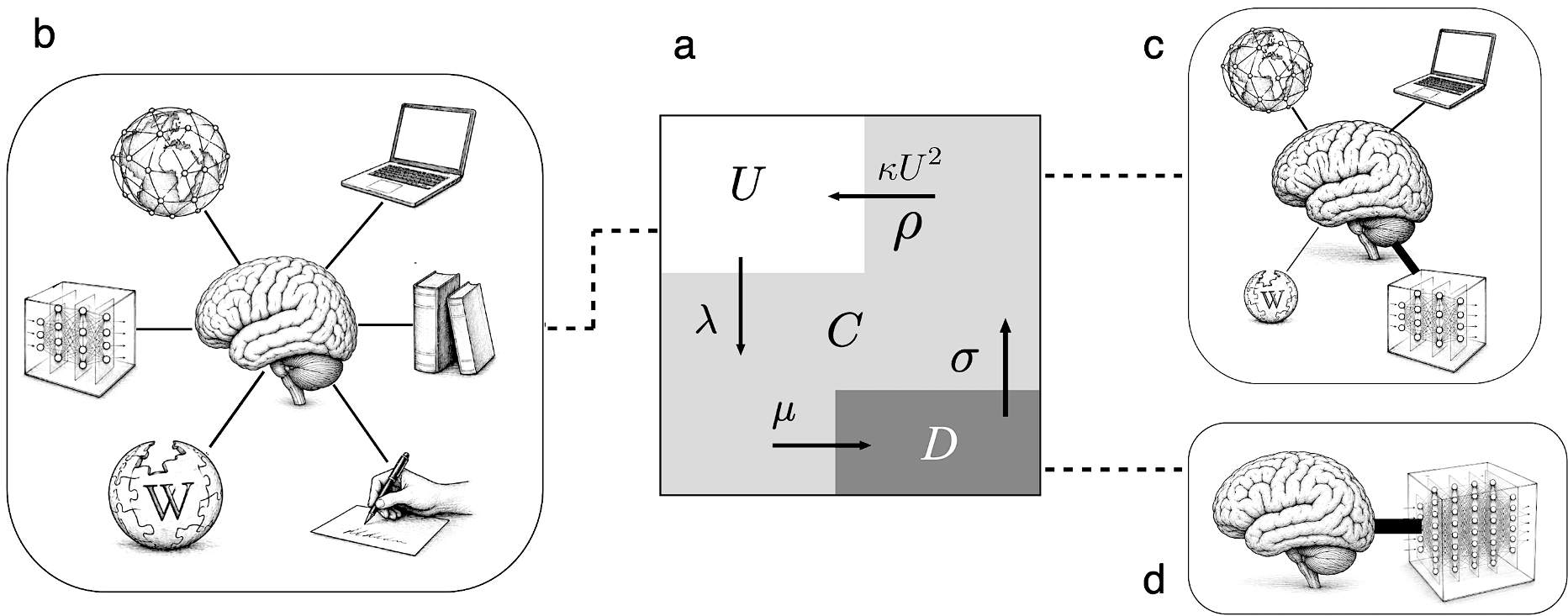
The dynamics are written as a nonlinear compartment system with U+C+D=1:
Here U, C, and D are dimensionless fractions of the population, all between 0 and 1. The parameter λ represents the effective social and institutional transmission pressure that converts exposure to regular use; ρ is the rate at which regular users return to the uncoupled or weakly coupled state; μ is the rate at which regular users become dependent; and σ is the rate at which dependent users recover to regular autonomous use. The crucial extra term is κU²C. Its role is not just to make the equations nonlinear, but to model a positive-frequency effect: autonomous cognitive practice is socially reinforced when there are many independent users, but that reinforcement can only restore those who are already coupled to LLM practices, hence the factor C. If κ=0, the system loses the cooperative restoration mechanism that makes abrupt collective lock-in possible. If λ=0, the adoption channel is closed and the model mainly describes recovery or abandonment. The authors are explicit that this is a host-state model, not a direct model of model-lineage reproduction; the analogy concerns the feedback loop in which persistent technological practices alter their human hosts and thereby influence their own propagation.
Equilibria, Thresholds, and the Emergence of Bistability
Using D=1-U-C, the three-dimensional system reduces to a two-dimensional one in U and C. The key object becomes the polynomial f(U), which determines the direction of change in the autonomous fraction whenever there are regular users present.
The variable f(U) is not a measured quantity; it is an effective drift coefficient. Where it is positive, autonomous individuals tend to increase; where it is negative, autonomy tends to decline. This reduction is powerful because it isolates the fixed points of the coupled population from the faster relaxation of the D fraction. The fully uncoupled equilibrium (U,C,D)=(1,0,0) always exists, but it is stable only while the transmission pressure λ remains below a threshold. The other equilibria correspond to coupled states with some combination of regular and dependent users.
Those coupled equilibria are determined by the roots of f(U)=0, and they inherit a fixed split between regular and dependent users from the linear recovery and dependency rates.
The notation means that, at equilibrium, the fraction of the non-autonomous population that is dependent rather than merely regular is governed only by μ and σ. If μ=0, dependency cannot accumulate and D^{*}=0; all coupled users remain in the autonomous regular state. If σ=0, recovery from dependency vanishes and the coupled population collapses entirely into dependence. This is one reason the paper separates interventions that change the bifurcation landscape, such as λ, ρ, and κ, from interventions that change the composition of the coupled state, such as μ and σ. The latter can reduce harm without preventing adoption, but they do not by themselves move the tipping points in this minimal model.
The autonomous fraction at the coupled equilibria is then given by the quadratic roots:
This expression carries the entire bifurcation logic. The square root is real when λ^{2} is at least 4κρ, so the coupled branch is born at the saddle-node threshold. The plus and minus signs denote two coupled branches, one stable and one unstable in the relevant regime. If κ is set to zero, the quadratic roots are not the right description because the restoring cooperative term has been removed; the transition becomes simpler and continuous in the paper's minimal construction. Thus the nonlinear term is not a cosmetic addition: it is the mechanism that generates a second equilibrium and makes the system capable of bistability.
The two critical transmission values are:
The saddle-node threshold λSN is where the coupled equilibrium branch appears; the transcritical threshold λTC is where the fully autonomous equilibrium loses stability. Genuine bistability requires κ greater than ρ, and in that case the system has a window 2\sqrt{\kappa\rho} \lt \lambda \lt \rho+\kappa in which both an autonomous attractor and a coupled attractor are locally stable. Increasing λ from a low value keeps the population near U=1 until λTC is crossed, then it jumps to a coupled state. Decreasing λ from the coupled state does not restore autonomy until the lower threshold λSN is reached. The difference between those thresholds is the hysteretic width, and it defines technological lock-in: the conditions that were sufficient to prevent the transition may no longer be sufficient to reverse it.
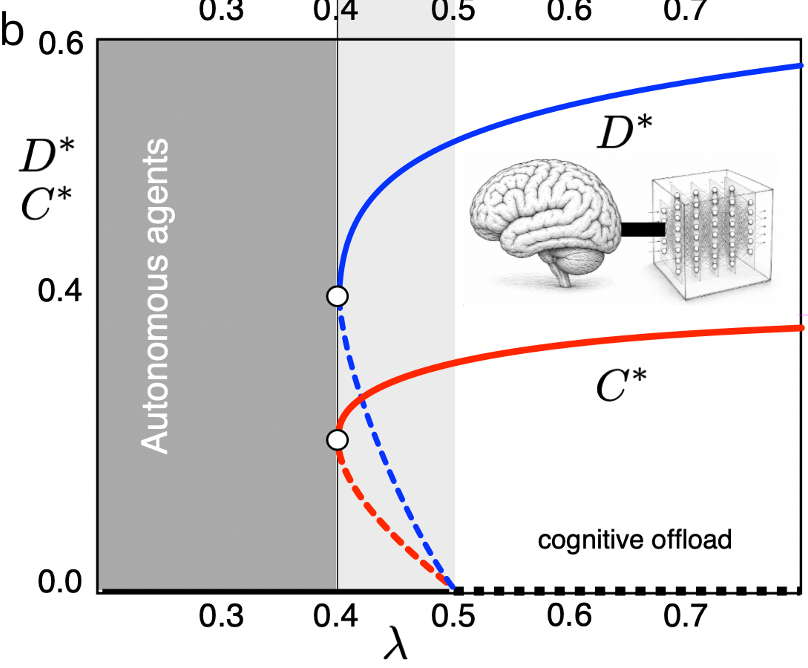
Figure 2 makes this structure visually concrete. With ρ=0.10, κ=0.40, μ=0.20, and σ=0.10, the bistable region lies between λSN=0.40 and λTC=0.50. At λTC, the stable autonomous state disappears, and the equilibrium moves sharply to the coupled branch, where both C^{*} and D^{*} rise. The important point is not that the model predicts a universal threshold at 0.50; those values are illustrative. The important point is that the parameterization produces a smooth change in transmission pressure but a discontinuous change in the population state.
Cognitive Competence as an Order Parameter
The authors then add a second layer of interpretation: they assign each host state a relative cognitive competence, Γu, Γc, and Γd, and define the average competence as a population expectation. To keep the exposition compact, they study the equilibrium average, which depends only on the autonomous fraction and a composite coupled-population competence.
The quantity g is the effective competence of the coupled subpopulation at equilibrium, averaged over regular and dependent users. It depends on both the values assigned to the states and on the recovery and dependency rates. If μ is large or σ is small, g moves toward the dependent value Γd; if σ is large, g moves toward the autonomous regular value Γc. The formula also shows the role of U^{*}: once the autonomous fraction changes, the average competence changes linearly with it. Thus any discontinuity in U^{*} is inherited by ⟨Γ⟩*. This is what allows a purely adoption-like bifurcation to become a statement about cognitive competence, even though the underlying equations first track population states rather than mental capacities.
The illustrative substitutive regime in the paper uses Γu=1, Γc=0.5, and Γd=0.1, giving g=7/30\approx0.233. The authors emphasize that this ordering is a modelling assumption for a substitutive-use scenario, not a general claim that coupling must reduce competence. In scaffolded or augmentative regimes, Γc could exceed Γu, or the coupling could leave later autonomous competence unchanged. The competence values are therefore a sensitivity layer: the bifurcation structure is independent of those values, but the cognitive cost depends on them.
At the tipping points, the jump magnitudes can be written as:
These expressions make the asymmetry explicit. The autonomous state is lost at λTC, where the coupled branch has U^{*}=\rho/\kappa. Recovery occurs at λSN, where U^{*}=\sqrt{\rho/\kappa}. Because the square root is larger than the linear ratio when ρ is less than κ, the recovery jump is smaller in magnitude than the loss jump in the forward direction. This is not just a numerical accident; it is the dynamical form of path dependence. In the reported parameterization, the paper states that the forward drop takes competence from 1 to approximately 0.425, while the reverse return remains at about 0.617 before jumping back to 1. The model therefore converts gradual changes in transmission pressure into abrupt, history-dependent changes in average cognitive competence.
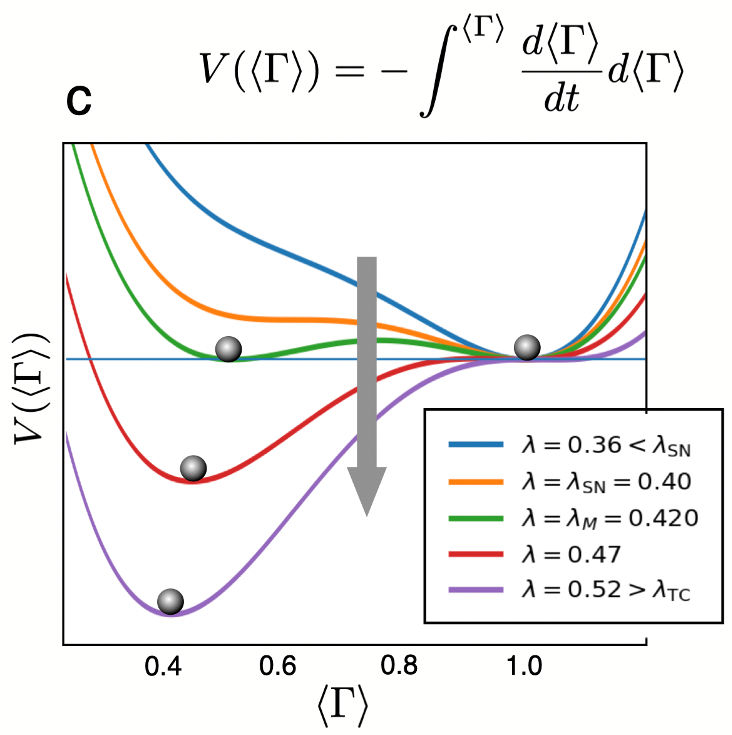
Figure 3 adds the phase diagram and an effective-potential interpretation. The paper derives, under a fast-relaxation reduction, a one-dimensional gradient-like representation for the equilibrium competence variable:
In this representation, stable population states are minima of a quartic potential V, and the unstable branch between them is the barrier. At low λ, there is a single valley at high competence. At the saddle-node threshold, a second valley appears at lower competence. In the bistable interval, the system can remain in either valley depending on its history. At the Maxwell point, which the paper reports as approximately λM\approx0.420 for the same parameters, the two valleys have equal depth. Above λTC, the high-autonomy valley disappears, so the population rolls toward the offloading minimum. This landscape picture clarifies the intuition behind runaway dynamics: once the autonomous basin is gone, no small correction can return the system by staying at the old equilibrium; recovery requires either a barrier-crossing perturbation or a reduction in transmission large enough to make the offloading basin disappear.
Evidence, Interpretation, and Intervention Logic
Because this is a theoretical and computational paper, the evidence is analytic and illustrative rather than empirical. The main claims come from three sources: algebraic fixed-point analysis, bifurcation theory in the (κ,λ) plane, and numerical phase diagrams using one parameter set. Table I in the original paper is the most complete summary of the intervention logic, and it is reproduced here as a Markdown table. It should be read not as a list of validated policies, but as a map from model parameters to qualitative dynamical effects.
| Intervention | Main mathematical effect | Effect on tipping and cognitive state |
|---|---|---|
| Reduce propagation of substitutive or dependency-producing coupling | Decreases λ by limiting automatic adoption and social or institutional amplification of LLM use. | Direct. Prevents invasion for $\lambda\lt\lambda_{\mathrm{TC}}$; after lock-in, recovery requires $\lambda\lt\lambda_{\mathrm{SN}}$. |
| Preserve autonomous alternatives and routes back to unaided cognition | Increases ρ, the rate at which regular users return to uncoupled or weakly coupled cognition. | Raises both thresholds and reduces hysteresis. Bistability disappears for $\rho\ge\kappa$. |
| Strengthen collective autonomy | Increases κ, the strength of nonlinear collective reinforcement of autonomous cognition. | Raises resistance to invasion, but for $\kappa\gt\rho$ also widens the hysteretic interval. |
| Favor recovery over collective lock-in | Increases the ratio ρ to κ, strengthening individual routes back to autonomous cognition relative to collective reinforcement. | Moves the system toward $\rho=\kappa$, where the saddle-node and transcritical thresholds merge and the transition becomes continuous. |
| Prevent progression to dependency | Decreases μ, reducing transitions from regular use C to persistent dependency D. | No direct effect on $\lambda_{\mathrm{SN}}$ or $\lambda_{\mathrm{TC}}$. Reduces $D^{*}/(C^{*}+D^{*})$ and increases $\langle\Gamma\rangle$. |
| Promote recovery from dependency | Increases σ, shifting users from persistent dependency D back to regular use C. | No direct effect on the bifurcation thresholds. Reduces dependency and raises $\langle\Gamma\rangle$ at fixed $U^{*}$. |
The most useful consequence of this table is that it distinguishes two different classes of interventions. The first class changes the landscape in which tipping happens. Reducing λ, increasing ρ, or tuning κ can prevent a runaway transition or remove bistability altogether. The second class changes what happens inside the coupled basin without necessarily preventing coupling. Reducing μ or increasing σ can keep ordinary use from collapsing into dependence, but in the minimal model they do not move the tipping thresholds. This maps neatly onto the paper's distinction between adoption and cognitive immunization. High adoption is not automatically harmful; high adoption can be benign if it remains compatible with verification, unaided practice, and recovery from substitutive use.
The reported numbers deserve a careful reading. The parameter values ρ=0.10, κ=0.40, μ=0.20, σ=0.10 are used to produce the bifurcation diagrams in Figures 2 and 3; the paper does not present them as estimates from real-world LLM usage data. The thresholds λSN=0.40 and λTC=0.50, the Maxwell point λM\approx0.420, the competence value g=7/30\approx0.233, and the competence drop to about 0.425 are therefore examples of the model's qualitative behavior, not calibrated forecasts. The evidence is strongest for the structural result that a positive-frequency autonomous-reinforcement term can generate bistability and hysteresis. It is weakest for claims about the numerical size of real-world thresholds, the real-world values of Γu, Γc, Γd, and the timescale over which such transitions occur in actual populations. The paper acknowledges this by stating that the minimal model does not determine how rapidly the transition unfolds in real time.
The model's assumptions also clarify what it can and cannot prove. It uses a mean-field population description and absorbs network heterogeneity into an effective λ. It assumes that dependency arises primarily through regular use, so transitions from U to D do not occur directly. It treats competence states as discrete and ordered, whereas real cognitive offloading is likely continuous and task-specific. It also does not model the reproduction, evolution, or market dynamics of LLM lineages themselves; the viral analogy refers to coupling states in human hosts, not to a pathogen with a single identifiable genetic material. These limitations do not make the framework empty, but they mean that the main value is mechanism identification: what kinds of social feedback can make dependence nonlinear and sticky.
Deep Insights and Summary
The real contribution of the paper is not the provocative phrase "cognitive virus," but the precise feedback structure behind it. The authors show that once you model LLM use as a transition among host-coupling states, the important variable is not simply how many people use LLMs. The important variable is whether the social and institutional ecology continues to support autonomous cognition. The nonlinear term κU²C encodes this as a positive-frequency protection mechanism, and its competition with the incidence term λUC produces a bistable regime. That single structural choice turns a gradual diffusion story into a tipping-point story. It also explains why prevention and reversal are not symmetric: before the transition, the autonomous state can be stable even at relatively high transmission; after the transition, the coupled state can persist even when transmission falls back below the original invasion threshold.
The paper's intervention logic follows directly from that geometry. Reducing transmission pressure is important, but in the hysteretic regime it may be insufficient. Increasing return rates ρ is especially powerful because it can both raise the invasion threshold and move the system toward the boundary where bistability disappears. Increasing collective autonomy κ is subtle: it helps resist invasion when autonomous individuals are common, but it can widen the hysteretic region once κ exceeds ρ. Reducing the dependency rate μ or increasing recovery σ changes the internal composition of the coupled state, lowering dependence and raising average competence, but it does not move the tipping points in this minimal model. Thus the authors are not arguing for avoidance of LLMs; they are arguing for designs that keep substitutive coupling reversible and that preserve unaided practice as an accessible attractor.
Several limitations are specific and important. The competence assumptions are illustrative rather than measured, and the paper does not provide a method for estimating Γu, Γc, Γd, λ, ρ, κ, μ, or σ from real data. The model also lacks explicit feedback from changing cognition to later adoption, even though the discussion identifies this as a natural extension. It does not include heterogeneous contact networks, spatial diffusion, institutional invasion thresholds, or the co-evolution of model capabilities and user behavior. For practical purposes, these omissions matter because real LLM ecosystems have platform effects, product updates, policy changes, education systems, and economic incentives that are not captured by a three-dimensional mean-field system.
Still, the framework gives a compact language for evaluating future empirical work. A strong follow-up would measure not only usage frequency but the persistence of autonomous competence after tools are withdrawn, and would test whether populations with different institutional supports show different hysteretic widths. It would also be valuable to compare scaffolded protocols, such as verification and deliberate disengagement, against substitutive protocols using longitudinal task performance. If such studies could estimate the relevant rates, the model could become more than a qualitative metaphor and turn into a predictive tool for cognitive infrastructure. In its present form, however, its power is diagnostic: it makes visible the mechanism by which widespread use can turn from a gradual cultural change into a collective loss of autonomy.