
Beyond Fact-Checking: How LLMs Detect "Synthetic Lies" in Science News
Can Large Language Models Detect Misinformation in Scientific News Reporting?
The paper introduces CoSMis (SciNews), a novel dataset of 2,400 scientific news stories (human-written and LLM-generated) paired with CORD-19 abstracts. It proposes three LLM-based pipelines—SERIf, SIf, and D2I—that detect misinformation by grounding news in scientific evidence using a new framework called Dimensions of Validity (DoV). The study achieves SOTA-like results using GPT-4 with DoV-guided Chain-of-Thought prompting, bypassing the need for manual claim generation.
Executive Summary
Scientific misinformation is a public health hazard, yet checking it is a bottlenecked process requiring experts to extract claims manually. In the landmark paper "Can Large Language Models Detect Misinformation in Scientific News Reporting?", researchers from the Stevens Institute of Technology tackle this by introducing CoSMis (SciNews), a balanced dataset of human and AI-generated news. They demonstrate that by using a Dimensions of Validity (DoV) framework, LLMs like GPT-4 can debunk scientific fakes "in the wild" without needing human-annotated claims or specialized training.
The "Vicious Cycle" of Scientific Misinformation
The path from a lab's research abstract to a populist news headline is fraught with "leakage." Prior work focused on Claim Verification, which requires a human to say, "The article claims X; does the paper support X?" This doesn't scale. Moreover, LLMs are now being used to generate "convincing fakes" that reverse scientific findings while maintaining a professional tone, creating a new category of LLM-generated misinformation that is harder for both humans and machines to catch.
Methodology: The DoV-Guided Architecture
The researchers proposed five Dimensions of Scientific Validity (DoV) to bridge the gap between technical abstracts and sensationalized reporting:
- Alignment: Do they mean the same thing?
- Causation Confusion: Did the news turn a correlation into a cause?
- Accuracy: Are the percentages and numbers correct?
- Generalization: Is a study on ten mice being reported as a cure for all humans?
- Contextual Fidelity: Is the broader scientific context preserved?
Pipeline Comparison
They tested three distinct pipelines (SERIf, SIf, and D2I) to see how much "pre-processing" a news article needs before an LLM can judge it.
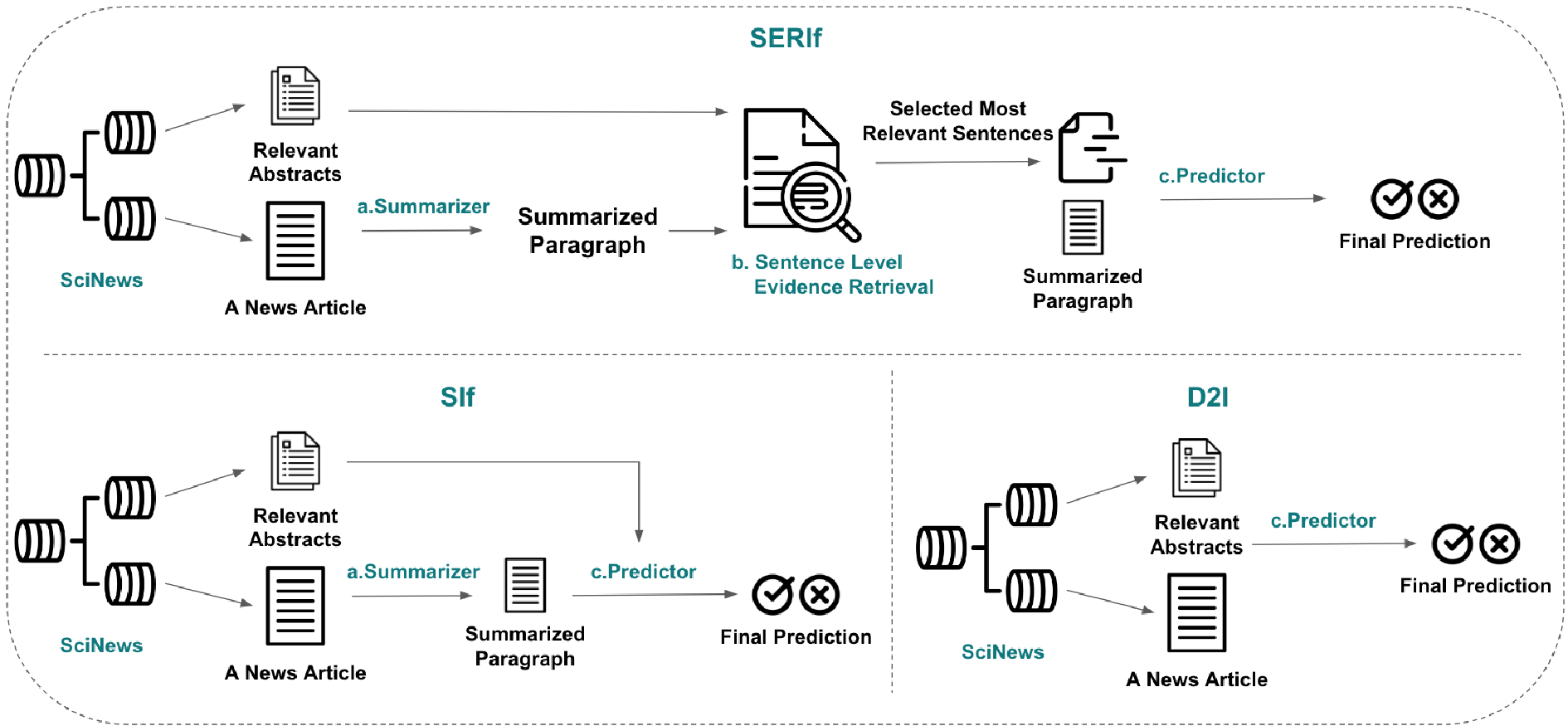 Figure 1: The SERIf, SIf, and D2I pipelines demonstrate varying levels of intermediate processing.
Experimental Insights: GPT-4 vs. The World
The results were telling. While the Llama series struggled (barely beating random chance), GPT-4 excelled.
- The SIf Winner: The SIf (Summarization + Inference) architecture performed best. Summarizing the news article first removes "noise" and helps the LLM focus on the core scientific claim.
- The AI Difficulty Gap: The models consistently had high recall but low precision on LLM-generated fakes. Translation: LLMs are very good at lying to other LLMs.
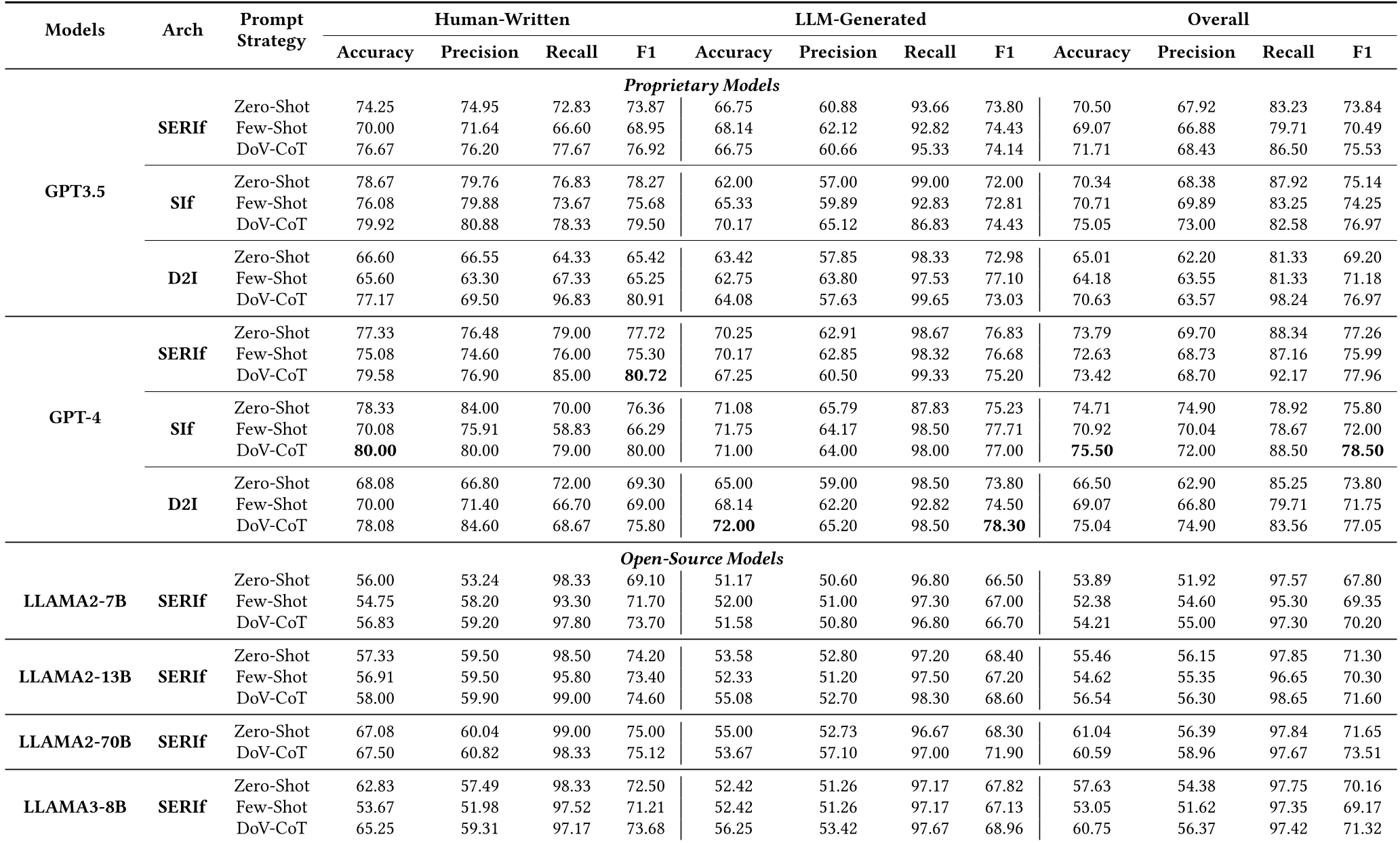 Table 1: Performance comparison across models and architectures. GPT-4 in the SIf + DoV-CoT setting provides the most robust detection.
Explainability: The Spider Plot
One of the most impressive contributions of this work is the move toward Explainable AI (XAI). By prompting the model to score the news along the five DoV axes, the system generates a "fingerprint" of the misinformation.
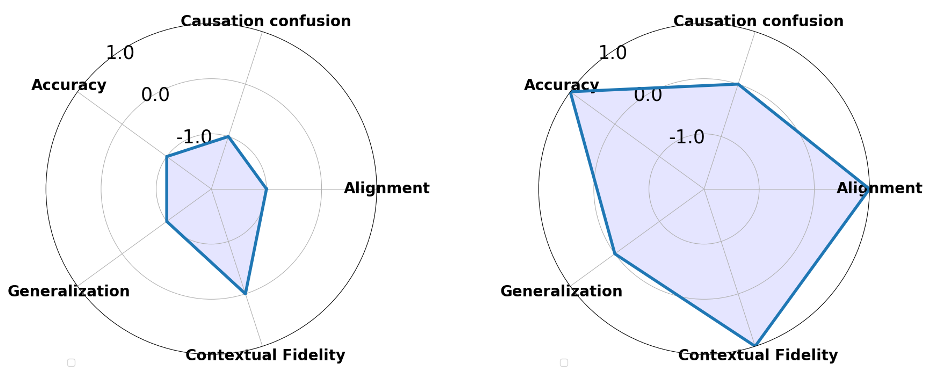 Figure 2: Visualizing misinformation. The Reliable case (right) shows high agreement across DoV axes, while the Unreliable case (left) collapses in Alignment and Accuracy.
Critical Analysis & Conclusion
This study proves that the bottleneck of manual claim extraction can be bypassed through grounded reasoning.
- Key Insight: Summarization is a superpower for fact-checkers; it acts as a filter that strips away rhetorical bias.
- Limitation: The current reliance on GPT-4's massive parameter count suggests that smaller, open-source models (like Llama 3) still lack the "nuanced reasoning" required for technical scientific verification.
- Future Work: The industry needs to move toward fine-tuning specific "Science-Checker" models that don't just rely on general knowledge but are specifically trained on the delta between formal academic prose and public journalism.
Final Takeaway: As AI generates more content, we must use AI to verify it. The DoV framework provides a vital roadmap for building the next generation of automated, explainable fact-checkers.