
UniReasoner: Leveraging LLMs as Universal Reasoners to Close the Understanding-Generation Gap
Large Language Models are Universal Reasoners for Visual Generation
UniReasoner is a novel framework that treats Large Language Models (LLMs) as universal reasoners to bridge the "understanding-generation gap" in text-to-image synthesis. It implements a "Draft-Evaluate-Diffuse" pipeline, using a frozen SANA diffusion backbone to achieve SOTA results on GenEval (0.88) and DPG-Bench (86.30).
TL;DR
Despite the rapid progress in photorealistic image generation, models often struggle with complex logical constraints—like "exactly four apples" or "a coin in the top-left corner." UniReasoner addresses this by transforming the Large Language Model (LLM) from a simple text encoder into a Universal Reasoner. By introducing a Draft-Evaluate-Diffuse pipeline, it achieves a 0.88 GenEval score, setting a new benchmark for compositional faithfulness using a frozen diffusion backbone.
The "Understanding-Generation Gap"
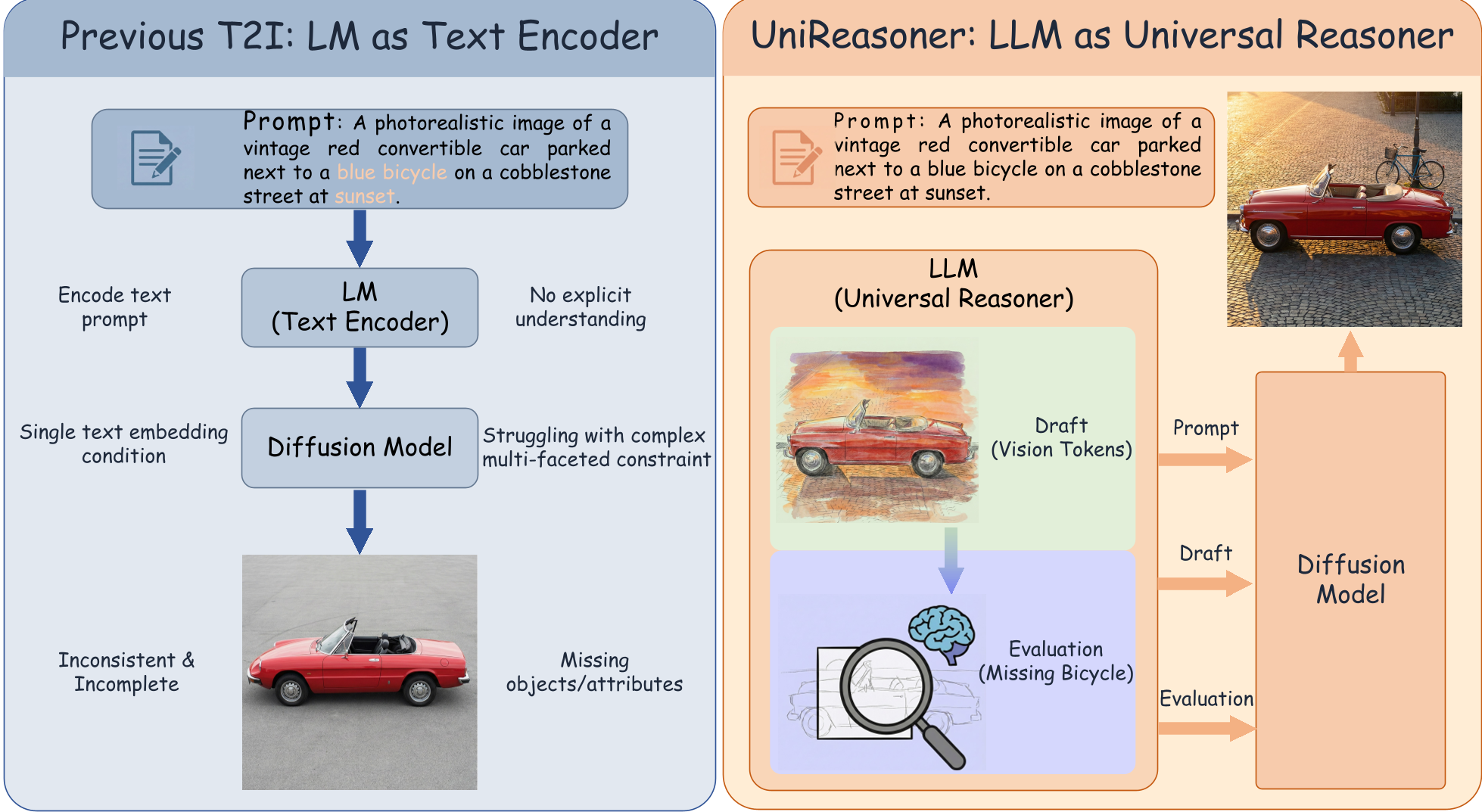
The core motivation behind this work is a fascinating paradox: Unified models like BAGEL or Qwen-Image can easily identify that an image has the wrong number of objects, but they struggle to generate the correct number in the first place.

As shown above, the same model that fails to put "four apples in a tree" can correctly count five apples in its own flawed output. The authors argue that we should treat this verification strength as a feature, not a bug, by feeding the model's own critiques back into the generation loop.
Methodology: The Draft-Evaluate-Diffuse Pipeline
Instead of the traditional "Prompt -> Image" approach, UniReasoner breaks the process into three distinct reasoning steps:
1. Visual Drafting (The "Spatial Plan")
The LLM generates a sequence of discrete vision tokens. Unlike standard VQGAN tokens focused on pixel reconstruction, these tokens are derived from SigLIP-2 features. These are semantically rich "primitives" that the LLM can "read" and reason about more effectively.
2. Grounded Evaluation (The "Self-Critique")
The LLM looks at its own draft and the original prompt. It generates a "grounded evaluation"—a text stream that specifically identifies what is missing or wrong (e.g., "The image shows only one glass... there is no second cup").
3. Joint Diffusion (The "Targeted Correction")
The final image is generated by a diffusion model (SANA) conditioned on the original prompt, the visual draft, and the corrective evaluation. The evaluation acts as a "what-to-fix" signal, allowing the diffusion model to focus its capacity on correcting specific semantic errors.
Experiments & Results: Precision over Bulk
The most impressive aspect of UniReasoner is that it achieves SOTA results without retraining the diffusion backbone. By simply improving the reasoning and conditioning signals, the authors saw significant jumps in GenEval scores:
| Metric | SANA (Baseline) | UniReasoner | Improvement | | :--- | :--- | :--- | :--- | | Overall | 0.79 | 0.88 | +0.09 | | Counting | 0.78 | 0.90 | +0.12 | | Position | 0.62 | 0.83 | +0.21 | | Attr. Binding | 0.57 | 0.72 | +0.15 |
The 21% jump in Position accuracy is particularly noteworthy, proving that the visual draft provides a spatial grounding that text alone cannot convey.
 Figure: The pipeline in action. Note how the Evaluation (e) identifies the missing "coaster" and "second cup" from the draft, which are then corrected in the final output.
Critical Analysis & Takeaways
UniReasoner represents a shift from "Scaling Laws" (more parameters/data) to "Reasoning Laws" (better inference-time logic).
Why it works:
- Semantic Anchoring: SigLIP-based discrete tokens bridge the gap between abstract text and raw pixels.
- Actionable Feedback: The "what-to-fix" evaluation prevents the diffusion model from blindly following a flawed draft.
Limitations:
- Inference Latency: The three-step process is naturally slower than a single-pass diffusion generation, as it requires autoregressive LLM sampling.
- Token Dependency: The system's performance is heavily tied to the quality of the VQ-tokenizer; poor quantization could lead to "hallucinations" in the drafting phase.
Future Outlook
This work suggests that the future of Multimodal AI isn't just "one model for everything," but rather "one Reasoner to rule them all." By using the LLM's superior understanding to guide specialized generative heads (like Diffusion), we can create systems that are not just creative, but logically consistent and faithful to human intent.