
LMNNR: Predicting Student Success through the Lens of Social Media Traces
Using Large Margin Nearest Neighbor Regression Algorithm to Predict Student Grades Based on Social Media Traces
This paper introduces the application of the Large Margin Nearest Neighbor Regression (LMNNR) algorithm to predict student academic performance based on social media activity. By analyzing 14 features from blogs, wikis, and Twitter, the method achieves a high correlation coefficient (r > 0.8), significantly outperforming standard regression baselines.
TL;DR
Researchers have successfully applied the Large Margin Nearest Neighbor Regression (LMNNR) algorithm to predict student grades by analyzing their "digital footprints" on blogs, wikis, and Twitter. The approach achieves a remarkable correlation of over 0.8, outperforming traditional tools like Random Forests and standard k-NN by roughly 20%.
Background: The Social Learning Frontier
While most Learning Analytics (LA) focus on "clicks" within formal systems like Moodle or Blackboard, modern education increasingly happens on social media. However, these environments are messy. Predicting a grade from the length of a blog post or the frequency of tweets requires an algorithm that doesn't just look at the data—it needs to understand which behaviors actually signal learning.
The "Why": Why LMNNR?
The core intuition behind LMNNR is borrowing the "Large Margin" concept from Support Vector Machines (SVM) and applying it to Nearest Neighbors.
- The Problem with Standard k-NN: It assumes all features (e.g., number of tweets vs. average blog length) are equally important.
- The LMNNR Solution: It learns a custom distance metric. It "stretches" the importance of features that accurately predict grades and "shrinks" those that are mere noise. It seeks to ensure that a student with a grade of '9' is mathematically "closer" to other '9's and '10's than to a '3'.
Methodology: Distance Metric Learning
The algorithm optimizes a distance function where is a matrix that adjusts the geometry of the feature space.
The Optimization Goals:
- Pulling Similar Instances: Minimize the distance between an instance and its neighbors that have similar target values ().
- Pushing Dissimilar Instances: Ensure a "margin" of at least 1 remains between instances that should be far apart ().
 The optimization objective (Eq. 4) ensures the model maintains a protective margin between varying student performance levels.
Experimental Battleground
The study involved 75 students using Blogger, Twitter, and MediaWiki. 14 features were extracted, ranging from NO_BLOG_POSTS to NO_ACTIVE_DAYS_WIKI.
Performance Comparison:
- Random Forest:
- Standard k-NN:
- LMNNR (Proposed):
Interestingly, LMNNR performed better without manual feature selection. This proves the algorithm's innate ability to perform "implicit" feature selection by assigning near-zero weights to irrelevant attributes.
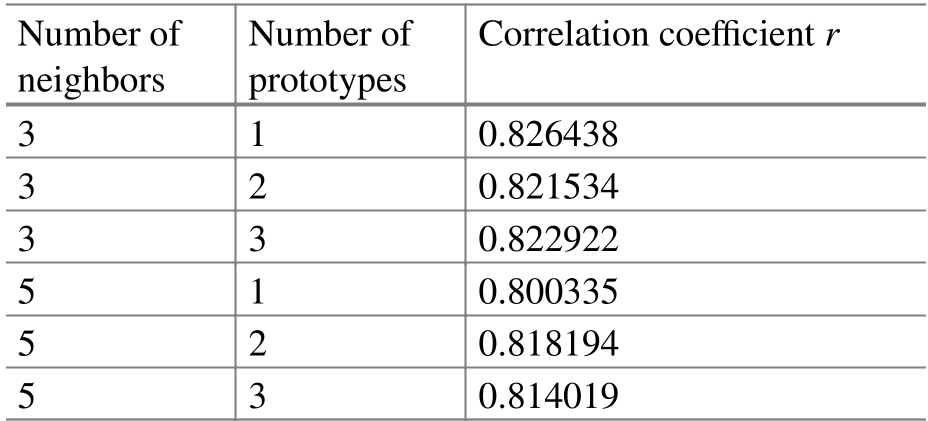 Table 1: The simplest model (1 prototype, 3 neighbors) yielded the highest generalization, echoing the 'Occam’s Razor' principle.
Results & Deep Insights
The model is surprisingly accurate for such a small dataset. 85% of the predictions were within a single grade point of the actual result.
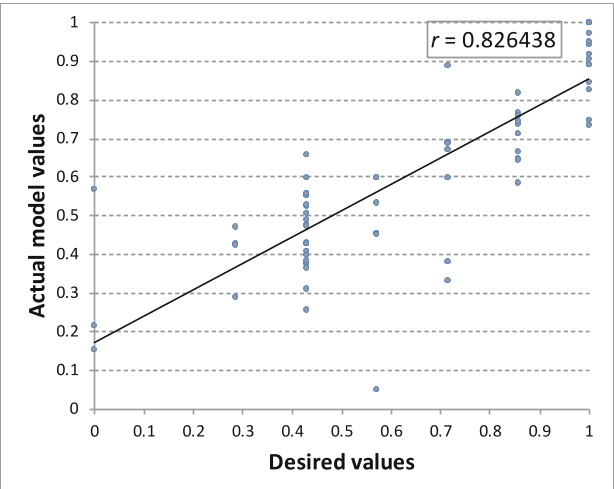 Fig 1: The tight alignment between the model predictions and actual normalized values showcases the effectiveness of the distance metric.
Limitations:
As an instance-based method, LMNNR suffers from extrapolation issues. If the training set doesn't contain examples of very low grades (e.g., 3s or 4s), the model cannot "invent" them, leading to higher error rates for outlier students.
Critical Analysis & Future Outlook
This work validates that participation is a proxy for performance. Students who are more engaged—writing longer comments and maintaining active daily streaks on Wikis—tend to master the material better.
For educators, this means LMNNR can act as an "Early Warning System." Rather than waiting for a midterm exam, an instructor can identify "at-risk" students by their lack of social media activity within the first three weeks of a project.
Future Work: The next step is scaling. A dataset of 75 is a great "Proof of Concept," but to be truly robust, this metric learning needs to be tested across different academic years and multi-disciplinary cohorts.