
Decoding Facebook's Vital Signs: A Three-Year Global Analysis of Growth and Engagement
A Large-Scale Analysis of Facebook's User-Base and User Engagement Growth
This paper provides the first large-scale longitudinal study of Facebook's global user-base and engagement evolution (2015-2018) using a novel methodology based on Facebook's Marketing API. Over 230 countries and diverse demographic groups were monitored, revealing that despite predictions of decline, Facebook reached 2.2 billion users with 1.3 billion Daily Active Users (DAU) by mid-2018.
TL;DR
Contrary to previous "doom-and-gloom" predictions suggesting the death of Facebook, this large-scale analysis reveals a platform that is still expanding, albeit with significant demographic shifts. By leveraging Facebook's own Marketing API, researchers mapped the evolution of 2.2 billion users, showing that while Western markets have plateaued, Africa and Central Asia are driving a new wave of growth tailored toward older adults and male users.
Background: Beyond the Epidemic Model
In 2014, a viral study used epidemiological models to predict that Facebook would lose 80% of its users by 2017. However, those models lacked ground-truth data. This paper positions itself as a dose of "real-world data," utilizing the very tools advertisers use to reach specific cohorts. It moves away from the "what" of raw numbers to the "why" of socioeconomic drivers.
Methodology: Repurposing the Marketing API
The core innovation is the methodology. Instead of trying to "scrape" a walled garden, the authors queried Facebook's Marketing API.
- Scalability: They tracked 230 countries for 3 years.
- Precision: Data was sliced by age (13 to 65+) and gender.
- Variables: Two metrics were tracked—User-base (Monthly Active Users) and Engagement (Daily Active Users).
 Figure 1: Conceptual overview of the data collection environment leveraging the Facebook Graph API.
Key Insights: The Changing Face of Engagement
1. The Demographic Shift: "Graying" of the Platform
The study confirms the "Constrictive Population" hypothesis. Facebook is no longer the primary terrain for adolescents. Growth rates for those aged 13-19 are 2.3 times smaller than those for adults.
- Insight: Facebook exhibits a "late majority" behavior where users often join as they mature, finding the features more appealing in adulthood than in their teens.
2. The Geography of Growth
The "Growth Capacity" map reveals a stark divide. Developed regions (US, EU, Scandinavia) have reached a plateau.
- The New Frontier: Africa and Central Asia show the highest growth potential and actual user-base increases.
- Engagement vs. Penetration: Interestingly, while Africa has a room for growth, its engagement (DAU/Total Users) often varies based on local infrastructure and competing services like WeChat in China (where Facebook remains blocked).
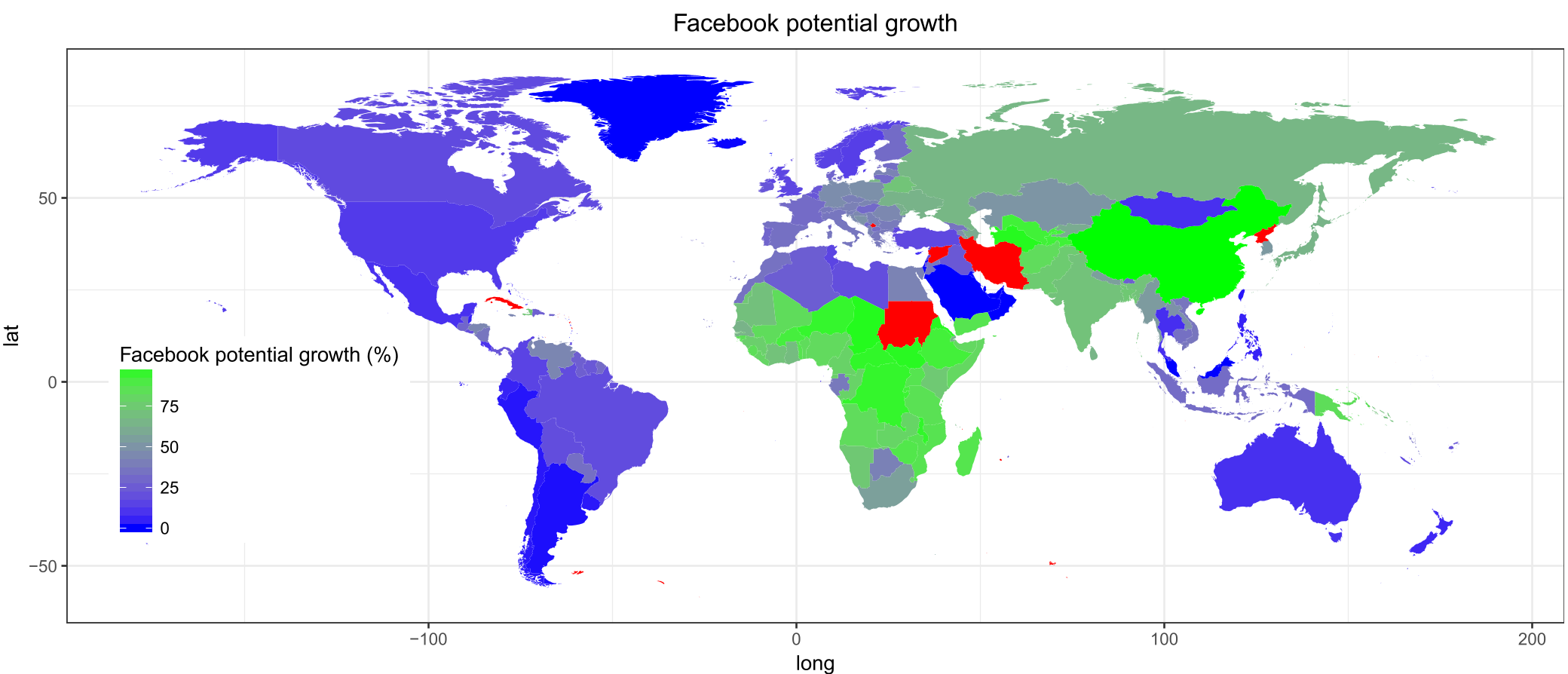 Figure 2: Heatmap showing available "room" for Facebook growth. Light green indicates high potential in developing regions.
3. Socioeconomic Drivers
The researchers used Random Forest Regression to determine what influences growth.
- Geography was the #1 factor (90.3% influence on user-base growth).
- Correlation: Rapid growth is positively correlated with high urbanization rates and, surprisingly, higher gender inequality. This suggests that in many emerging markets, the "digital divide" is still heavily skewed toward male adoption.
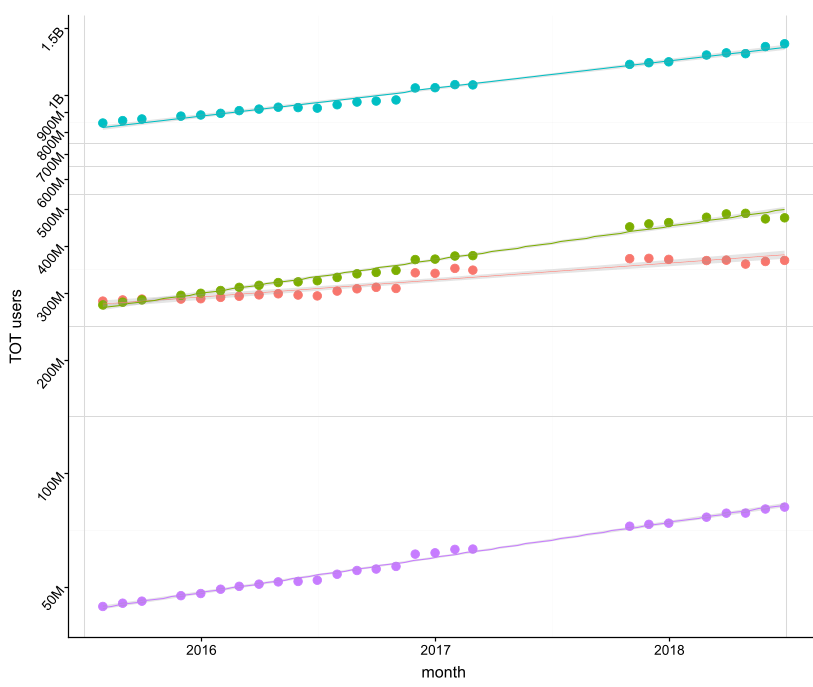 Figure 3: Growth rates of user-base and engagement across different life stages (Adolescence vs. Maturity).
Critical Analysis & Conclusion
The study effectively debunked the "death of Facebook" narrative by providing the most granular look at its demographic evolution to date.
Major Lessons:
- Platform Lifecycle: Social networks may follow a lifecycle where they evolve from "youthful trends" to "essential utilities" for older populations.
- The Gender Gap: The finding that Facebook growth is male-biased in developing nations highlights a persistent socioeconomic hurdle for global digital equality.
Limitations: The data relies on Facebook's self-reported estimates for advertisers, which may include "gray" accounts or be subject to the platform's internal rounding algorithms. Furthermore, it doesn't account for the rise of subsidiaries like Instagram and WhatsApp, which might capture the "lost" adolescent demographic mentioned in the report.
Future Outlook: For researchers, this paper proves that marketing tools are valid proxies for sociological study. For investors, it highlights that Facebook's future revenue is increasingly tied to the infrastructure and economic development of the Global South.