
Debunking the Decline: A Three-Year Deep Dive into Facebook’s Global Growth and Engagement
A Large-Scale Analysis of Facebook's User-Base and User Engagement Growth
This paper presents a comprehensive, large-scale analysis of Facebook's user-base and engagement growth across 230 countries and diverse demographics over a three-year period (2015-2018). Leveraging a novel methodology via Facebook's Marketing API, the study confirms that Facebook continues to grow globally, reaching 2.3B total users and 1.3B daily active users (DAU), despite previous academic predictions of its decline.
TL;DR
Contrary to the "Facebook is dying" narrative popularized by epidemiological models in the mid-2010s, this large-scale study proves the platform is alive and expanding. By leveraging data for 2.3 billion users across 230 countries, researchers found that while growth has plateaued in the West and among teenagers, it is surging in Africa and Central Asia, driven by "late majority" adopters and specific socioeconomic shifts like rapid urbanization.
Background: The Limits of Hearsay
For years, academic and market analysts struggled to quantify Facebook's actual health. Because Facebook is a "walled garden," researchers previously relied on public crawls or Google search trends—leading to infamous (and wrong) predictions that the platform would lose 80% of its users. This paper solves the "data wall" by using an ingenious backdoor: the Facebook Marketing API. By posing as advertisers, the researchers could query the platform for the exact number of users matching specific criteria without violating individual privacy.
Methodology: The Advertiser's Lens
The core innovation lies in the automated distributed measurement system. Instead of scraping profiles, the system queries the API for:
- User-Base: Monthly Active Users (MAU).
- Engagement: Daily Active Users (DAU).
The team segmented this data by 230 countries, 53 age groups (13 to 65+), and gender. This allowed them to construct a "Demographic Pyramid" for the entire digital social network, offering a fidelity never seen before in independent research.
 Figure 4: The Facebook population pyramid (2018) shows a 'Constrictive' base, indicating the platform is less appealing to 13-18 year-olds but gains momentum as users age.
Key Finding 1: The Adolescent Plateau
The data confirms a popular intuition: Facebook has a youth problem.
- Growth among adolescents (13-19) is roughly 2.3 times smaller than among adults (40-64).
- The platform acts more like an "expansive population" for users over 20, suggesting that individuals join Facebook as they "age into" its features (utility, family connection, professional groups) rather than as a trend-driven youth hobby.
Key Finding 2: Geography is the New Frontier
Western markets (US, EU, Scandinavia) have reached a plateau. The real action is happening in the Global South.
- Africa and Central Asia show the highest growth rates.
- Using Random Forest regression, the authors found that geography accounts for 90.3% of the variance in user-base growth.
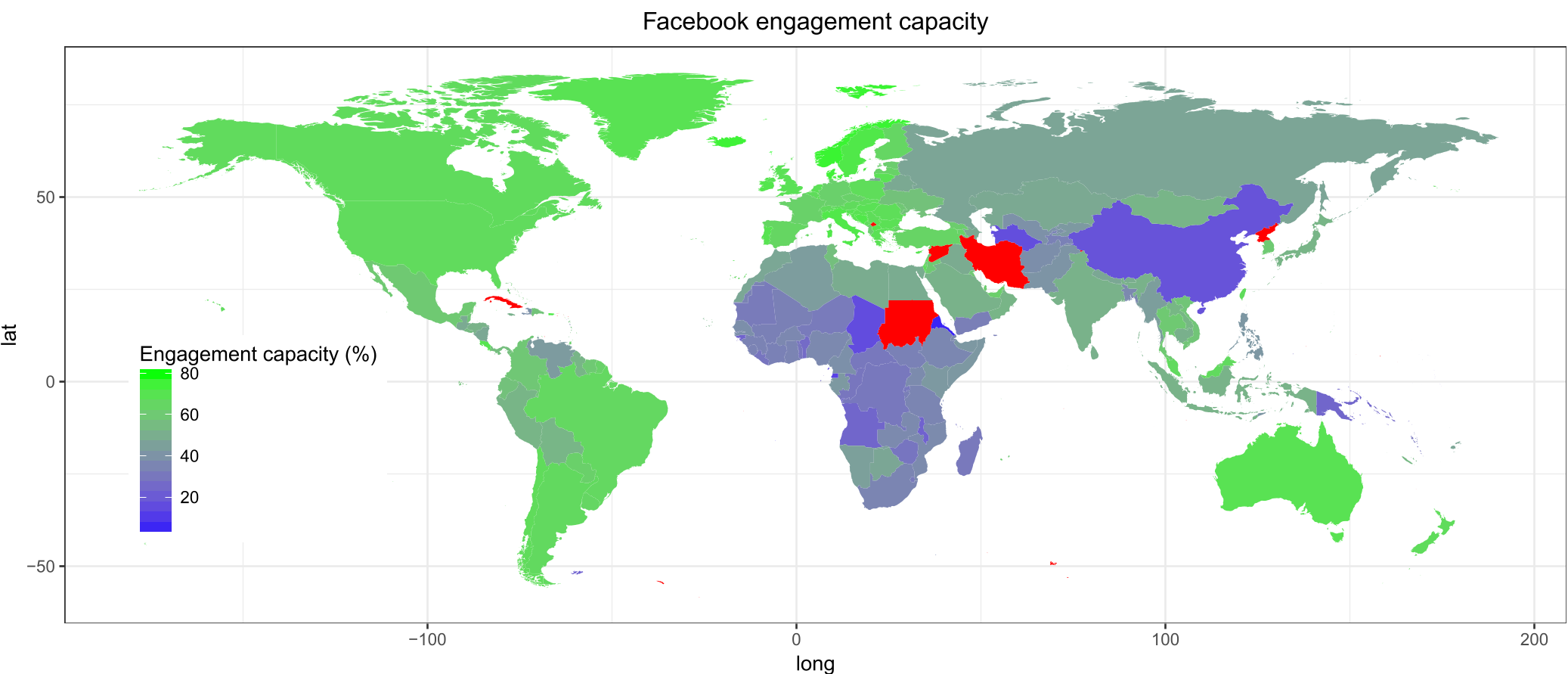 Figure 3: Global heatmap of engagement (DAU/Total Users). Darker blue areas indicate lower engagement density, highlighting potential growth zones in Asia and Africa.
Key Finding 3: Socioeconomic Drivers
The study linked Facebook's growth to "real-world" indicators from the World Bank and CIA Factbook. They discovered that the user-base grows fastest in countries with:
- High Urbanization Growth: City-dwellers have better access to the infrastructure needed for OSNs.
- Lower Broadband Penetration: Ironically, Facebook grows where internet service is developing, as seen through initiatives like Internet.org (Free Basics).
- Gender Divide: Male-biased growth is dominant in regions with existing gender inequality, suggesting the "digital divide" reflects social realities.
Critical Analysis & Conclusion
This work highlights a fundamental shift in "social network evolution." Facebook is no longer a high-growth "cool" app; it has become digital utility infrastructure.
Limitations
- API Trust: The data relies on Facebook's own reporting. While arguably more accurate than third-party crawls, it remains a "black box" regarding how DAU/MAU are precisely calculated.
- Default Bias: The researchers noted a massive "spike" in users aged 25, likely because 1993 was the default birth year on the registration page—a reminder that UI design heavily skews demographic data.
Final Takeaway
For investors and advertisers, the message is clear: Look past the teenagers. Facebook’s resilience lies in its ability to capture the "late majority" in emerging economies and the maturing population in developed ones. It is evolving from a social network into a global utility.