
Deciphering Virality: Why Some Tweets Spread While Others Die
Want to be Retweeted? Large Scale Analytics on Factors Impacting Retweet in Twitter Network
This paper presents a large-scale analysis of factors impacting "retweetability" on Twitter using 74 million tweets. By employing Principal Component Analysis (PCA) and Generalized Linear Models (GLM), the authors identify key content and contextual drivers for information diffusion, providing a predictive framework for social media virality.
TL;DR
What makes a tweet go viral? This seminal research from the Palo Alto Research Center (PARC) analyzes 74 million tweets to decode the "DNA" of a retweet. The findings are striking: while having more followers helps, the true engines of virality are URLs and Hashtags. Surprisingly, being a "heavy poster" (high status count) does almost nothing to help your tweets spread.
The "Why" Behind the Research
In the early days of Twitter, retweeting was an emergent behavior—a manual hack where users typed "RT" before copying text. The authors recognized that this simple act was actually the fundamental mechanism for Information Diffusion. They sought to move beyond anecdotal evidence to find a mathematically rigorous answer to the question: Which factors actually predict that a tweet will be shared?
Methodology: The Math of Social Influence
The researchers categorized tweet features into two buckets:
- Content Features: The "What" (URLs, Hashtags, Mentions).
- Contextual Features: The "Who" (Follower count, account age, total tweets).
Using a Principal Component Analysis (PCA), they discovered three "Factors" that define Twitter behavior:
- The Broadcaster Factor: High followers and followees.
- The Content Factor: A trade-off between using links/hashtags vs. personal mentions.
- The Authority Factor: High follower count but low "noise" (fewer tweets and favorites).
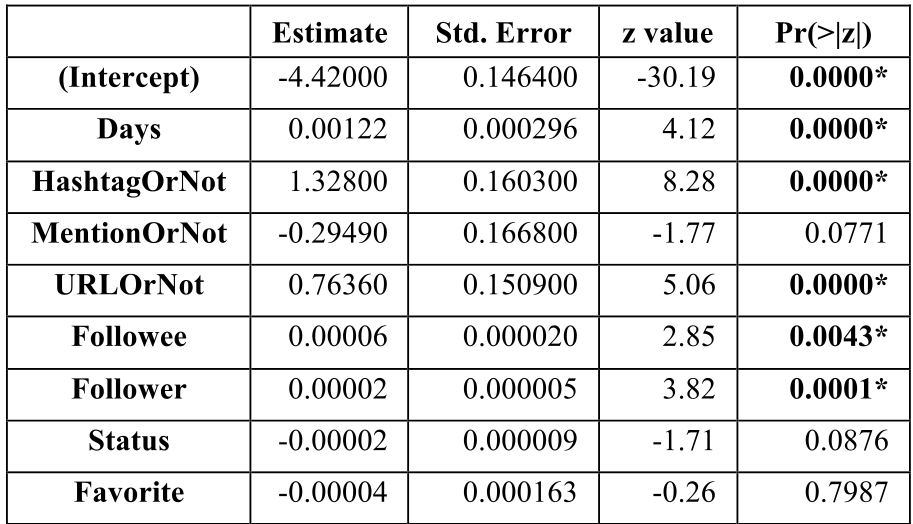 Table: GLM Analysis showing the statistical significance of each feature.
Key Insights: Content is King, but Context is the Kingdom
1. The Power of the Link (URL)
The data shows that tweets containing URLs are much more likely to be retweeted. However, not all domains are equal.
- High Virality: Tools that extend Twitter's utility (TwitLonger) and reputable news/tech sites (Mashable, NYTimes).
- Low Virality: Highly personal media streams (Justin.tv) or check-in services (Foursquare).
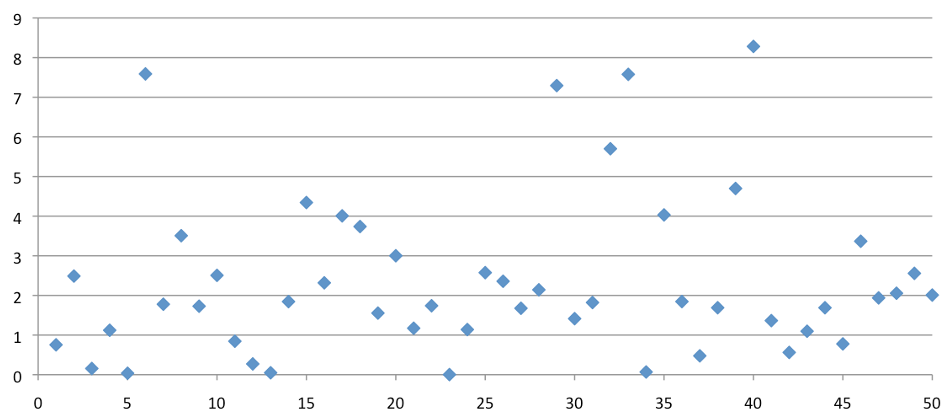 The graph shows that popularity in tweets does not always translate to popularity in retweets.
2. Hashtags: The Ultimate Organizer
Hashtags aren't just for search; they are a signal of "topicality." Retweets containing hashtags appeared at nearly double the frequency compared to the general tweet population.
3. The "Broadcaster" Paradox
While common sense suggests that the more you post, the more you'll be noticed, the study found that Status Count (total past tweets) is not a significant predictor of retweetability. This suggests that "spamming" the feed actually degrades the value of a user's information.
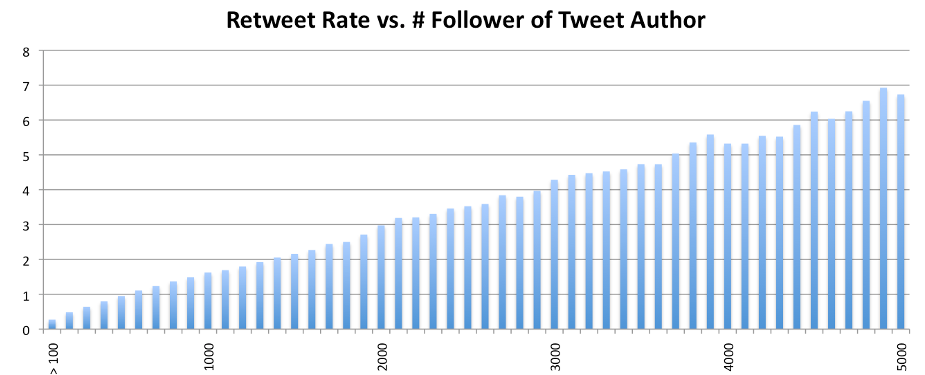 A clear linear relationship: More followers equals a higher probability of diffusion.
Conclusion and Future Impact
The research concludes that retweeting is a combination of Social Authority and Informational Value.
Takeaway for Developers: When building recommendation engines or social analytics tools, the most "valuable" content is often found at the intersection of high external links (URLs) and established social status (Account Age/Followers), not just sheer activity.
Limitations: The study uses sampled data (2-3% of the firehose) and focuses on English-centric markers. Future research should investigate how these patterns hold in multi-modal environments where images and videos dominate the text.