
Socially Aware Recognition: Revolutionizing Face ID with Network Context
Toward Large-Scale Face Recognition Using Social Network Context Theauthorsofthispaperbelievethatsocialincentivescanbeusedtoobtainnumerous facialimagesoffacesandtheyproposeacomputationalmethodforusingtheseimages.
This paper introduces a "socially aware" face recognition framework that leverages social network context—specifically user-generated identity tags and graph-based relationships—to facilitate large-scale face recognition. It employs a structured prediction approach using Markov Random Fields (MRFs) to jointly label faces in personal photographs.
TL;DR
Face recognition "in the wild" is notoriously difficult due to environmental noise and the sheer number of possible identities. This paper argues that the solution lies not just in better pixels, but in social context. By leveraging the "free" labels provided by social network tagging and the underlying "friendship" graphs, the authors propose a structured prediction model that transforms face ID from an isolated image task into a joint inference problem over social relationships.
The Scalability Wall in Face Recognition
Most face recognition research focuses on the "What": What features make this face unique? However, when searching for an identity among 400 million users (the size of Facebook at the time of publication), the variation between different people becomes smaller than the variation within one person's different photos (pose, lighting, aging).
The authors identify two critical bottlenecks:
- The Enrollment Burden: Manually labeling millions of people for a training set is impossible for researchers but happens naturally on social platforms through "social incentives."
- The Discriminative Challenge: Without prior knowledge, every face could be anyone. Using the social graph reduces the "search space" from millions to a few hundred likely friends.
Methodology: Structured Prediction & MRFs
Instead of labeling each face in a photo independently, the authors treat a photograph as a Joint Labeling Problem.
The Mathematical Intuition
The core of the methodology is a Pairwise Markov Random Field (MRF). Imagine a photo with three people. Instead of three separate identity guesses, the model creates a graph where:
- Nodes (): Represent the identity of each detected face.
- Univariate Features (): Captures "Face Appearance" (how much does this crop look like Ben?).
- Bivariate Features (): Captures "Social Context" (how likely are Ben and Avery to appear in a photo together?).
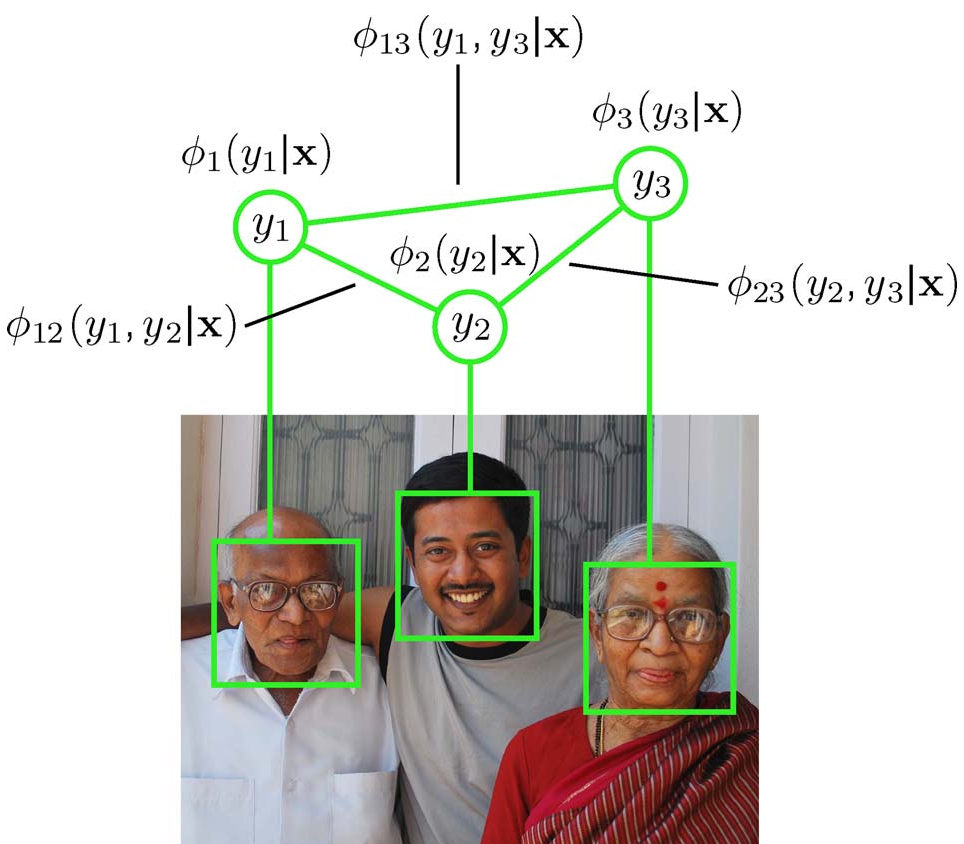 Fig 1. The graphical model treats identities as interdependent nodes. The goal is to maximize the compatibility between the image data and the social network ties.
The objective function balances official appearance scores with social tie strengths. This means even if a face is blurry, if the person standing next to them is their best friend, the system can "infer" the correct identity with high confidence.
Harvesting "Free" Data
The study highlights a fascinating sociological shift: while people hate organizing their own local photo libraries, they are highly motivated to tag photos on Facebook. This "tagging as communication" creates a self-scaling training database.
| Metadata Metric | July 2009 Status |
|---|---|
| Total Individuals in Network | 22,108 |
| Total Photos Retrieved | 7.7 Million |
| Reliable Frontal Face Tags | 2.5 Million |
Experimental Results: The Power of Context
Comparing a pure appearance-based model (face) against a pure social co-occurrence model (context), the authors found that neither is perfect. However, when fused, the identification rate jumps significantly.
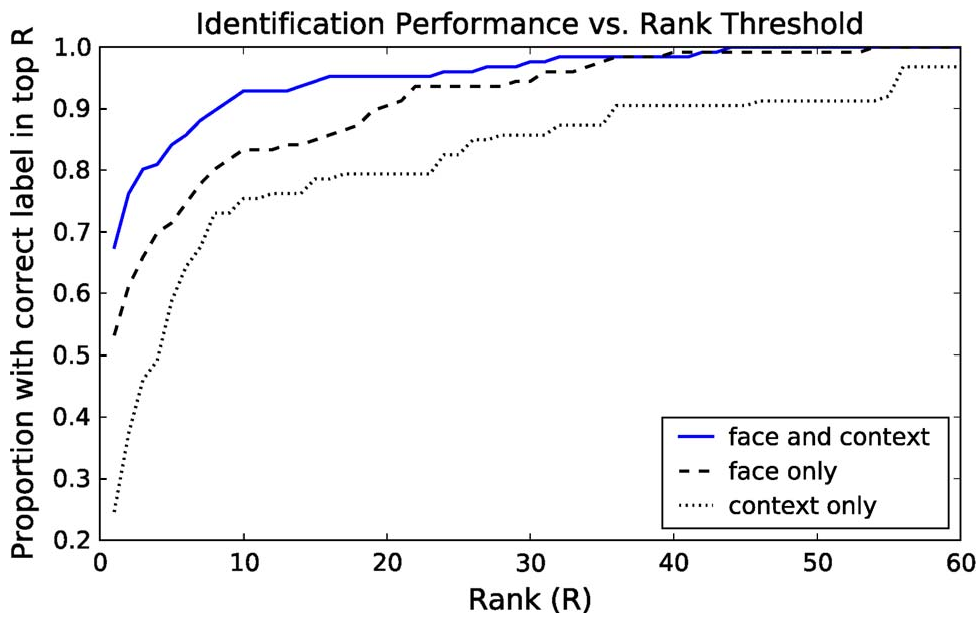 Fig 2. The Rank-R curve proves that combining face and context (solid blue line) consistently outperforms either signal in isolation.
Key Finding: In a photographer's album, 30% of tagged faces are typically the photographer themselves, and only 13% of a user's Facebook friends ever appear in a photo with them. This "photo co-occurrence subgraph" is far more predictive than the raw "friend" list.
Critical Analysis & Future Outlook
This work provided the blueprint for how modern social media giants handle autotagging. However, the authors acknowledge several limitations:
- Graph Complexity: As the number of people in a photo or event grows, the MRF inference (the
argmaxoperation) becomes computationally expensive, requiring approximate inference techniques. - Information Variety: The authors suggest future models should incorporate timestamps, geotags, and even gender/name priors to further constrain labels.
Conclusion
The transition from "Face Recognition" to "Socially Aware Recognition" marks a shift in Computer Vision from a signal-processing discipline to a multi-modal data science. By treating the social graph as a structured prior, we can overcome the inherent ambiguities of visual data "in the wild."
Senior Editor's Note: This paper effectively predicted the "Big Data" era of computer vision, where the metadata surrounding the image is often as valuable as the pixels themselves.