
Socially Aware Face Recognition: Scaling Identity Through the Social Graph
Toward Large-Scale Face Recognition Using Social Network Context Theauthorsofthispaperbelievethatsocialincentivescanbeusedtoobtainnumerous facialimagesoffacesandtheyproposeacomputationalmethodforusingtheseimages.
This paper introduces a "socially aware" face recognition framework that leverages online social network markers—specifically user-generated identity tags and social graph structures. By framing recognition as a joint labeling problem using a pairwise Markov Random Field (MRF), the method achieves significant accuracy gains on unconstrained "in the wild" photos by combining facial appearance with social relationship context.
TL;DR
The explosion of digital photography has far outpaced our ability to organize it. This paper argues that the solution lies not just in better pixels, but in the social context surrounding them. By leveraging Facebook’s social graph and user-generated tags, the authors propose a "socially aware" recognition system that uses Markov Random Fields (MRF) to combine facial geometry with relationship data, effectively "narrowing the field" from millions of possibilities to a handful of likely friends.
Background: The Scale of the "In the Wild" Problem
Traditional face recognition systems often operate in controlled environments. However, personal photographs—vibrant, messy, and "in the wild"—present extreme variations in illumination, pose, and expression. When you scale this to the level of the Web, where you might need to distinguish between hundreds of millions of people, the mathematical "distance" between distinct individuals becomes smaller than the "noise" within images of the same person.
The Insight: Social Incentives as Data Engines
The authors identify two key revolutionary components provided by social networks like Facebook:
- Free Labeling: Users are socially incentivized to "tag" friends to share experiences, creating a massive, self-updating database of labeled faces without traditional "enrollment" costs.
- Structure as Context: A photographer is far more likely to take photos of their friends than of random strangers. This social graph acts as a powerful prior that restricts the search space.
Methodology: Joint Labeling via Structured Prediction
The authors treat recognition as a Structured Prediction problem. Instead of identifying each face in isolation, they identify all faces in a photo simultaneously, considering the visual evidence and the likelihood that those specific people would appear together.
The Graphical Model
They use a pairwise Markov Random Field (MRF) where:
- Nodes: Represent detected faces.
- Edges: Represent the social relationship between the people in those faces.
- Unary Potentials: Scores from a standard face recognition engine (appearance).
- Binary Potentials: The "Social Tie" strength—calculated based on how often two people are jointly tagged in previous photos.
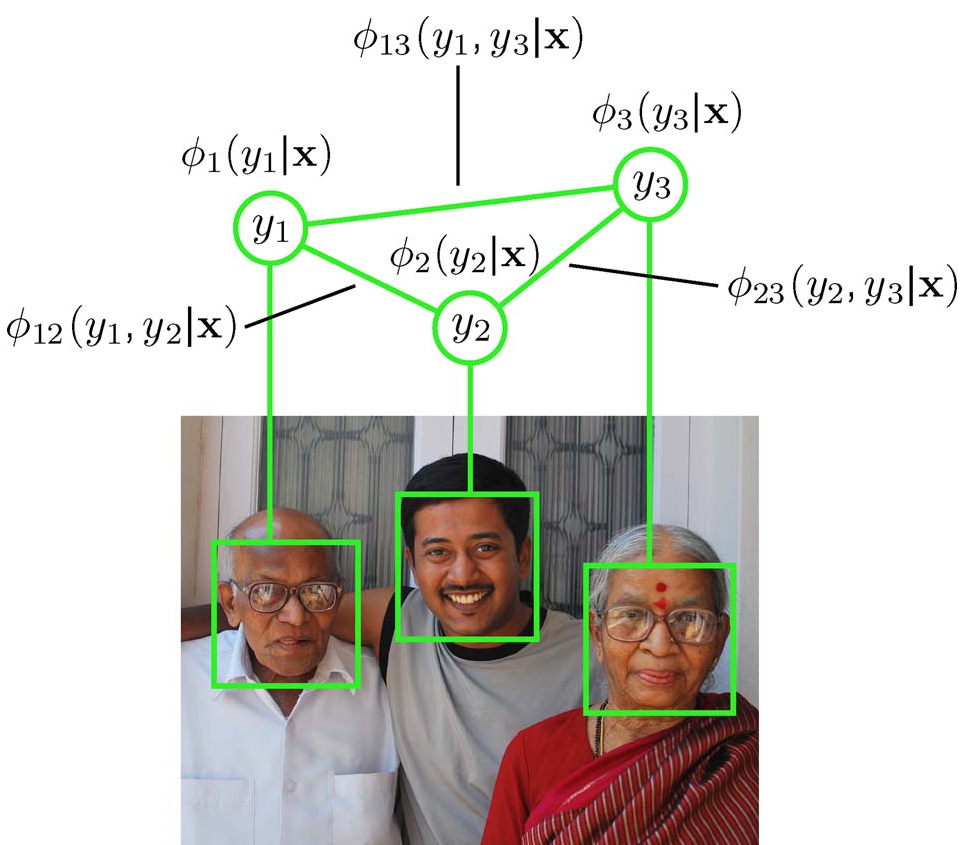 Caption: The graphical model represents nodes as identities and edges as social relationships. Inference involves finding the joint labeling that maximizes the score across both individual appearance and social ties.
Experimental Results: The Power of Context
Using a dataset expanded over two years (reaching 7.7 million photos), the researchers demonstrated that context isn't just a minor "boost"—it is a fundamental necessity for accuracy.
As shown in the performance curves below, the Face + Context (combined) approach dominates. While the "Face only" model struggles due to the "in the wild" variability, and the "Context only" model (guessing based on frienship) has a ceiling, the fusion of the two provides a robust leap in identification rates.
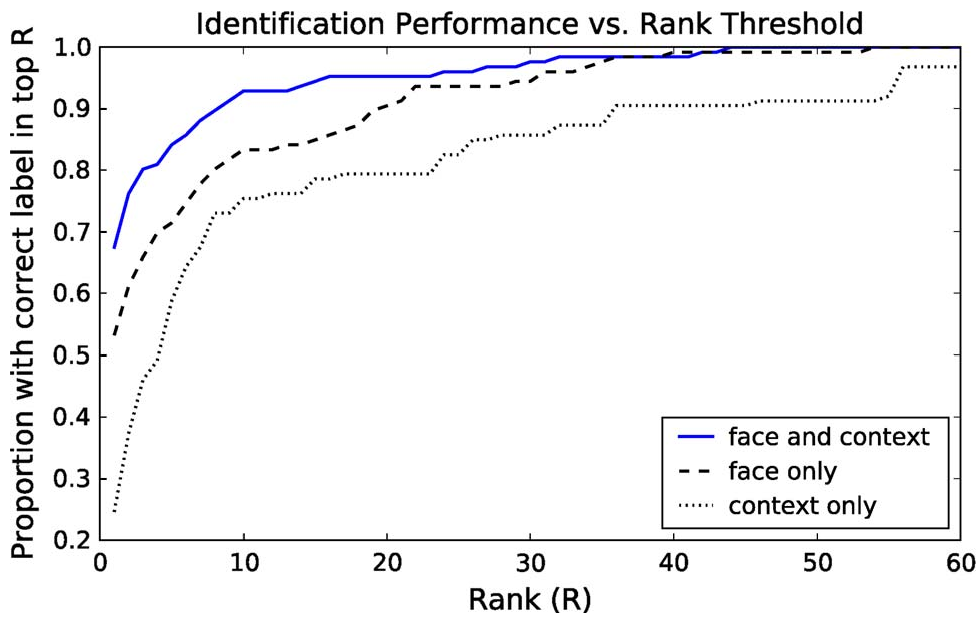 Caption: Identification performance as a function of Rank threshold. The green line (Face + Context) consistently outperforms the blue (Face only) and red (Context only) baselines.
Takeaway and Future Outlook
This work marks a shift from seeing face recognition as a pure Computer Vision problem to seeing it as a Contextual Inference problem.
Key Implications:
- Scale: Social context allows systems to handle millions of identities by effectively creating "local" search spaces for every photographer.
- Beyond Faces: The authors suggest that additional metadata—geotags, timestamps, and even gender/name priors—can be integrated into this same MRF framework to further improve accuracy.
- Limitations: The reliance on "friend links" means the system may struggle with strangers or public figures not in the immediate social graph.
In conclusion, the paper proves that our digital identities are not just defined by our features, but by the people we stand next to. The "social awareness" of an algorithm is just as important as its "visual acuity."