
ZenCrowd: Bridging the Gap Between Scalable Algorithms and Human Precision in Linked Data
Large-scale linked data integration using probabilistic reasoning and crowdsourcing
This paper introduces ZenCrowd, a hybrid system for large-scale Linked Open Data (LOD) integration encompassing both instance matching and entity linking. It combines automated probabilistic reasoning with human intelligence via a three-stage blocking technique, achieving a SOTA average accuracy of 95% on instance matching.
TL;DR
Integrating massive datasets often forces a trade-off between the speed of algorithms and the accuracy of humans. ZenCrowd breaks this dichotomy by using a probabilistic factor graph to orchestrate both. By employing a clever three-stage blocking strategy, it filters millions of candidates down to a few "uncertain" cases for the crowd, boosting instance matching accuracy to 95% while keeping costs strictly controlled.
The Scalability Wall and the Ambiguity Trap
In the world of Linked Open Data (LOD), the "same" entity (e.g., Barack Obama) might be described across hundreds of datasets (DBPedia, Freebase, NYT) using completely different schemas.
Current SOTA methods face two primary hurdles:
- The Quadratic Explosion: Comparing every entity in Dataset A to every entity in Dataset B is computationally impossible at web scale ().
- Semantic Ambiguity: Is "Michael Jordan" the basketball star or the UC Berkeley professor? Algorithms often lack the "world knowledge" to decide when data is sparse or noisy.
Methodology: The Three-Stage Filter
ZenCrowd's brilliance lies in its Three-Stage Blocking Technique, which treats human effort as a scarce resource to be optimized via probabilistic confidence.
1. Inverted Index (The Broad Net)
First, the system uses a TF-IDF based inverted index to quickly retrieve the Top-K candidates. This reduces the search space from millions to a handful in milliseconds.
2. Graph-Based Schema Matching (The Refinement)
Candidate pairs are then analyzed using a structured graph database. The system calculates Jaccard similarities across tokens of matched schema elements (e.g., comparing dbp:birthDate with fb:date_of_birth).
3. Dynamic Crowdsourcing (The "Human" Precision)
If the probabilistic confidence remains low, ZenCrowd generates a Human Intelligence Task (HIT).
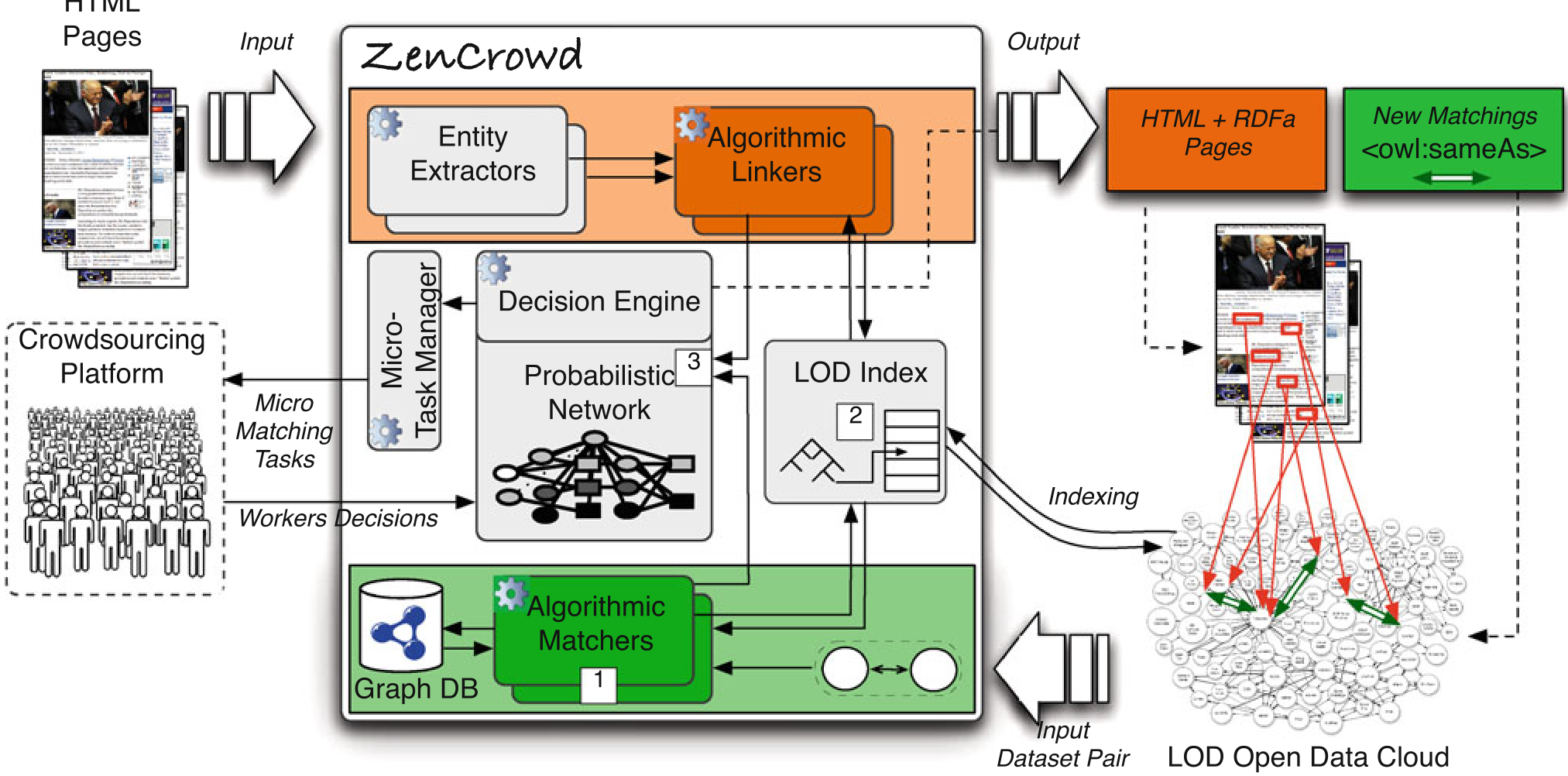
The Core Engine: Probabilistic Factor Graphs
ZenCrowd doesn't just "vote" on crowd results. It uses a Factor Graph to model the relationship between:
- Candidate Matches (): Binary variables (Correct/Incorrect).
- Workers (): Modeled as "Good" or "Bad" based on their reliability.
- Clicks (): The actual observations from the crowd.
The system uses the Sum-Product algorithm to propagate messages through this graph. This allows ZenCrowd to automatically down-weight "spammers" and reward consistent workers without needing a massive gold-standard dataset.
Experimental Results: High Stakes, High Accuracy
The researchers tested ZenCrowd against the OAEI 2011 instance matching benchmark.
- Accuracy Baseline: Purely automatic methods achieved ~88%.
- ZenCrowd Performance: Jumped to 95%.
- Entity Linking: Showed a 14% relative improvement over standard automated techniques.
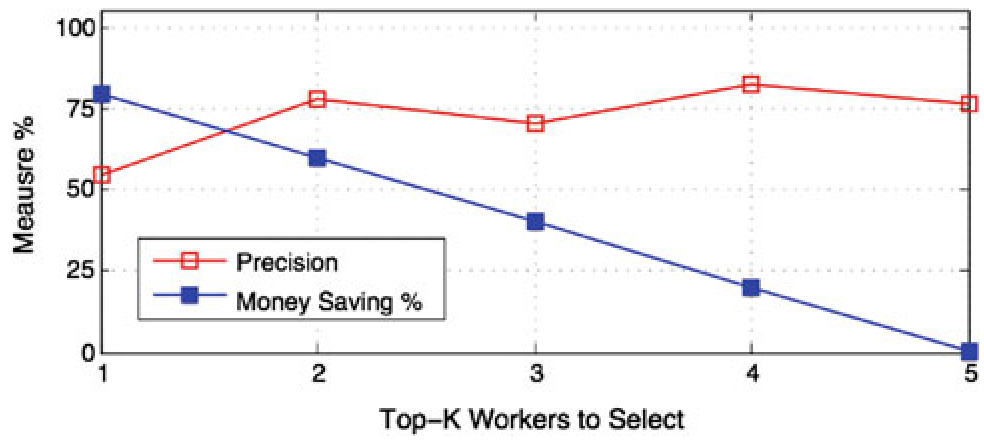
Crucially, the "Molecule" HIT design—which presented workers with structured property-value pairs rather than just links—significantly outperformed simpler interfaces, proving that context is king in human-in-the-loop systems.
Critical Insight & Future Outlook
ZenCrowd proves that the future of Data Engineering isn't about replacing humans with AI, but about building probabilistic orchestrators that know exactly when to ask a human for help.
Limitations: The system relies on high-quality external knowledge graphs (like DBPedia) to provide the "context" for workers. In niche domains (e.g., specialized medical data), the "crowd" might not be expert enough to help.
Takeaway: For any architect building large-scale Knowledge Graphs, ZenCrowd's message-passing approach to worker reliability is a masterclass in handling "noisy" human inputs.