
Pinned It! Decoding the Social Fabric and Gender Dynamics of Pinterest
Pinned it! A Large Scale Study of the Pinterest Network
This paper presents a large-scale characterization of Pinterest, analyzing 3.3 million user profiles and 58.8 million pins. The study identifies core user interests (fashion, food, design) and proposes a gender prediction model for American users using a J48 Decision Tree classifier.
TL;DR
Is Pinterest just a digital scrapbook, or a complex social ecosystem? This study performs a massive-scale "check-up" on Pinterest, analyzing millions of users and pins. The core findings reveal a platform driven by curated external content rather than original uploads, a heavy female demographic tilt, and a surprisingly high accuracy in predicting user gender (86%) using only public profile data.
Background Positioning
In the landscape of 2014 Social Computing, Pinterest was the "new kid on the block" that broke records for user growth. Unlike the text-heavy Twitter or the connection-centric Facebook, Pinterest introduced Social Curation. This paper acts as a foundational SOTA characterization, mapping the geographical, topical, and demographic layout of the network.
Problem & Motivation: The "Public" Mystery
Unlike other networks, Pinterest users often leave their profiles relatively "thin" on traditional PII (Personally Identifiable Information). However, the way they organize boards and describe their interests creates a digital footprint. The authors’ intuition was that these curation habits—what you "pin" and how you name your "boards"—are strong enough signals to reconstruct latent attributes like gender, which the platform hides by default.
Methodology: The Core of the Crawl
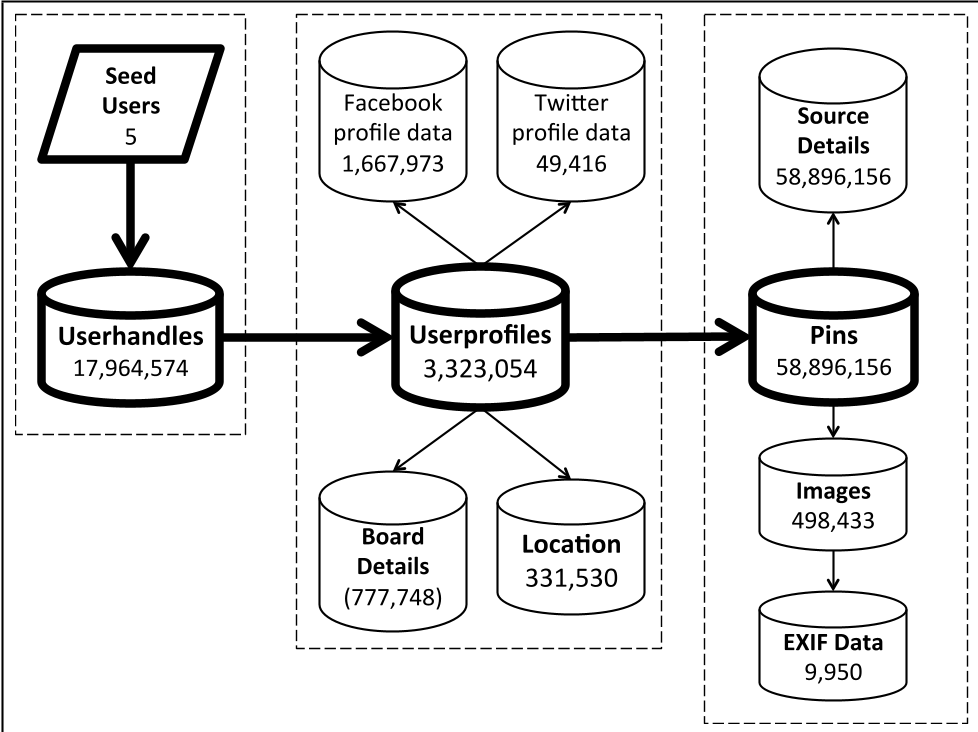
The researchers built a custom Breadth-First Search (BFS) crawler in Python, starting with the top 5 most-followed users and moving outwards.
Architecture of Characterization
The analysis was split into four distinct dimensions:
- User Attributes: Analyzing connected accounts (82% of users linked Facebook).
- Content Sources: Tracking where pins come from.
- Topical Analysis: Using LIWC (Linguistic Inquiry and Word Count) to find that Pinterest is an overwhelmingly positive space (low instances of "anger" or "swear words").
- Gender Prediction: Utilizing a J48 Decision Tree with 9 key features.
The logic behind the Gender Prediction was to calculate an About_Ratio and Board_Desc score. By comparing the frequency of certain words (e.g., "Style," "Wedding" vs. "Technology," "Geek") in male vs. female profiles, the model creates a weighted probability for new users.
Experiments & Results: Curation Over Creation
The most striking discovery was the Source Analysis. Pinterest is not a platform for creators; it is a platform for collectors.
- 95.3% of content is pinned from external sites like Google, Etsy, and Flickr.
- Only 4.7% of images are original uploads.
Gender Prediction Performance
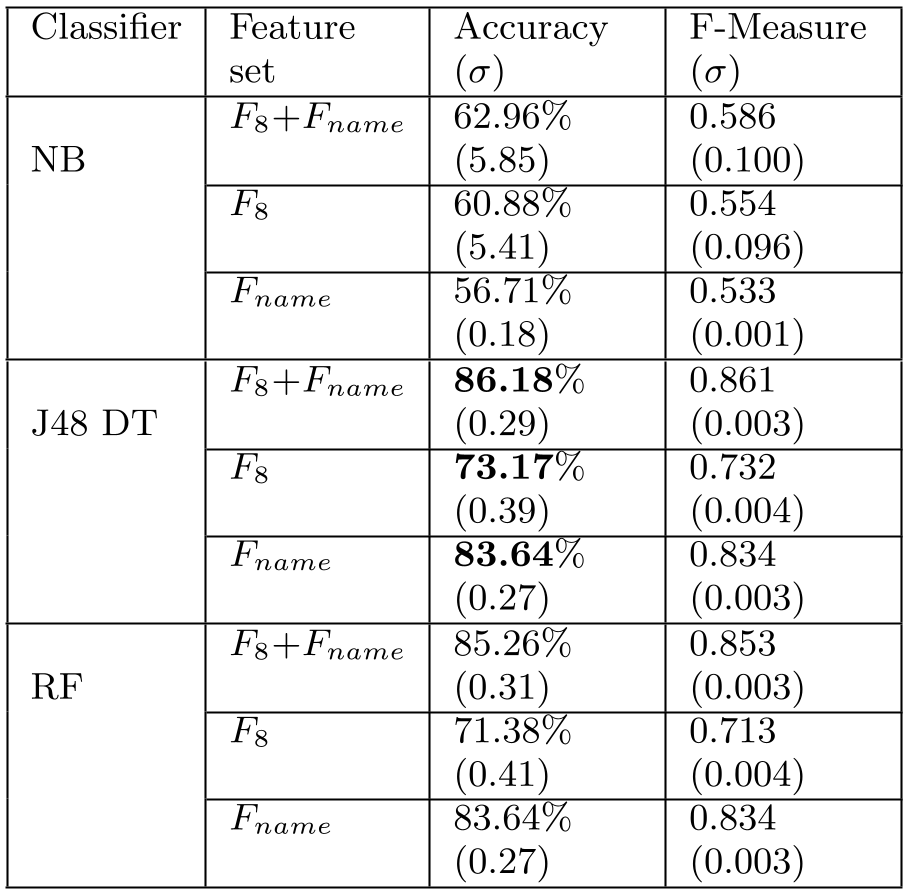
The model proved that "Identity is in the Name and the Board." Using just Pinterest metadata (pins, board counts, follows), they hit 73% accuracy. Adding a name-matching algorithm (comparing names against US Census data) spiked that to 86%.
Deep Insight & Conclusion
Takeaways
The paper confirms that Pinterest is a "Positive Echo Chamber." Unlike the often-toxic environments of Twitter or Facebook comments, Pinterest's utility is functional and aesthetic. It also highlights a massive privacy loophole: even if you don't list your gender, your curated boards (e.g., "DIY Crafts" vs. "Architecture") effectively "tell" the system who you are.
Limitations & Future Work
The study’s primary limitation is the Snowball Sampling Bias—by starting with the "top" users, the data may be skewed toward active, popular accounts rather than the "long tail" of casual users. Future research should look at Image-based features—actually "looking" at the pictures instead of just reading the captions—to predict user intent and identity.
Final Thought
This work serves as a reminder that in the age of Social Curation, what we choose to save defines us just as much as what we choose to say.