
SentiBank: Bridging the Affective Gap with Adjective-Noun Pairs
Large-scale visual sentiment ontology and detectors using adjective noun pairs
The paper introduces the Visual Sentiment Ontology (VSO) and SentiBank, a large-scale framework for visual sentiment analysis. It leverages over 3,000 Adjective-Noun Pairs (ANPs) to bridge the "affective gap" between low-level visual features and high-level human sentiments, achieving state-of-the-art results in predicting sentiments of image-based tweets.
TL;DR
While AI has become adept at identifying a "dog" in a photo, it historically struggles to tell if that dog is "cute" or "menacing." This paper introduces SentiBank, a library of 1,200 visual concept detectors based on a new Visual Sentiment Ontology (VSO). By shifting from simple object labels to Adjective-Noun Pairs (ANPs), the researchers have achieved a breakthrough in automated sentiment analysis for social media, outperforming text-based tools by nearly 30% in accuracy.
Background: The Affective Gap
In computer vision, we often talk about the semantic gap—the difficulty of mapping pixels to concepts like "car." However, sentiment analysis introduces the affective gap. Sentiment is subjective; a "rollercoaster" can evoke "excitement" for one person and "terror" for another.
Prior work attempted to bridge this by looking at color histograms or aesthetic measures. However, these lack the semantic "hooks" needed for robust prediction. The authors argue that we need mid-level representations that carry both semantic meaning and emotional weight.
Methodology: Engineering Emotion
The core innovation lies in the construction of the Adjective-Noun Pair (ANP).
- Why ANPs? A noun like "face" is sentiment-neutral. An adjective like "beautiful" is visually too abstract to detect reliably. Combined, "beautiful face" becomes both visually concrete and emotionally charged.
The Construction Pipeline
- Psychological Foundation: The team started with Plutchik’s Wheel of Emotions, using its 24 emotional categories to seed web searches on Flickr and YouTube.
- Web Mining: They extracted 6 million tags, filtered them using SentiWordNet to find high-sentiment adjectives and nouns.
- Ontology Building: 3,000 ANPs were curated. For instance, "joy" is linked to "happy smile," while "disgust" is linked to "nasty bugs."
 Figure: The framework overview shows how psychological models feed into web mining to create SentiBank.
Training SentiBank
The researchers trained 1,200 detectors using 500,000 images. They utilized a "Bag-of-Words" approach combined with GIST, Color Histograms, and specific attributes. Interestingly, they found that detectability is not correlated with frequency; some rare concepts are easier to see than common, abstract ones.
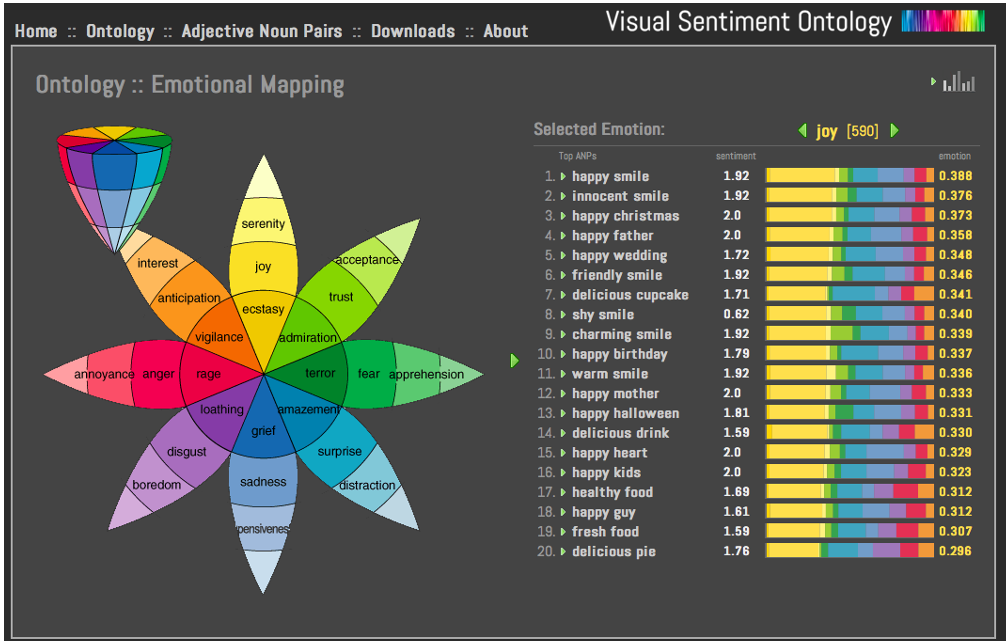 Figure: Using Plutchik's Wheel to organize and visualize the Visual Sentiment Ontology (VSO).
Experiments & Results: Visuals vs. Text
The most striking result of this study is the evaluation on Twitter (Image Tweets).
- The Problem with Text: Tweets are short (140 characters). Often, the text is neutral (e.g., "Four more years"), but the image (e.g., Obama hugging his wife) carries the heavy emotional lifting.
- The Performance: Text-only tools like SentiStrength managed only 43% accuracy. SentiBank, looking only at the image, achieved 70%.
 Table: Comparison showing SentiBank significantly outperforming low-level visual features and text-based baselines.
When combined, the hybrid model reached 72%, proving that visual and textual sentiments are often complementary but the visual side is frequently more informative in social media contexts.
Critical Insight & Conclusion
The genius of this paper is the Adjective-Noun Pair. It provides a "detectable" unit for an "abstract" feeling. By moving away from pixels and toward these mid-level concepts, the authors created a tool that doesn't just "see" an image—it begins to "interpret" it.
Limitations:
- The model was built using 2013-era linear SVMs and hand-crafted features.
- It relies on Flickr tags, which can be noisy (though the authors used Amazon Mechanical Turk to verify that 97% were accurate).
Future Work: With the rise of Deep Learning (CNNs and Transformers), the "detectors" in SentiBank could be vastly improved. However, the Visual Sentiment Ontology remains a foundational contribution for any researcher looking to teach machines how to understand human empathy and sentiment in a visual world.