
TIP DECOMP: Scaling Viral Marketing to Millions of Nodes
Large Social Networks Can Be Targeted for Viral Marketing with Small Seed Sets
This paper introduces TIP DECOMP, an efficient algorithm for the MIN-SEED problem in social networks under the "tipping" (deterministic linear threshold) model. It identifies a subset of individuals capable of triggering a network-wide behavior adoption, scaling successfully to massive datasets like Friendster (5.6M nodes).
TL;DR
Researchers from the Network Science Center at West Point have developed TIP DECOMP, a shell-decomposition-based algorithm that solves the "seed set" problem for viral marketing on a massive scale. While the problem is technically NP-Complete, this method identifies seed sets that are several orders of magnitude smaller than total population sizes—processing 28 million edges in just a few hours.
Background Positioning
In the landscape of network science, the "Multiple Influence" or "MIN-SEED" problem is a classic hurdle. Most SOTA (State-of-The-Art) solutions are either too slow for modern social media graphs or rely on stochastic assumptions. This work transitions from purely theoretical complexity to algorithmic feasibility, providing a practical tool for "tipping" entire networks.
Problem & Motivation: The Wall of Complexity
The "Tipping Model" (or Deterministic Linear Threshold) posits that an individual adopts a behavior only if a specific number of their neighbors have already done so. Finding the minimum initial set to flip the whole network is notoriously difficult (-Hard).
The authors observed two major flaws in prior work:
- Lack of Scalability: Greedy approximations often require expensive simulations ( or ), making them useless for networks with millions of users.
- Structural Blindness: Many models fail to account for how local "tight-knit" groups (clusters) prevent a trend from escaping into the wider network.
Methodology: The Logic of Reverse Pruning
Instead of building a seed set from the bottom up (which involves complex trial-and-error), TIP DECOMP identifies the seed set by working backward—pruning the nodes that are "easy" to influence.
The Intuition
If a node has enough neighbors in the current set to meet its threshold, it doesn't need to be in the seed set; it will "tip" naturally. By iteratively removing these nodes, the algorithm eventually isolates a "stubborn core" that must be activated manually to trigger the cascade.
Algorithm Architecture
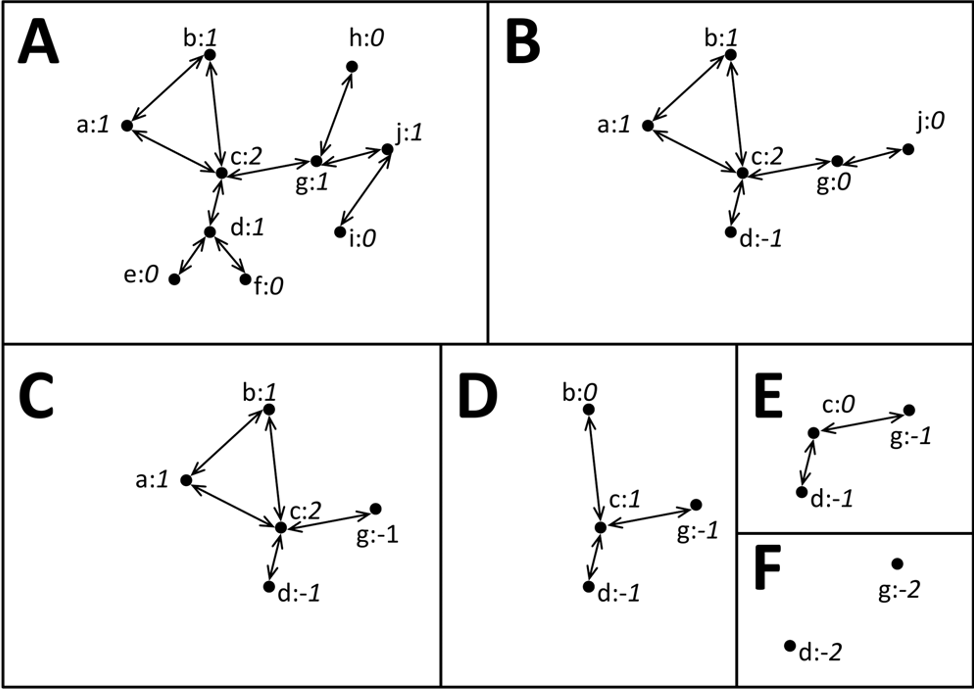
The algorithm maintains a value for each node: .
- Step 1: Find the node with the minimal (but non-negative) .
- Step 2: Remove it from the graph as it is "triggerable" by the remaining set.
- Step 3: Update neighbors and repeat until no such nodes exist.
- Result: The remaining nodes constitute the seed set.
Experiments & Results: Where Viral Trends Go to Die
The authors tested the algorithm on 31 datasets, ranging from email logs to the massive Friendster social network.
Key Findings
- Efficiency: The algorithm runs in , allowing it to process the Friendster network (5.6M nodes) in 3.6 hours.
- Identity of the Seed Set: For social media (Category A), seed sets were incredibly small—often less than 2% of the network size.
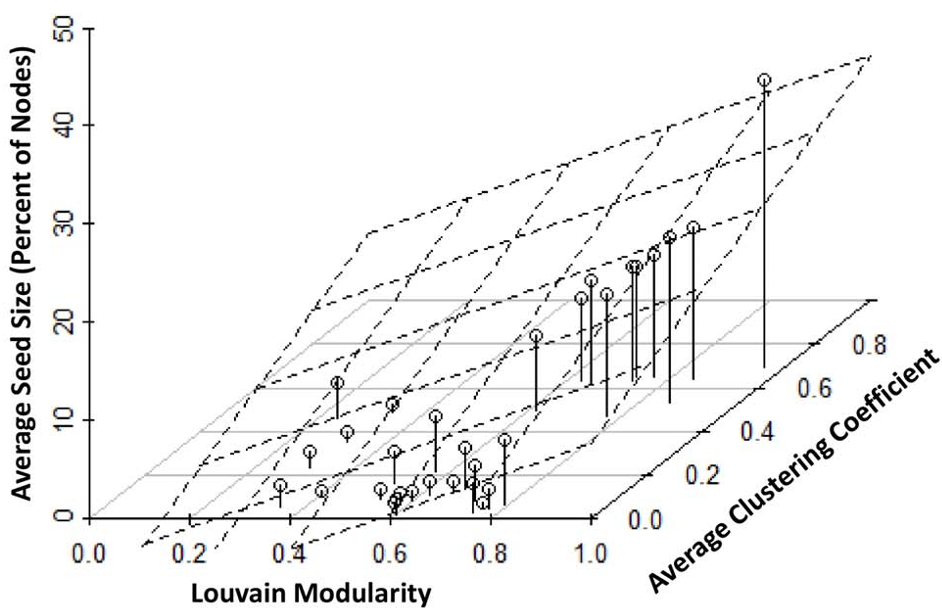
- Structural Inhibitors: The research identifies two "trend killers":
- Average Clustering Coefficient (): High local friend-of-a-friend density.
- Louvain Modularity (): Defined community segregation.
As shown in the figure below, as and increase, the required seed set size () grows significantly. In short: Dense, segregated communities suppress trends.
Comparison to Theoretical Bounds
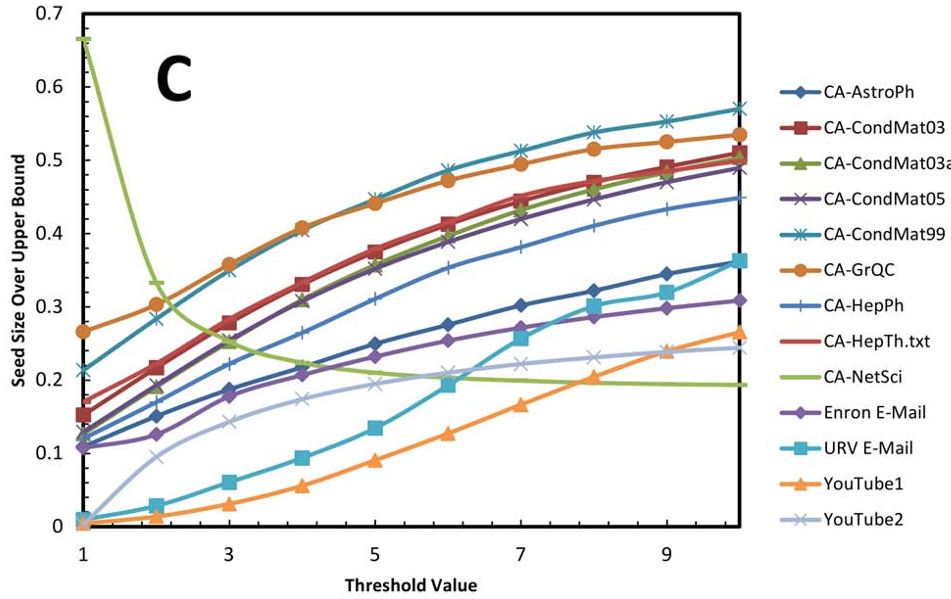
When compared to Reichman’s theoretical upper bounds, TIP DECOMP produced seed sets that were often an order of magnitude smaller, proving that real-world networks are far more "tippable" than pure mathematics might suggest.
Critical Analysis & Conclusion
Takeaway: This work provides a definitive link between shell decomposition and influence maximization. It proves that marketing "virality" is heavily dependent on the global modularity of the network; a highly partitioned network requires a much larger initial investment to "tip."
Limitations:
- The model is deterministic. It does not account for the "noise" of human behavior or probabilistic adoption.
- It assumes a static network. In reality, edges in social networks are dynamic and change over the course of a campaign.
Future Outlook: For practitioners, this algorithm suggests that "influencers" should not be picked just by degree (popularity), but by their position relative to the network's k-shell core. For researchers, exploring how this decomposition interacts with Temporal Networks is the next logical frontier.