
Why Larger Models Learn More: Scaling as a Shield Against Gradient Interference
Why Larger Models Learn More: Effects of Capacity, Interference, and Rare-Task Retention
This paper investigates the fundamental reasons why larger models learn tasks that smaller models fail to, introducing a "data-centric" account of scaling. By employing a multi-task regression framework and validating results on the OLMo pretraining pipeline (4M to 4B parameters), the authors identify that model capacity directly mitigates "gradient interference," allowing larger models to retain knowledge of rare and complex tasks that are otherwise overwritten in smaller models.
TL;DR
Why does a 175B parameter model solve a niche logic puzzle that a 7B model can’t, even if you train the 7B model on that puzzle forever? This paper posits that it isn't just about "intelligence" or "capacity" in the abstract; it's about resource competition. In smaller models, frequent tasks (like basic grammar) generate aggressive gradient updates that "overwrite" the fragile progress made on rare tasks. Scaling acts as a buffer—by providing enough neurons to "solve" the common tasks, the model reduces their gradient noise, finally giving rare tasks the "quiet" they need to be learned.
The Resource War: Why "Infinite Data" Isn't Enough
The traditional view of scaling suggests that smaller models are just "slower learners." If we gave them enough data, they’d eventually reach the same loss as the big players. The authors of this paper disagree. They introduce a rigorous distinction between:
- Learnable via data scaling: Small models can catch up with more time.
- Learnable via model scaling: Even with infinite data, a small model will never learn the task because its architecture creates a fundamental bottleneck.
The reason? Interference. Imagine a small room (a model's parameter space) with 100 people shouting. If 99 people are shouting about "English Grammar" and 1 person is whispering about "Quantum Physics," the physicist's message is lost. Scaling the model is like making the room a cathedral—the 99 grammarians find their corners and go quiet once they've finished their work, finally allowing the physicist to be heard.
Methodology: From Toy Regressions to OLMo
The researchers didn't just speculate; they used a two-pronged approach.
1. The Synthetic "Staircase"
They built a linear regression setup where multiple tasks compete for a shared bottleneck. They proved that features are learned in order of Utility (Frequency Complexity).
- The Insight: A larger model lowers the "utility floor." It learns high-frequency tasks so well that their "residual signal" (and thus their gradient) vanishes, freeing up "un-pressured" neurons for the rare tasks.
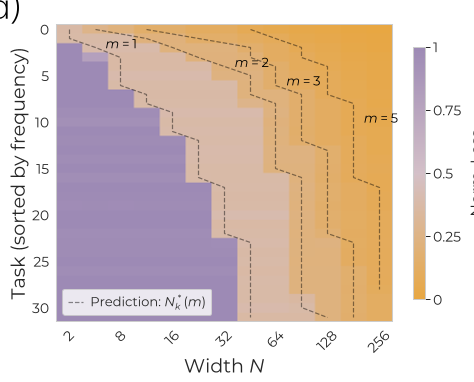 Figure: The "Utility Phase Diagram" showing how increased width () allows the model to descend the utility ladder to capture rarer task features.
2. The OLMo Validation
The team took real LLMs (OLMo, up to 4B parameters) and "poisoned" the pretraining data with two specific injected tasks: Comparison and Modular Addition. They controlled the frequency () of these tasks precisely.
The results mirrored the toy models:
- Small models (20M) only learned the tasks if they appeared constantly.
- Large models (4B) could learn the tasks even if they appeared only once every few thousand batches.
The Smoking Gun: Gradient Interference
The most compelling evidence comes from the gradient analysis. In small models, the "gradient" for the rare task is constantly being drowned out by the "non-task" (general language modeling) gradient.
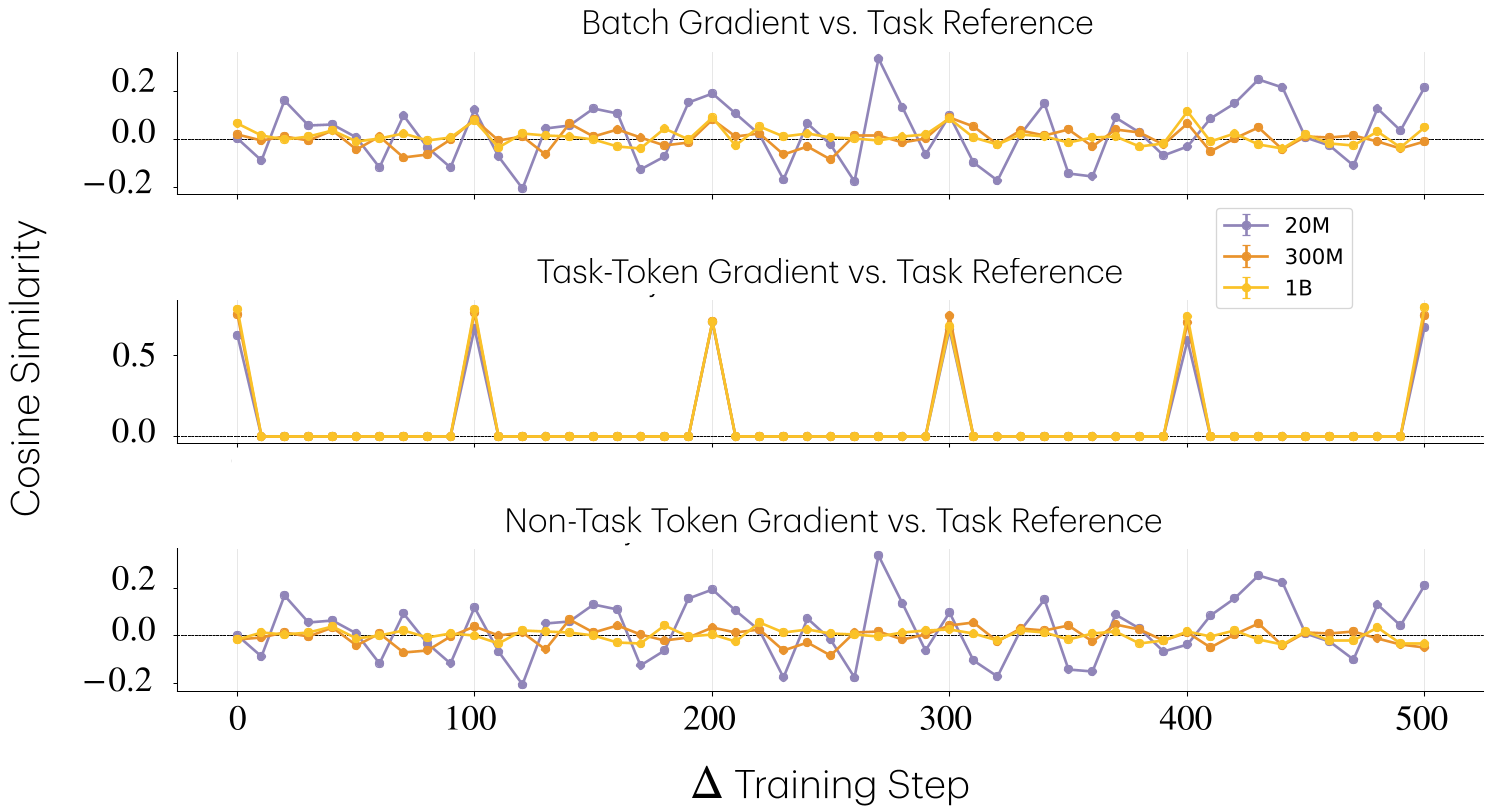 Figure: Comparison of gradient alignment. In larger models (1B), the non-task gradient is almost perfectly orthogonal to the task direction, meaning the general learning process doesn't "mess with" the rare task learning.
In the 20M parameter model, the similarity scores for non-task gradients oscillated wildly. This confirms the Update-and-Forget loop: the model learns a little bit of the rare task, but then the next batch of general text "washes it away" before the next rare sample arrives.
Critical Analysis & Takeaways
This paper shifts the narrative of scaling from "bigger is smarter" to "bigger is more stable."
Core Takeaways:
- Memorization is a Feature, not a Bug: The authors argue that a model must be able to "memorize" a signature of a rare task across "injection gaps" to eventually build an abstraction. Memorization is the prerequisite for generalization in the long tail.
- Data Mixture Matters: If you have a specific capability you want a model to learn, you have two choices: scale the model, or artificially increase that task's frequency in the data. The latter is often "compute-cheaper."
Limitations: While the paper provides a masterclass in phenomenological analysis, it primarily focuses on model width. Whether depth scaling provides the same "interference protection" through different hierarchical mechanisms remains an open question for future research.
Future Outlook
As we approach the limits of data scaling, this "data-centric" view suggests that the next frontier isn't just "more data," but "cleaner gradients." If we can architect models that naturally partition themselves to prevent interference (like hard-coded Mixture-of-Experts), we might be able to achieve "large model" performance on rare tasks with vastly fewer total parameters.