The Last Harness You’ll Ever Build: Automating the Scaffolding of AI Agents
The Last Harness You'll Ever Build
The paper introduces a two-level framework for automated "harness engineering"—the systematic optimization of prompts, tools, and orchestration logic that empower foundation models. It features a Harness Evolution Loop for task-specific optimization and a Meta-Evolution Loop that learns universal "blueprints" to accelerate agent adaptation to novel domains.
TL;DR
Building effective AI agents is no longer just about the "brain" (the model), but the "harness" (the tools, prompts, and logic) surrounding it. This paper introduces a hierarchical optimization framework: the Harness Evolution Loop automates the creation of a specialized agent for a specific task, while the Meta-Evolution Loop optimizes the process of building those agents. It marks the transition from manual, expert-driven agent design to a fully automated, meta-learning-driven engineering pipeline.
Problem & Motivation: The Manual Bottleneck
We have entered the era of the Agent Harness. As the paper points out, a raw model is not an agent. To make an LLM useful in a real-world enterprise environment—navigating web apps, filling forms, or reviewing code—engineers spend weeks building "scaffolding."
Current SOTA agents like those used in WebArena rely on hand-crafted:
- Orchestration Logic: How sub-agents hand off tasks.
- Observability Stacks: Custom logs and traces to help the model "see."
- Evaluator Criteria: Complex prompts to judge if the agent succeeded.
The pain point is clear: Harness engineering doesn't scale. Every new domain (e.g., from legal research to software testing) requires a human expert to iterate on prompts and tools. The authors argue that if the harness is mostly code and configuration, we should be able to optimize it algorithmically.
Methodology: The Two-Level Evolution Engine
The core contribution is a nested loop system that treats "agent design" as an optimization problem.
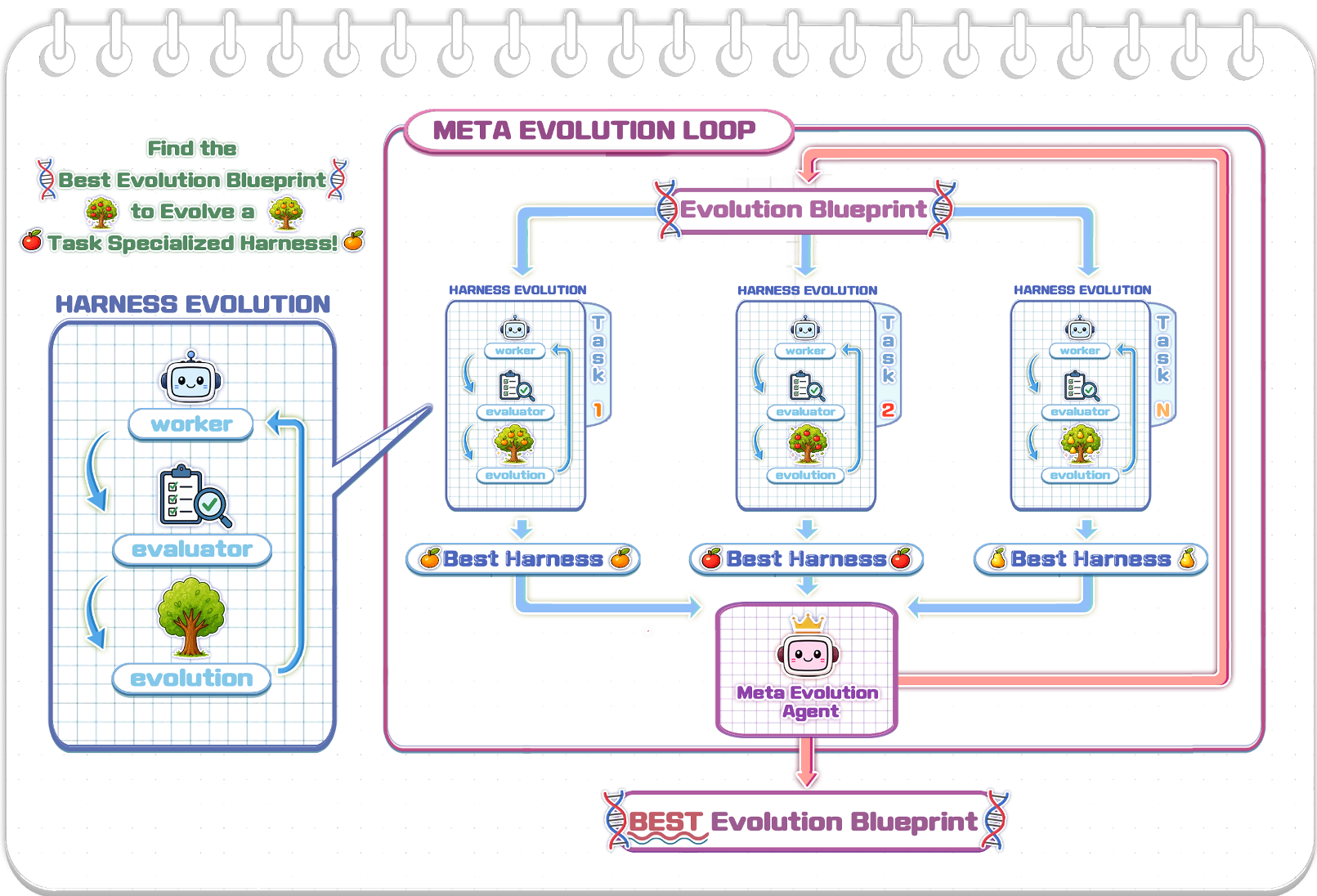
1. Level One: The Harness Evolution Loop
This is the inner loop focused on a single task. It consists of three distinct roles:
- The Worker (): Executes the task using the current harness .
- The Evaluator (): An adversarial agent that performs "Performance Auditing" and "State Verification." It doesn't just check if the task is done; it looks for hallucinations and bottlenecks.
- The Evolution Agent (): Acting as a "Senior Engineer," it looks at the failure history and modifies the code of the harness (not the model).
2. Level Two: The Meta-Evolution Loop
The breakthrough here is the realization that the Evolution Loop itself is a harness. The prompts given to the Evaluator and Evolution agents are also parameters that can be optimized.
By running the inner loop across a variety of training tasks (), the Meta-Evolution Agent learns a Blueprint (). This blueprint is a set of optimized instructions and configurations that ensures the inner loop converges to a successful agent faster and more reliably on new, unseen tasks.
Formalizing the "Meta-Learning" Connection
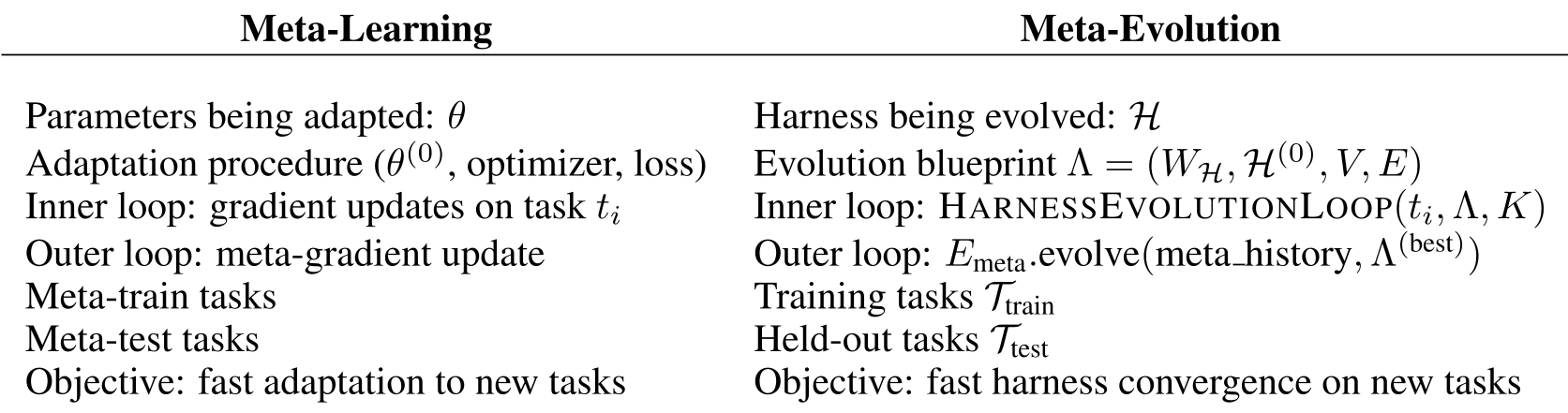
The authors brilliantly map this process to traditional Meta-Learning. In this framework, the "Parameters" being adapted are the Harness code (), and the "Outer Loop" update is the modification of the evolution instructions.
| Meta-Learning Concept | Meta-Evolution (The Paper) |
|---|---|
| Parameters () | Harness code/config () |
| Adaptation Procedure | Evolution Blueprint () |
| Inner Loop | Harness Evolution Loop |
| Meta-Test Tasks | Novel, held-out domains |
Deep Insight: Why This Works
Unlike simple prompt optimizers (like DSPy or LLM-AutoDiff), this framework treats the agent's entire environment as mutable. If an agent fails because a tool is too slow, the Evolution Agent might rewrite the tool's implementation. If the agent is getting lost in long contexts, the harness might be evolved to include a "summarization middleware."
By separating the Worker (who does the work) from the Evaluator (who finds the flaws) and the Evolver (who fixes the system), the framework mimics an agile software development team, but running at machine speed.
Critical Analysis & Future Outlook
Strengths:
- Scalability: It moves away from "hand-crafted" agents toward "generative" agents.
- Comprehensive: Includes orchestration and infrastructure in the optimization loop, not just prompts.
Limitations:
- Compute Cost: Running nested loops with high-tier LLMs (like GPT-4o or Claude 3.5) for multiple iterations is computationally expensive.
- Convergence Security: Letting an LLM modify its own "bundled infrastructure" or "hooks" requires strict sandboxing to prevent the agent from evolving ways to "cheat" the evaluation.
Conclusion: One Step Further
The paper concludes with a bold vision: Automating the design of the automation itself. As we move toward 2026, the competitive advantage in AI will not come from who has the best foundation model, but from who has the most efficient Meta-Evolution blueprint to deploy specialized agents instantly across any enterprise workflow.