
The End of the PDF Era? ARA: Making Science Truly Agent-Native
The Last Human-Written Paper: Agent-Native Research Artifacts
This paper introduces the Agent-Native Research Artifact (ARA), a novel protocol that replaces traditional narrative-based PDFs with machine-executable research packages. ARA achieves state-of-the-art results by increasing LLM agent reproduction success (57.4% to 64.4%) and question-answering accuracy (72.4% to 93.7%) on specialized benchmarks like PaperBench and RE-Bench.
TL;DR
Researchers from Stanford, MIT, and Michigan argue that the traditional scientific paper (PDF) is a "lossy compression" format that sabotages AI agents. They propose ARA (Agent-Native Research Artifact): a protocol that replaces the story with an executable graph. ARA increases LLM reproduction success to 64.4% and prevents agents from wasting time on "dead ends" by preserving the failures that humans usually hide.
Background: Why the "Last Human-Written Paper"?
For centuries, scientific papers were designed for humans—bandwidth-limited readers who need a linear story. But as AI agents like The AI Scientist begin to lead research, the narrative PDF becomes a liability. The authors identify two massive bottlenecks:
- The Storytelling Tax: We delete all the failed attempts and "dead ends" to make our paper look like a straight line to success. Agents have to rediscover these failures at 100x the cost.
- The Engineering Tax: Papers describe the why, but codebases often lack the specific how (hyperparameters, environment seeds).
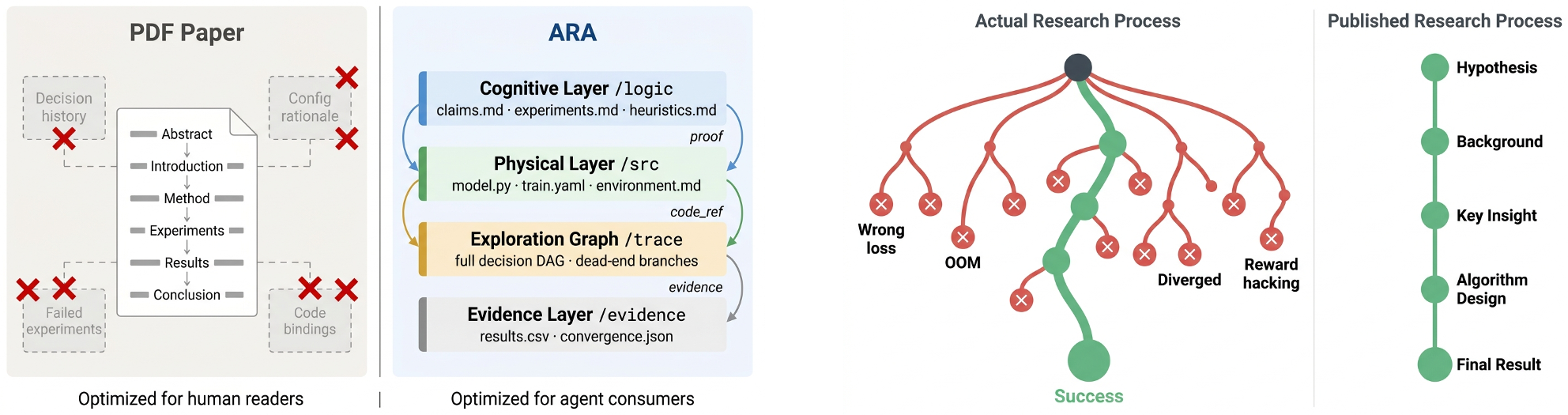 Figure 1: Traditional PDFs flatten the branching tree of research (left) into a linear story (right), losing critical failure knowledge.
The Core Insight: Four Layers of Knowledge
Instead of a PDF, the ARA protocol organizes a project into four queryable directories:
- /logic (Cognitive): Defines claims, falsification criteria, and the "Key Insight."
- /src (Physical): Modular "code kernels" instead of messy repositories.
- /trace (Exploration): A YAML-based tree of every decision, experiment, and dead_end.
- /evidence (Grounding): Raw tables and logs to prevent hallucination.
Methodology: The Live Research Manager
How do you build an ARA without doubling the workload? The authors introduce a Live Research Manager that sits in the background of a researcher-agent session (like Claude Code or Cursor). It "harvests" the conversation history, crystallizing hunches into claims and recording every bug as a "dead end node" in the exploration graph.
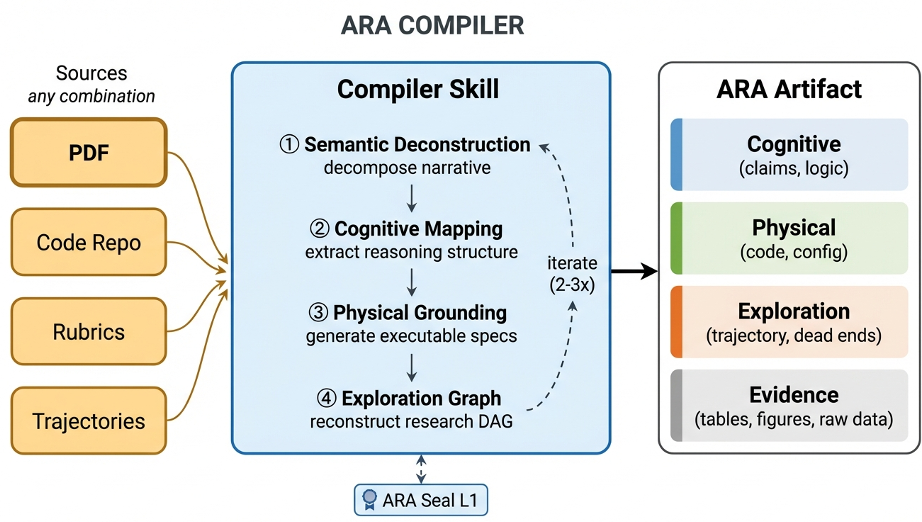 Figure 2: The ARA Compiler can retrospectively ingest legacy PDFs and codebases to generate these structured artifacts.
Experiments: Performance in the Agent Era
The researchers tested ARA against standard PDF+Repo setups using PaperBench and RE-Bench.
- Understanding: ARA accuracy reached 93.7% (vs 72.4% for PDF).
- Reproduction: ARA boosted success rate to 64.4%. Notably, for "Hard" tasks, ARA outperformed PDFs because it explicitly provided the hyperparameters that papers usually omit.
- Extension: When tasked with beating a reference score, agents with ARA traces reached successful moves significantly earlier. They "knew" what not to try because the artifact preserved prior failures.
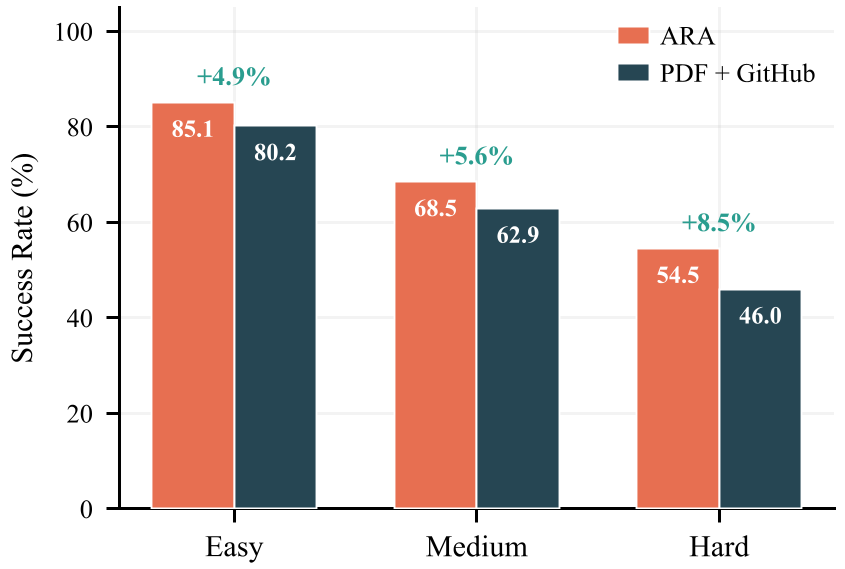 Table 1: Reproduction gap across different difficulty levels. ARA shows the strongest advantage in "Hard" subtasks.
Critical Insight: Failure is a First-Class Citizen
The most profound takeaway is that negative knowledge is high-value signal. Current frontier AI models spend over 90% of their compute cost on failures. By turning these failures into machine-readable "dead end" nodes, we stop the next generation of researchers (and agents) from repeating the same mistakes.
Summary & Outlook
The ARA protocol suggests a future where "publishing" is a git push of an executable epistemic graph. Reviewers (both human and AI) will use a Three-Stage Review Pipeline to verify structural integrity and execution before a human ever has to read the "story." While currently limited to ML research, this framework sets the stage for a scientific commons that scales at the speed of compute, not the speed of human prose.