
Facebook as a Digital Lab: Identity Crisis and the Illusion of Privacy
Late adolescent identity definition and intimate disclosure on Facebook
This study investigates the relationship between late adolescent psychosocial development and intimate self-disclosure on Facebook. Using a mixed-methods approach (focus groups, surveys, and content analysis), the research explores how identity statuses—specifically "Moratorium" and "Achievement"—influence the sharing of highly personal information on social media.
TL;DR
Is oversharing on social media a temporary phase of teenage rebellion, or a fundamental shift in how we define the "self"? This study analyzes college students' Facebook behaviors through the lens of developmental psychology. It reveals that the platform has become a "Digital Moratorium"—a safe (yet dangerously public) space where young adults experiment with their identities, often ignoring the long-term risks of their intimate disclosures.
Background: The Adolescent Liminal State
Adolescence is defined as a period of "storm and stress," a liminal state where individuals are neither children nor adults. Traditionally, this identity negotiation happened in private or small peer groups. However, the rise of Facebook shifted these "performances of the self" into the public eye. The authors position this work as a bridge between Erikson’s Psychosocial Theory and Computer-Mediated Communication (CMC), asking why late adolescents divulge "vaults" of personal information in such public forums.
The Core Dilemma: Identity Status vs. Digital Disclosure
The researchers utilized James Marcia’s four identity statuses to categorize participants:
- Diffusion: No commitment, no crisis.
- Foreclosure: Commitment without exploration (adopting parents' values).
- Moratorium: In the midst of identity crisis; active exploration.
- Achievement: Resolved crisis; stable commitments.
The hypothesis was that those in Moratorium—those actively struggling to find themselves—would disclose more as a means of seeking validation.
Methodology: Peeking Behind the Privacy Settings
The study employed a rigorous dual-phase approach:
- Phase 1: Focus groups to identify "lingo" (e.g., "chillaxing," "detagging") and attitudes toward employers viewing their profiles.
- Phase 2: Professional coding of actual Facebook walls and profile changes over a month, mapped against the EOMEIS-2 (Extended Objective Measure of Ego Identity Status) survey.
 The study mapped interpersonal and ideological dimensions to these four quadrants.
Key Findings: The Culture of Disclosure
The results challenged the initial hypothesis in a fascinating way. While they expected "Moratorium" students to be the most "disclosive," the data showed that all groups shared intimately.
- The Diffusion Overlap: Participants in "Identity Diffusion" actually showed the highest mean of intimacy mentions (9.14 in interpersonal identity). This suggests that those with the least committed sense of self may use the platform most haphazardly.
- Emotional Venting: 87% of intimacy mentions were "emotional aspects of self." Facebook isn't just for "checking in" at locations; it's a primary outlet for processing internal emotional states.
- The Buffer Effect: Users felt "simultaneously linked to and buffered from" one another. The screen acts as a shield that paradoxically makes people feel safe enough to reveal secrets they wouldn't share face-to-face.
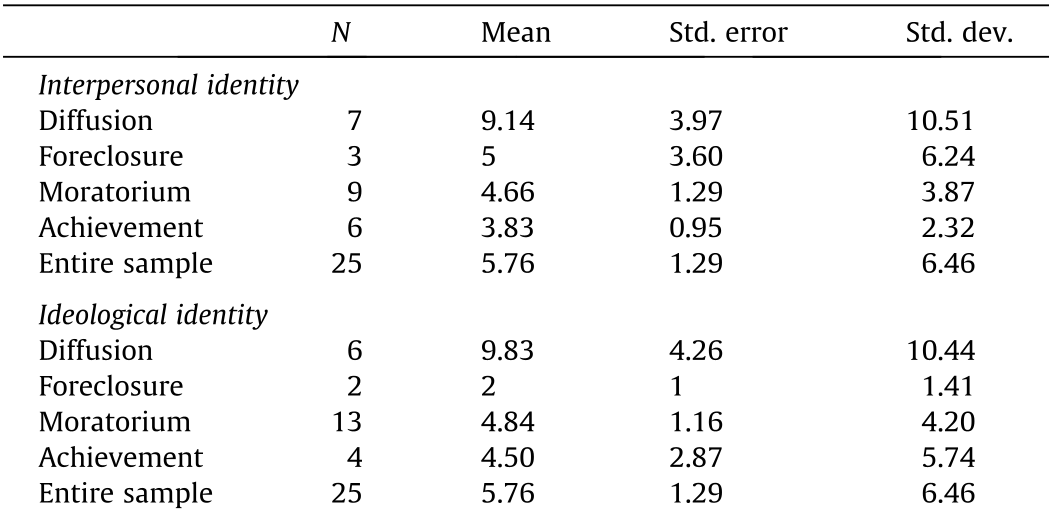 Statistical breakdown showing higher disclosure rates in Diffusion and Moratorium statuses compared to Achievement.
Critical Insight: The "Pseudo-Intimacy" of Social Networks
The study concludes that Facebook has facilitated an extended adolescence. Because the digital world offers infinite "playful" versions of the self, the commitment to a single adult identity is being delayed.
The authors warn that while students see Facebook as a "creative environment" where they shouldn't be bothered by "grown-ups," the persistence of data creates a generational clash. The "pseudo-intimacy" shared with 500 "friends" (most of whom are mere acquaintances) creates a high-stakes record of a developmental phase that was historically ephemeral.
Conclusion & Future Outlook
This work serves as a foundational reminder for social architecture designers. If social networks are the new institutions of identity formation, they must account for the "nuanced conventions" of human relationships rather than forcing a binary "Friend/Not Friend" logic.
For researchers, the next frontier is understanding how these behaviors have evolved in the age of ephemeral media (like Snapchat) or algorithmic curation (like TikTok), which may either further complicate or finally solve the adolescent's need for a private "Moratorium" space.