
[LatentAudit] Real-Time White-Box Faithfulness Monitoring for RAG with Verifiable Deployment
LatentAudit: Real-Time White-Box Faithfulness Monitoring for Retrieval-Augmented Generation with Verifiable Deployment
LatentAudit is a real-time white-box faithfulness monitor for Retrieval-Augmented Generation that reads mid-to-late residual-stream activations from an open-weight LLM and scores answer-evidence alignment with a Mahalanobis-distance rule. Instead of using an auxiliary judge model, it pools salient answer-token states, aligns them to a document embedding with a lightweight affine projector, and flags risky generations during inference. On PubMedQA with Llama-3-8B, it reaches 0.942 AUROC with only 0.77 ms overhead, while also supporting Groth16-based public verification.
Executive Summary
TL;DR
RAG is often marketed as a hallucination fix, but in deployment the real question is narrower and harsher: is this particular answer actually supported by the retrieved evidence right now? LatentAudit argues that you do not need a second judge model to answer that question. Instead, the generator’s own mid-to-late residual-stream activations already carry a usable faithfulness signal, and a simple Mahalanobis distance between pooled answer states and evidence representations is enough to detect unsupported generations in real time.
The empirical result is strong: on PubMedQA with Llama-3-8B, LatentAudit achieves 0.942 AUROC with only 0.77 ms extra latency, coming surprisingly close to GPT-4o judging (0.948 AUROC) while being roughly four orders of magnitude faster. Even more interesting, the same quadratic decision rule can be quantized and verified in zero knowledge, making it one of the few hallucination-monitoring methods that is both practically deployable and cryptographically auditable.
Background Positioning
This is not just another leaderboard paper. Its real contribution is conceptual:
- It reframes RAG faithfulness checking as a white-box geometric monitoring problem.
- It converts a finding from mechanistic interpretability into a production-time systems primitive.
- It chooses a detector simple enough to support zkML-style verification, avoiding the impossible cost of proving a full transformer forward pass.
In the current literature, that combination is unusual and strategically important.
Problem & Motivation
The real deployment gap in RAG
RAG helps because it conditions generation on external evidence. But that only changes the probability of hallucination; it does not eliminate it. A production system still needs a serving-time monitor that decides whether the generated answer is:
- genuinely supported by the retrieved passages, or
- merely fluent, topical, and wrong.
That distinction matters most in high-stakes domains:
- clinical QA,
- legal analysis,
- compliance systems,
- financial reporting.
In such settings, a false answer that “sounds aligned” is often worse than an abstention.
Why prior work is unsatisfying
The dominant families of faithfulness verification each carry a structural weakness:
-
LLM-as-a-Judge
- Usually accurate.
- But adds seconds of latency and often external API dependence.
- Leaks question, context, and answer to another model.
-
Self-consistency / repeated sampling
- Can detect instability.
- But is extremely expensive because it requires many generations.
- It checks agreement, not necessarily evidence support.
-
Text-side probes such as perplexity
- Cheap.
- But they mostly capture fluency or model confidence.
- Hallucinations are often confident.
-
Learned internal-state detectors
- Closer to the right signal.
- But often train a dedicated classifier, making the monitor heavier and more calibration-sensitive.
LatentAudit’s thesis is that these methods are asking the model to justify itself after generation in the wrong space: text. The paper instead asks whether the answer is already encoded as “grounded” or “drifting” in the model’s latent geometry before output projection.
The authors’ core intuition
The crucial intuition is elegant:
If the answer is truly grounded in the retrieved evidence, then the answer tokens and evidence should occupy a nearby region in the generator’s residual-stream representation. If the answer is unsupported, the model must drift away from that evidence-conditioned manifold.
This is a stronger idea than “faithful answers are semantically similar to documents.” Unsupported answers can still have high lexical overlap or high cosine similarity. What separates them is often the direction of deviation in anisotropic latent space, especially along low-variance directions. That is exactly where Mahalanobis distance becomes meaningful.
Methodology - The Core
1. What LatentAudit actually computes
LatentAudit has two layers:
-
A latent faithfulness monitor
- Runs during generation.
- Produces a binary faithful/risky decision.
-
An optional verification layer
- Converts the final quadratic test into a zero-knowledge proof.
- Enables public verification without exposing activations or model weights.
The monitor itself is surprisingly small.
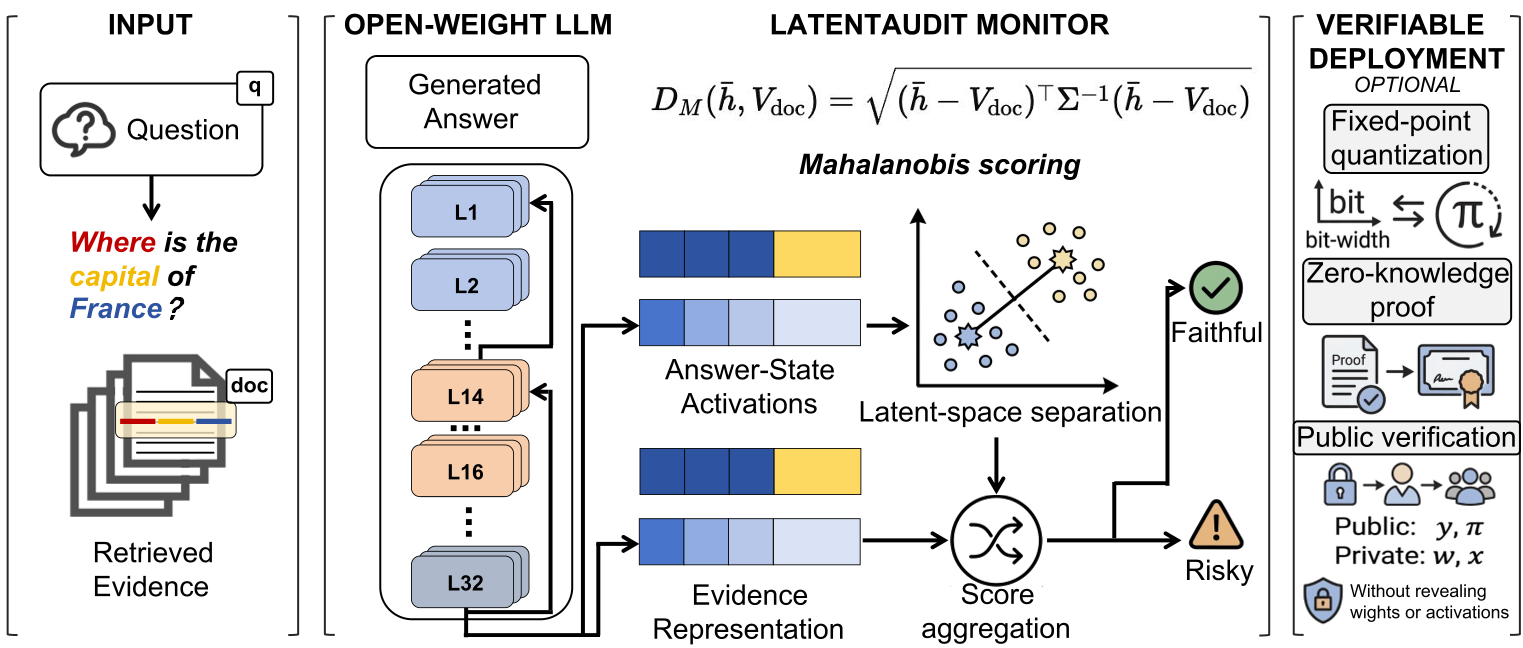
Step A: extract answer-state activations
Let the generator be an open-weight transformer. During decoding, each answer token has hidden states across layers. Instead of reading the final logits, LatentAudit reads mid-to-late residual-stream states close to the unembedding head.
Formally, the residual update is:

The paper follows prior mechanistic-interpretability work suggesting that factual content becomes most separable in mid-to-late layers, before the final collapse into vocabulary logits.
Step B: pool the answer into one stable latent vector
Single-token activations are noisy. The paper therefore does not score the last token only. Instead, it:
- selects top-k salient answer tokens using TF-IDF salience,
- takes their hidden states,
- mean-pools them into one vector:
Vact.
This is important. The paper’s ablations show:
- last-token evaluation: 0.884 AUROC
- max-pooling: 0.912 AUROC
- top-8 mean-pooling: 0.942 AUROC
So the paper’s signal is not just “look at the last token harder.” The centroid of salient answer states is the actual robust statistic.
Step C: build an evidence representation in the same space
The retrieved context is embedded with a frozen dense retriever, specifically all-MiniLM-L6-v2, then projected into the residual-stream dimension through a lightweight affine map Wproj.
This is a subtle but very good design choice.
Why not train a larger neural projector?
- Because the calibration split is tiny: only 200 samples.
- A non-linear projector can easily become a hidden judge model.
- The paper shows that a 2-layer MLP indeed overfits: Train AUROC 0.991 vs Eval AUROC 0.945.
By contrast, ridge regression gives:
- 0.942 Eval AUROC
- with only 200 calibration samples
That result strongly supports the authors’ claim that the useful signal comes from geometry, not from classifier capacity.
Step D: compare answer and evidence with Mahalanobis distance
This is the central test:

The covariance inverse Σ^-1 is estimated on a small calibration set. A threshold τ* is chosen by maximizing Youden’s J.
Why Mahalanobis instead of cosine or Euclidean?
Because LLM hidden states are anisotropic. In anisotropic spaces:
- some directions vary a lot and are uninformative,
- some directions are tight and semantically sharp.
A faithful answer should not merely be “close on average”; it should avoid drifting along those low-variance directions that grounded generations rarely traverse. Mahalanobis distance explicitly amplifies those deviations.
This is the paper’s main technical insight: faithfulness is not just semantic similarity; it is covariance-aware geometric conformity.
2. Where the signal lives in the network
The paper reports that the strongest discrimination emerges in mid-to-late layers, such as layers 14–16 for Llama-3-8B. This matches a plausible processing story:
- early layers: syntax and local token mixing,
- middle layers: semantic integration and evidence fusion,
- final layers: collapse toward output-space decisions.
If you audit too early, the evidence-conditioned semantics have not stabilized. If you audit too late, the geometry may be partially compressed by the unembedding bottleneck.
The paper’s diagnostic figures support this layer-localization claim.
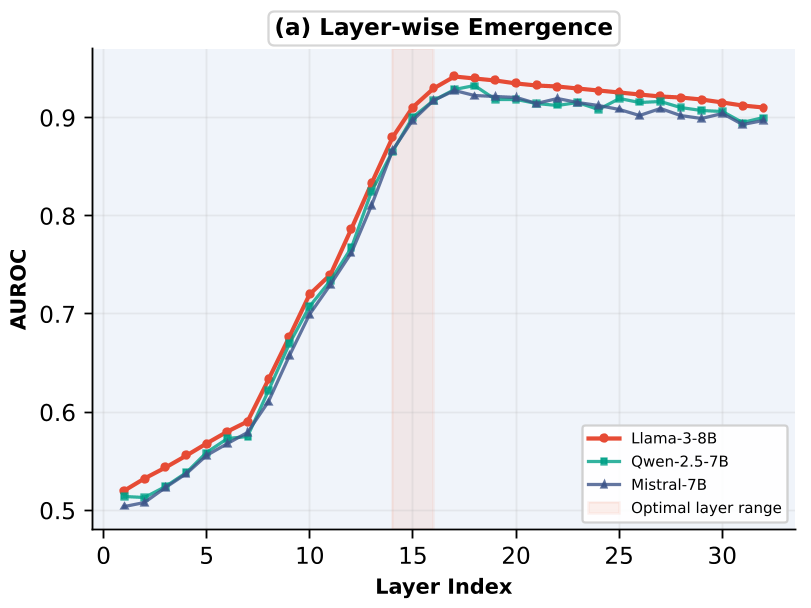
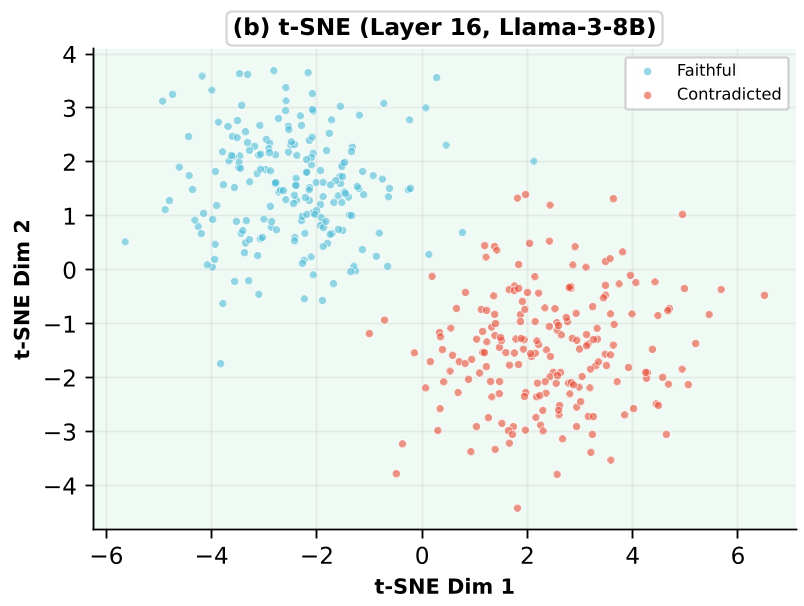
This is one of the most convincing parts of the paper, because it anchors the method in an interpretable internal phenomenon rather than a purely empirical detector.
3. Why the zero-knowledge angle is actually plausible here
Most zkML proposals struggle because proving a full transformer inference is prohibitively expensive. LatentAudit avoids that trap by proving only the final quadratic inequality:
- compute quantized difference vector,
- apply quantized inverse covariance,
- check if the resulting scalar is below threshold.
That is dramatically cheaper than proving attention and MLP blocks.
The paper quantizes the decision rule and shows:
- k = 16 bits preserves 99.8% of FP16 AUROC,
- proof time around 11.9 ms,
- gas around 580K.
This is not free, but it is finally in the realm of deployable infrastructure.
Experiments & Results
1. Main benchmark: quality versus latency
The main headline result compares LatentAudit against GPT-4o Judge, SelfCheckGPT, INSIDE, SAPLMA, and Min-Perplexity.
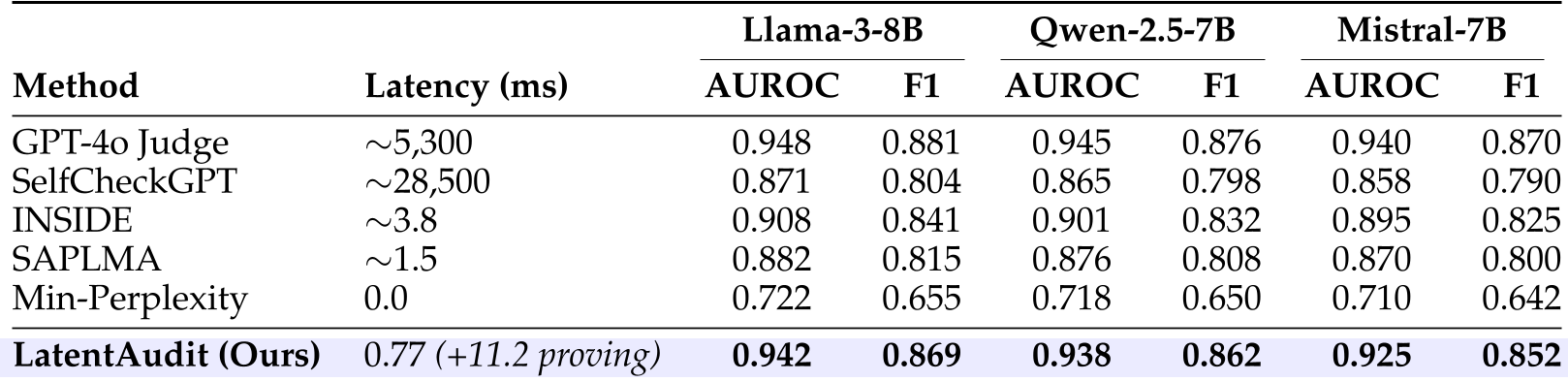
The key numbers on Llama-3-8B are:
- GPT-4o Judge: 0.948 AUROC, 0.881 F1, ~5300 ms
- SelfCheckGPT: 0.871 AUROC, 0.804 F1, ~28500 ms
- INSIDE: 0.908 AUROC, 0.841 F1, ~3.8 ms
- SAPLMA: 0.882 AUROC, 0.815 F1, ~1.5 ms
- LatentAudit: 0.942 AUROC, 0.869 F1, 0.77 ms
This is the real value proposition:
- nearly GPT-4o-level detection quality,
- orders-of-magnitude lower latency,
- no external judge,
- no extra generative pass.
The paper correctly emphasizes that the relevant comparison is not only AUROC, but AUROC per millisecond and AUROC per deployment dollar.
2. Cross-model and cross-domain robustness
One concern with internal-state methods is that they overfit a specific architecture. The paper addresses that by evaluating across:
- Llama-2
- Llama-3
- Qwen-2.5
- Qwen-3
- Mistral
and across three datasets:
- PubMedQA
- TriviaQA
- HotpotQA
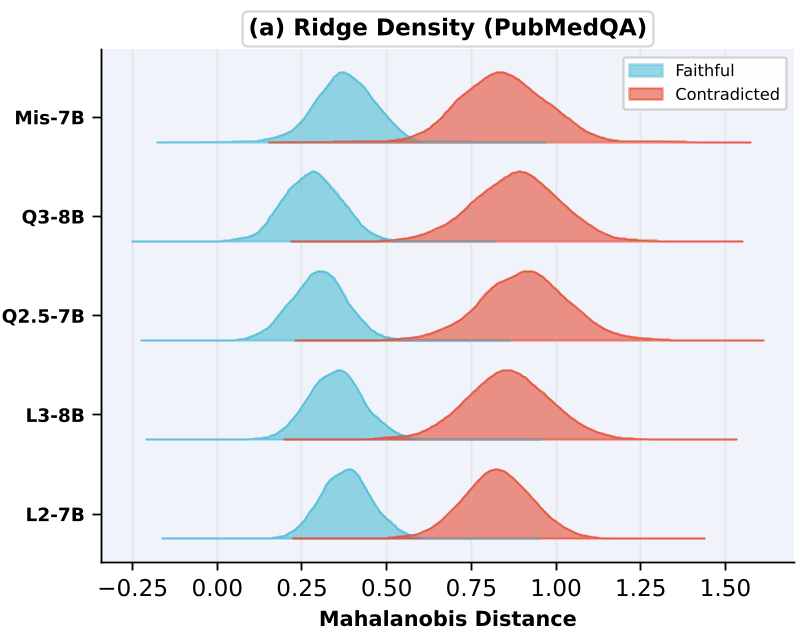
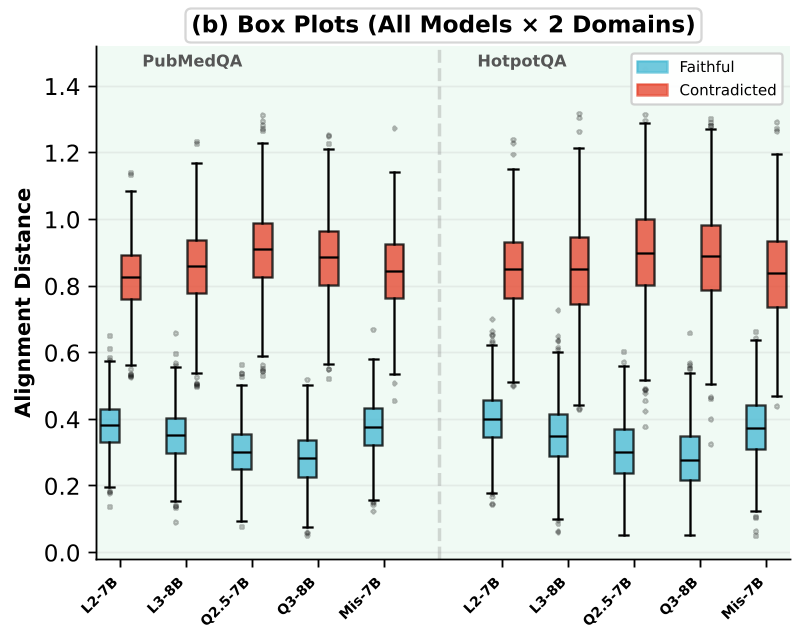
The AUROC ranges are stable:
- PubMedQA: 0.925–0.948
- TriviaQA: 0.915–0.940
- HotpotQA: 0.905–0.928
That pattern is meaningful:
- Performance is best on single-hop biomedical QA.
- It degrades on multi-hop HotpotQA, which is exactly where grounding is more distributed and answer spans are often shorter.
- But it does not collapse, which suggests the signal is real rather than brittle.
The distribution-level diagnostics also show faithful and contradicted cases remain well separated across model families.
3. Realism check: retrieval failures beyond contradiction
A strong paper on RAG faithfulness should not evaluate only obvious contradictions. LatentAudit does better here by constructing a four-way stress test:
- faithful
- contradicted
- retrieval miss
- partial support
This matters because real retrieval systems fail in exactly these ways. The hardest negative is not contradiction; it is partial support, where the evidence is topically related but incomplete.
The paper reports:
- PubMedQA: 0.9566–0.9815 AUROC
- HotpotQA: 0.9142–0.9315 AUROC
The pairwise breakdown is especially informative:
- Faithful vs contradicted: nearly perfect
- Faithful vs retrieval miss: also very strong
- Faithful vs partial support: hardest
That failure pattern is exactly what one would expect from a geometry-based monitor. Partial-support examples occupy a region near the evidence manifold but not fully inside it. They are not absurdly wrong; they are under-supported. In deployment, those are often the most dangerous cases.
4. Calibration efficiency
The paper repeatedly uses only a 10% calibration split and even shows strong behavior with fewer samples:
- 50 samples: 0.912 Eval AUROC
- 100 samples: 0.931
- 200 samples: 0.942
- 500+ samples: plateau around 0.943
This is an underrated strength. It means the method is not data-hungry, which is crucial if teams want to calibrate a monitor quickly for a new domain.
5. Verifiable deployment trade-offs
The quantization study is refreshingly concrete:
- 8-bit: too lossy, only 82.4% AUROC match
- 16-bit: sweet spot, 99.8% AUROC match, 11.9 ms proof
- 32-bit: lossless but too expensive
That result supports the cryptographic story. The method is verifiable not because zkML suddenly got cheap, but because the underlying ML decision rule is exceptionally small.
Critical Analysis & Conclusion
What this paper genuinely contributes
The paper’s strongest contribution is not merely that it gets 0.942 AUROC. It is that it identifies a deployment-friendly abstraction:
- read hidden states already produced by the generator,
- compress them into a stable answer centroid,
- compare against evidence in covariance-aware latent space,
- make a decision with a calibrated quadratic rule.
That is much more elegant than stacking another learned model on top of generation.
In other words, the paper advances a useful design principle:
If a safety or trustworthiness property is already encoded in the model’s internal geometry, the best monitor may be a lightweight statistic rather than a second neural network.
Why it works, in deeper terms
The method works because it exploits a structural asymmetry between faithful and unfaithful generations.
- A faithful answer is constrained by evidence.
- An unsupported answer is constrained only by linguistic plausibility and prior knowledge.
Both can be fluent. Both can be topically similar. But only the faithful one remains in the local covariance structure induced by retrieved evidence. Mahalanobis distance is the right instrument because it penalizes precisely the “unlikely but subtle” deviations that cosine similarity washes out.
That is the core scientific claim, and the experiments support it.
Limitations
The paper is careful about its caveats, and they are real:
-
Open weights required
- The method needs hidden states.
- It cannot directly audit black-box APIs like GPT-4.
-
It audits faithfulness to retrieved evidence, not truth
- If the corpus is poisoned or retrieval is malicious, LatentAudit can certify a faithfully wrong answer.
-
Partial-support remains difficult
- This is the main realistic failure mode, especially in multi-hop settings.
-
Larger frontier models are untested
- Results are on 7B–8B families.
- It is plausible that the geometry improves at larger scale, but not yet demonstrated.
-
The ZK layer verifies computation, not epistemic correctness
- It proves the audit was computed honestly.
- It does not prove the monitor is right.
Future Work
Several directions seem especially promising:
-
Richer latent features
- Not just pooled residual vectors, but selected attention heads or MLP subspaces.
-
Token-level or span-level auditing
- Useful for localizing which part of an answer drifted from evidence.
-
Intervention instead of detection
- If latent drift is observable, perhaps it can be corrected before decoding completes.
-
Multimodal extension
- The same geometry idea may transfer to vision-language or audio-grounded generation.
-
Black-box approximations
- A surrogate open-weight model might audit outputs from proprietary systems.
Final Takeaway
LatentAudit is one of the more practically interesting RAG-faithfulness papers because it sits at the intersection of three fields that rarely align cleanly:
- mechanistic interpretability,
- low-latency model monitoring,
- verifiable ML deployment.
Its central lesson is simple but powerful: the generator’s own residual stream already contains a faithfulness signal strong enough for real-time auditing. Once that is true, a lot of complexity disappears. You no longer need a second judge, repeated sampling, or a heavy learned detector. You need a good latent representation, a well-calibrated geometric metric, and careful engineering.
That is why this paper matters beyond its benchmark numbers.