
Beyond the Screen: How Age and Gender Shape Children's Programming Preferences
Latent Class Modeling of Children’s Preference Profiles on Tangible and Graphical Robot Programming
This study investigates children's preferences between Tangible User Interfaces (TUI) and Graphical User Interfaces (GUI) for robot programming using Latent Class Analysis (LCA). By analyzing 148 children (ages 6–13), the research identifies distinct preference profiles influenced by age and gender, offering a more nuanced view than traditional simple statistics.
TL;DR
Is a physical block better than a mouse-click for teaching a child to code? While the industry has long debated the "Tangible vs. Graphical" (TUI vs. GUI) divide, this study moves past simple "which is better" questions. Using Latent Class Analysis (LCA), the researchers discovered that while physical blocks (TUIs) are universally loved, the appeal of screen-based programming (GUIs) is highly fragmented by a child's age and gender.
The "Controversy" of Choice
In the world of Human-Computer Interaction (HCI), researchers have spent decades trying to prove if physical "manipulatives" provide a better learning experience than software. However, the results have been messy—some say TUIs are more fun, others say GUIs are more efficient.
The authors of this paper argue that the problem isn't the interfaces, but the statistics. By using simple averages, we hide the fact that a 6-year-old girl might perceive a robot kit completely differently than a 12-year-old boy.
Methodology: The PROTEAS Experiment
To solve this, the researchers used two "isomorphic" (identical in function) tools:
- T-ProRob: A tangible system using physical Plexiglas cubes to command a Lego NXT robot.
- V-ProRob: A graphical equivalent using drag-and-drop on a computer screen.
They didn't just ask "which do you like?" They measured eight distinct factors, including Attractiveness, Collaboration, and Explainability, then applied Latent Class Analysis to find hidden groups (latent classes) within the data.
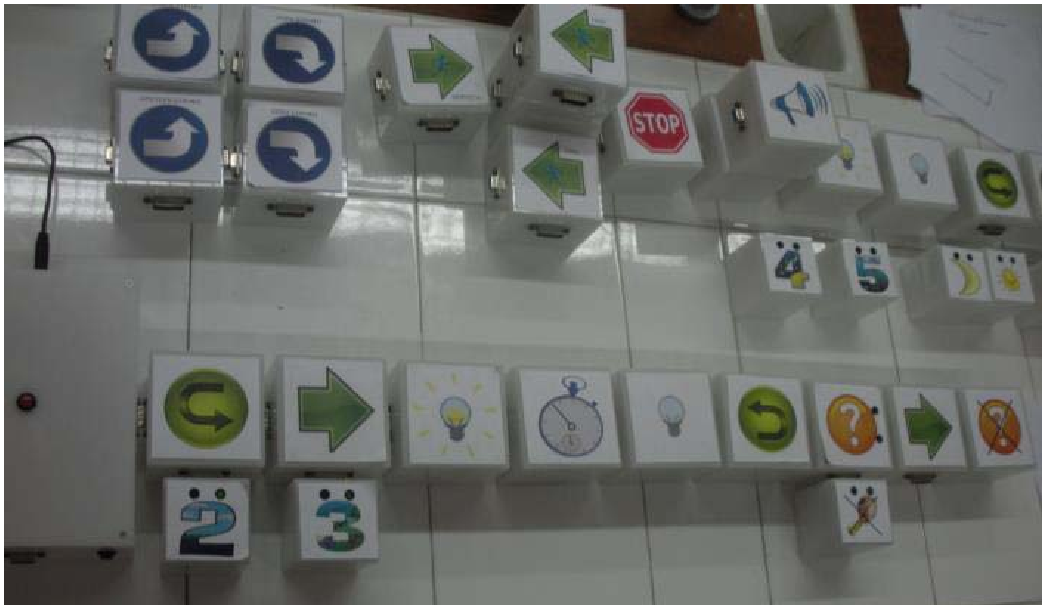 Fig 1 & 2: The Physical T-ProRob (top) and the Graphical V-ProRob (bottom) used in the study.
Key Insights: The Three Profiles
The LCA revealed a fascinating trisection in how children relate to digital tools:
- The Pro-Tech Enthusiasts (Cluster 2 - Mostly Older Boys): High preference for both GUI and TUI. These children are comfortable with screens and see the GUI as powerful and convenient.
- The Tangible-Leaning Socialites (Cluster 1 - Mostly Older Girls): High preference for TUIs, but a noticeably lower preference for GUIs. The study suggests girls favor the "rich social interaction" and collaborative nature of physical blocks over solitary screen time.
- The Tangible Beginners (Cluster 3 - Younger Children): Strong preference for TUIs and the lowest preference for GUIs. For these children, the "physicality" of the code makes it understandable before they have mastered computer literacy.
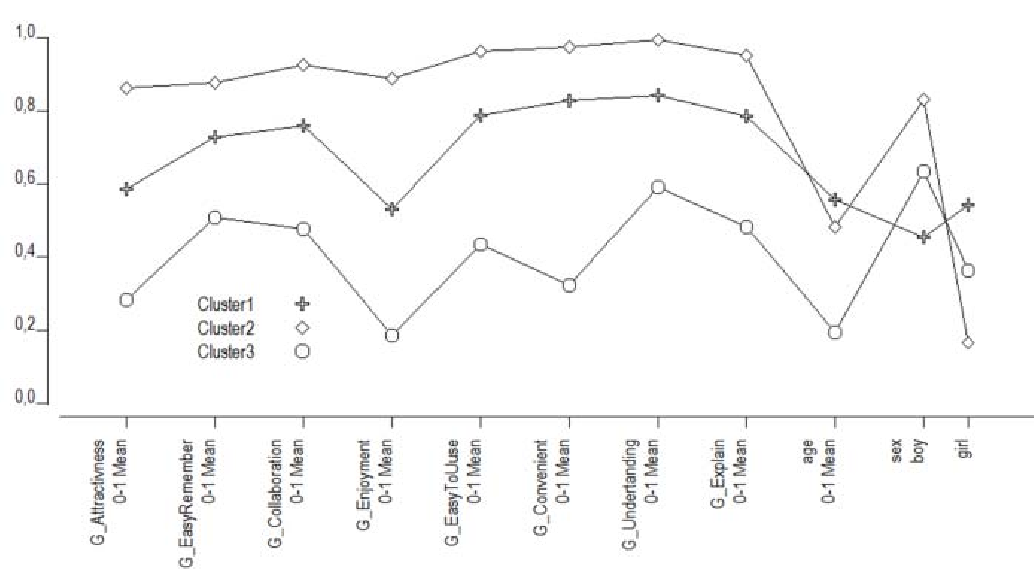 Fig 3: The Latent Class profiles showing consistent approval for TUI across all clusters, while GUI scores (the first 8 items) vary significantly.
Why This Matters: Breaking Stereotypes
The most profound takeaway is the "Age Threshold." Tangible interfaces effectively lower the barrier to entry for programming.
More importantly, the study highlights a critical window: as girls grow older, their attitude toward screen-based technology often becomes less positive due to cultural stereotypes. Because TUIs are perceived as "games" or "puzzles" rather than "intimidating computer work," they serve as a vital bridge to keep young girls engaged in STEM before those negative stereotypes set in.
Conclusion
The debate shouldn't be "TUI vs. GUI." Instead, educators should realize that Tangibles are the universal starting point. While older boys might adapt quickly to screens, TUIs remain the most inclusive and attractive entry point for younger children and girls, ensuring that the "logic of programming" is learned long before the "complexity of the interface" becomes a barrier.
Academic Takeaway: The use of Latent Class Analysis (LCA) provides a robust framework for HCI research, moving beyond the "Average User" myth to understand the diverse psychological profiles of learners.