
TIHAD: Decoding How Item Similarity and Social Homophily Drive Viral Diffusion
Latent Factors Meet Homophily in Diffusion Modelling
The paper introduces TIHAD (Topic Interaction and Homophily Aware Diffusion), a diffusion model for multiple items that integrates latent factors for item-item interaction and explicit network homophily. Unlike single-item models, TIHAD leverages topic-level similarities to capture how the adoption of one item (e.g., a book) triggers the adoption of another (e.g., its movie adaptation).
TL;DR
Why does watching a movie often follow reading the book? Most social diffusion models can't answer this because they treat every item as an independent "pathogen." This paper introduces TIHAD, a model that treats diffusion as a continuous interaction in latent space. By integrating item-item similarity and user homophily, it achieves a massive 150% boost in predicting hashtag adoptions on Twitter.
The "Independent Contagion" Fallacy
In classical diffusion research, if you are modeling the spread of "iPhone 15," you ignore the fact that your neighbors just bought an "iPad." In reality, social influence is cross-pollinating. Current SOTA models fail because:
- They assume items are independent.
- They treat social links as static weights, ignoring that people connect because they are similar (Homophily).
The authors argue that your interest in an item is a mix of your innate latent preference and the sum of your neighbors' recent activities—even if those activities don't involve the exact same item.
Methodology: Latent Factors Meet Social Dynamics
The core of TIHAD (Topic Interaction and Homophily Aware Diffusion) is its redefined social influence formula. It breaks down the adoption probability into several components:
- Personal Interest: The dot product of user vector and item vector .
- Item Interaction: Influence is not just from adopters of item , but from adopters of similar items , weighted by the cosine similarity .
- Homophily-Gated Influence: The strength of influence from neighbor to user is scaled by a parameter and their latent similarity .
 The core estimation formula combining latent preference, item interaction, and homophily.
The Effective Item Set
To keep the model computationally tractable, the authors introduce the "Effective Item Set" (). Instead of looking at a neighbor's entire history, they only look at the most recently adopted items, recognizing that social media users have limited attention spans and are most influenced by recent trends.
Experimental Insights
The authors tested TIHAD on both synthetic data and a real-world Twitter dataset from a Valentine's Day hashtag event in Singapore.
1. The Homophily Boost
Synthetic experiments proved a direct correlation: as the homophily level increases, the cascade size expands. This suggests that "birds of a feather" don't just flock together—they amplify each other's signals, allowing information to bypass the "resistance" found in heterogeneous networks.
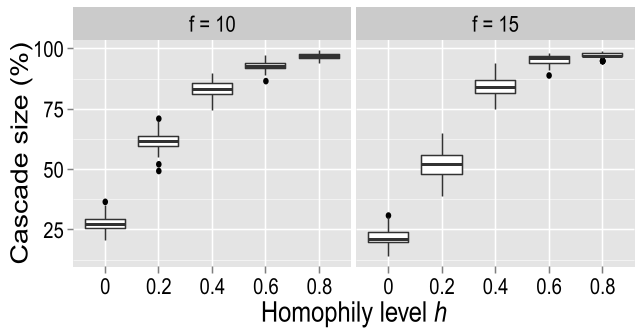 (a) Impact of homophily on cascade size across different latent factor dimensions ().
2. SOTA Performance on Real Data
On Twitter hashtag prediction, TIHAD's ability to "see" topical relationships allowed it to drastically outperform the LTLF (Linear Threshold with Latent Factors) model. In the F1@k metric (precision at top-k predictions), TIHAD showed a 1.5x performance gain.
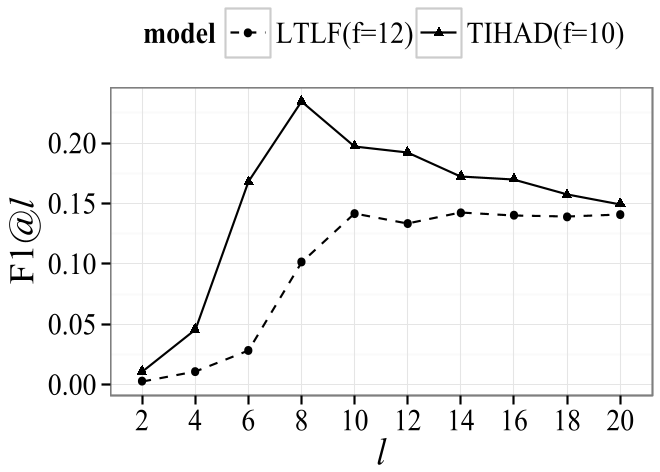 Comparison of RMSE and F1 scores showing TIHAD's predictive superiority.
Critical Analysis & Takeaways
Why it works: TIHAD bridges the gap between Collaborative Filtering (which is good at item similarity) and Social Network Analysis (which is good at influence topology). By making link weight a function of latent user similarity, the model learns the "relatability" of a social connection rather than assuming all "follows" are equal.
Limitations: The problem formulation for parameter learning is non-convex. The authors currently use Projected Gradient Descent (PGD), which can get stuck in local optima. Furthermore, the homophily level is treated as a global constant, whereas in reality, homophily can vary wildly between sub-communities (e.g., political echo chambers vs. general hobby groups).
Future Outlook: This work paves the way for "Multi-entity Viral Marketing." If you are launching a product, TIHAD suggests you shouldn't just target social influencers—you should target the temporal windows where similar topics are already trending in your target user's local neighborhood.