
The Latent Space Revolution: From Verbal Tokens to Machine-Native Thinking
The Latent Space: Foundation, Evolution, Mechanism, Ability, and Outlook
This comprehensive survey introduces the "Latent Space" paradigm for language-based models, shifting computation from explicit token generation to a machine-native continuous substrate. It provides a unified taxonomy of Mechanisms (Architecture, Representation, Computation, Optimization) and Abilities (Reasoning, Planning, Perception, Memory, etc.), establishing latent space as a core system paradigm for next-generation AI.
TL;DR
Modern AI is moving beyond "talking to itself" in human tokens. This paper argues that the next leap in intelligence lies in Latent Space—a continuous, machine-native substrate where models reason, plan, and remember without the bottlenecks of natural language. By shifting search and deduction into high-dimensional manifolds, models achieve higher fidelity, better efficiency, and superior multimodal integration.
Background: The Limits of the "Verbal" BottleNeck
For years, we have evaluated AI through its Explicit Space (Verbal Space)—the strings of tokens it generates. However, this "token-centric" view is fundamentally flawed for high-level intelligence. Natural language is:
- Redundant: Most tokens serve grammar, not logic.
- Discrete: It forces a "quantization bottleneck" where nuanced internal states are lost.
- Sequential: It locks the model into slow, step-by-step decoding.
As the survey points out, "Latent Space" is not just a hidden layer; it is a Machine-Native Substrate that allows for Superposition Reasoning—the ability to explore multiple reasoning paths simultaneously in a single continuous vector.
Methodology: How Latent Space Works (The Mechanism)
The paper deconstructs the latent paradigm into four pillars:
1. Architecture: The Engine of Thought
We are seeing a shift from standard Transformers to:
- Recurrent Backbones: Like Huginn and Ouro, which reuse layers to "ponder" in depth.
- Auxiliary Models: Using JEPA-style architectures to provide perceptual anchors.
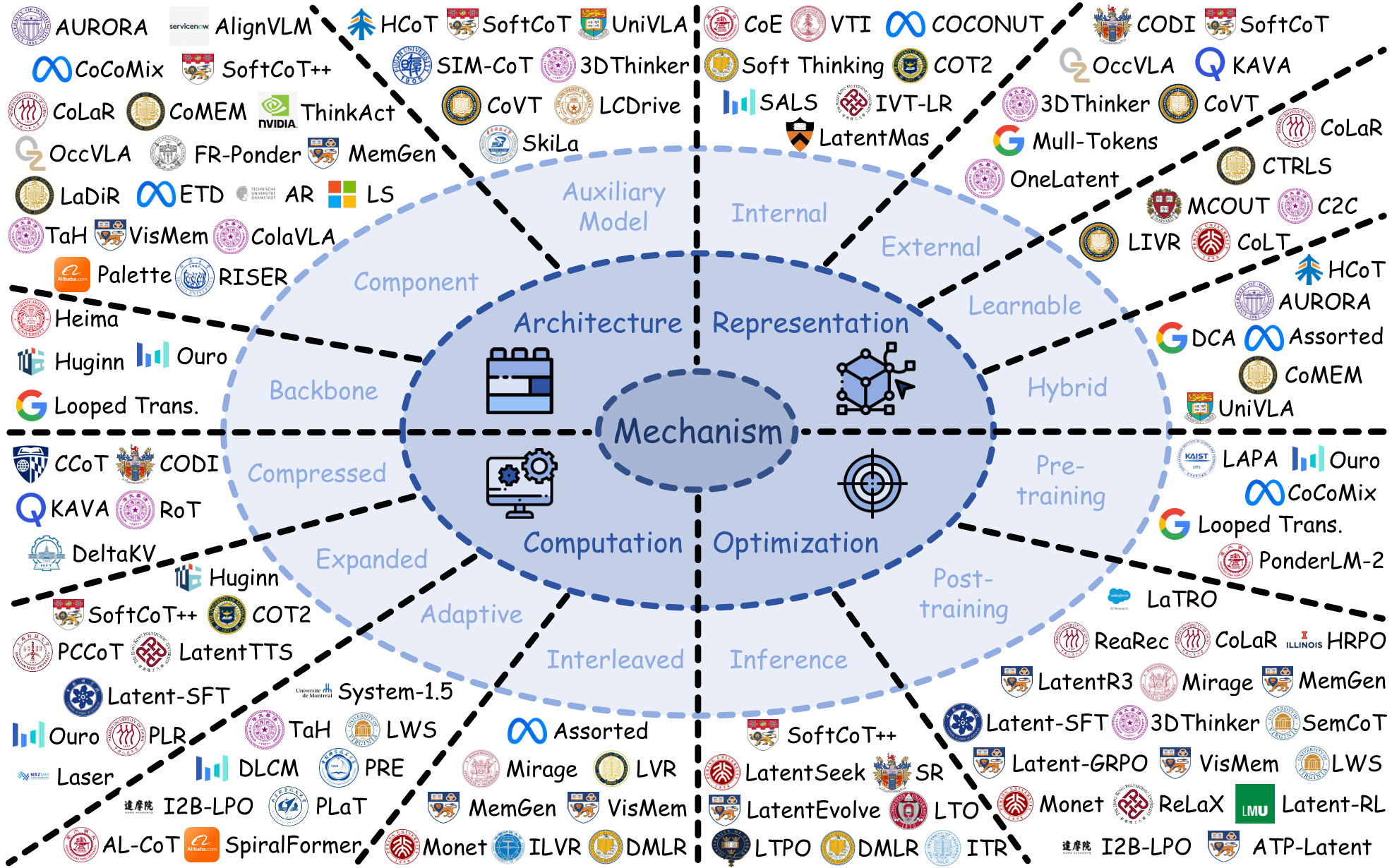
2. Computation: From Compressed to Adaptive
Computation in latent space isn't fixed. Adaptive Pondering allows models to spend more "latent cycles" on hard problems and "shortcut" easy ones. Interleaved Computation enables a hybrid flow where a model can switch between silent latent thinking and explicit verbal reporting.
3. Representation: Chain-of-Embedding (CoE)
Instead of a Chain-of-Thought (CoT), we now have Chain-of-Embedding. This preserves fine-grained uncertainty and multi-modal alignment that language simply cannot describe—such as the precise torque for a robotic arm or the 3D spatial layout of a room.
Empowering New Abilities
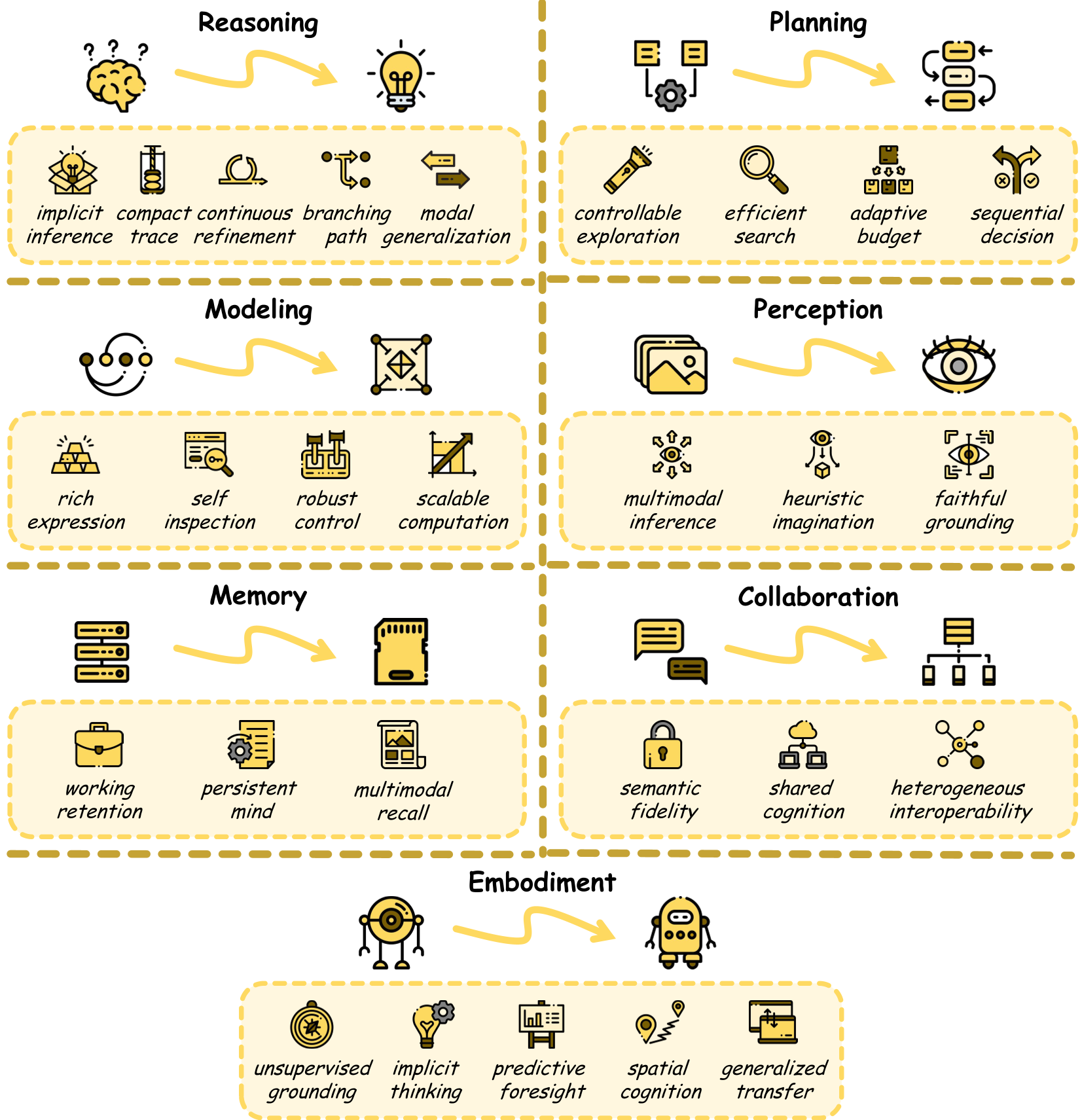
The survey identifies seven core abilities unlocked by this shift, but two stand out:
- Perception & Imagination: Latent space allows models to "sketch" internal visual thoughts. Paradigms like Latent Sketchpad enable models to simulate 3D environments internally before acting.
- Embodied Action: For robotics (VLA models), latent space solves the "correspondence problem." Actions are mapped into a body-agnostic latent space, allowing a model trained on human videos to control a four-legged robot zero-shot.
The Critical Analysis: The "Black Box" Problem
As an editor, I must highlight the "Double-Edged Sword" mentioned by the authors. While latent space is more powerful, it is less evaluable.
- Interpretability: If the model doesn't "speak" its reasoning, how do we audit it?
- Controllability: Intervening in a continuous manifold is harder than editing a prompt.
The paper calls for a new "Representation Engineering" (RepE) to make these hidden "thoughts" governable.
Final Takeaway: The Systems Paradigm
We are entering an era where Language is the Interface, but Latent is the Workspace. Future SOTA models will likely be judged not just by their parameter count, but by the "depth" and "flexibility" of their latent manifolds. This survey provides the first comprehensive map of this new territory.
For more details on the evolution of latent models, visit the Awesome-Latent-Space repository.