
LatentChem: Bridging the Continuity-Discretization Gap in Chemical Reasoning
LatentChem: From Textual CoT to Latent Thinking in Chemical Reasoning Haven
LatentChem is a novel chemical reasoning framework that introduces a continuous latent thinking interface for LLMs. By bypassing discrete textual Chain-of-Thought (CoT) and using a dynamic perception-reasoning loop, it achieves a 59.88% non-tie win rate on ChemCoTBench while reducing reasoning overhead by an average of 10.84x.
TL;DR
The paradigm of "thinking in text" is reaching its limit for scientific discovery. LatentChem breaks through this by decoupling chemical reasoning from natural language. By allowing an LLM to "think" in a continuous latent space through a sequence of "silent" thought vectors, it achieves superior performance in molecule optimization and reaction prediction while being 10.8 times faster than traditional Chain-of-Thought (CoT) models.
Problem: The Linguistic Bottleneck in Science
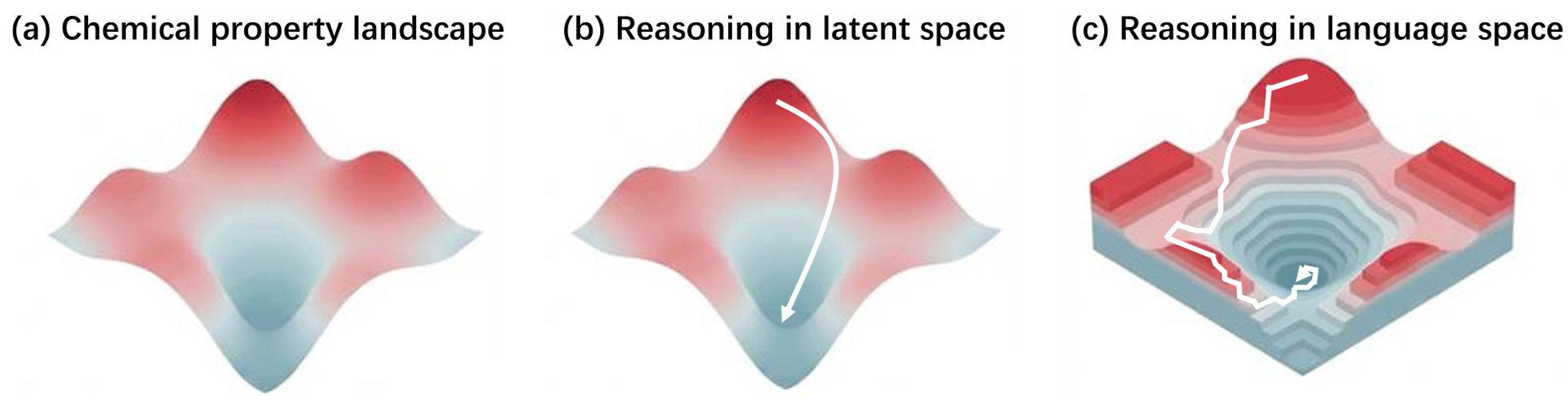
Current chemical LLMs force complex physicochemical intuitions into a sequence of discrete words. This creates what the authors call a "continuity-discretization gap."
Unlike a math problem that can be solved step-by-step with logic, chemistry involves navigating high-dimensional, continuous property manifolds. Forcing these "smooth" transitions into "staircase-like" discrete tokens (see Figure 1) causes two major issues:
- Hallucination: The model's textual plan often drifts away from the actual chemical structure.
- Inefficiency: Describing a single structural change (like adding a functional group) can take dozens of tokens, even though it is a single "move" in latent space.
Methodology: The Architecture of Latent Thinking
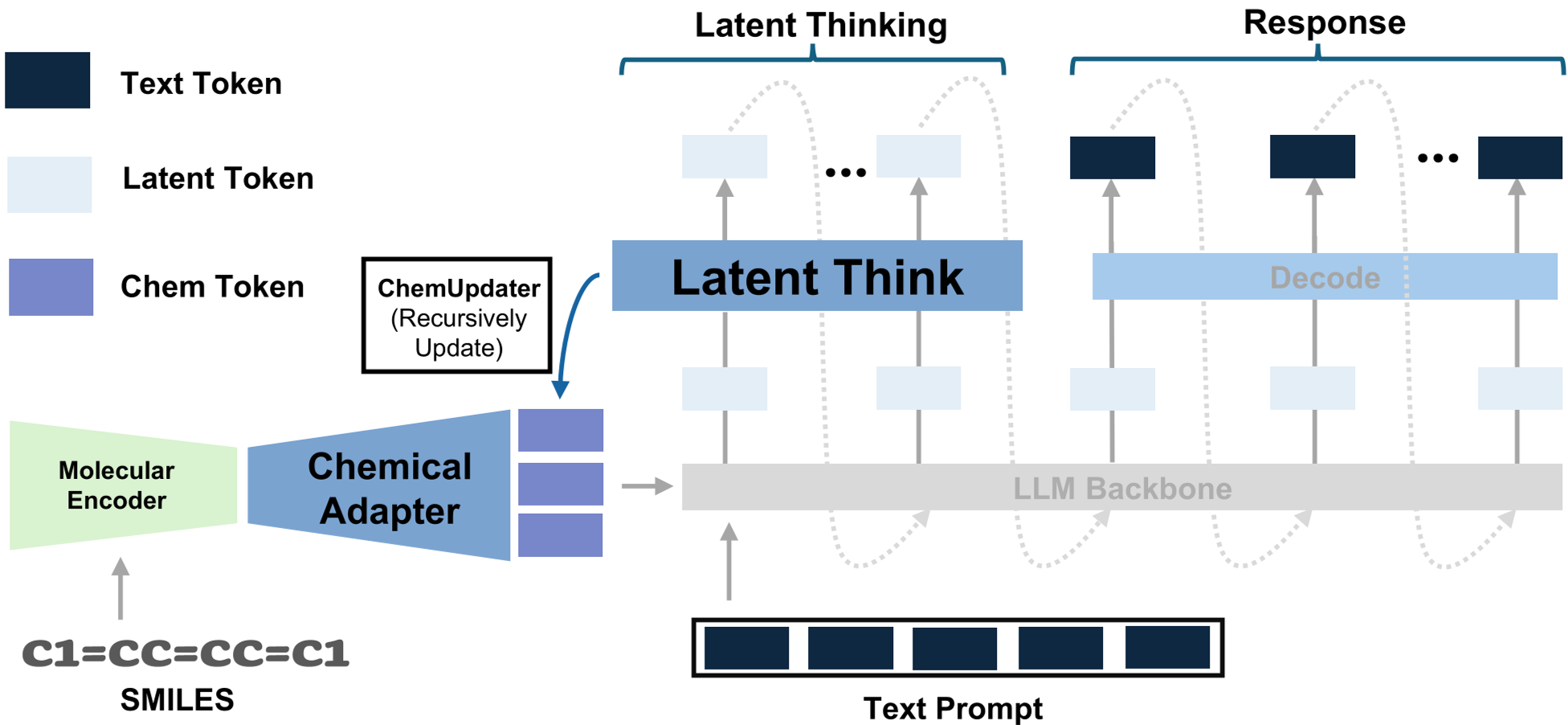
LatentChem introduces a dedicated "latent thinking" phase between perceiving a molecule and generating an answer. It consists of three pillars:
- ChemAdapter: Bridges the gap between 2D/3D molecular features (from SMI-TED encoder) and the LLM's latent space.
- Latent Projector: A residual network that feeds the LLM's hidden state back into the next input step without decoding it into a word.
- ChemUpdater (The Dynamic Loop): Unlike previous latent models that treat molecules as static, the ChemUpdater allows the model to "re-focus" on different sub-structures of the molecule as its internal "thought" evolves.
Spontaneous Internalization
One of the paper's most fascinating findings is the "Internalization" effect. When the model is trained with Reinforcement Learning (GRPO) and rewarded only for the correctness of the final answer, it spontaneously stops writing CoT. It learns that it is more efficient and accurate to solve the problem in its internal latent space and output only the final result.
Experiments: Superiority in Generative Tasks
LatentChem's performance shines in "open-ended" tasks like Molecule Optimization, where the model must navigate a manifold to find a molecule with better solubility or binding affinity.
- Success Rate: In GSK3-β binding optimization, LatentChem achieved an 82% success rate, crushing the 67% rate of explicit CoT baselines.
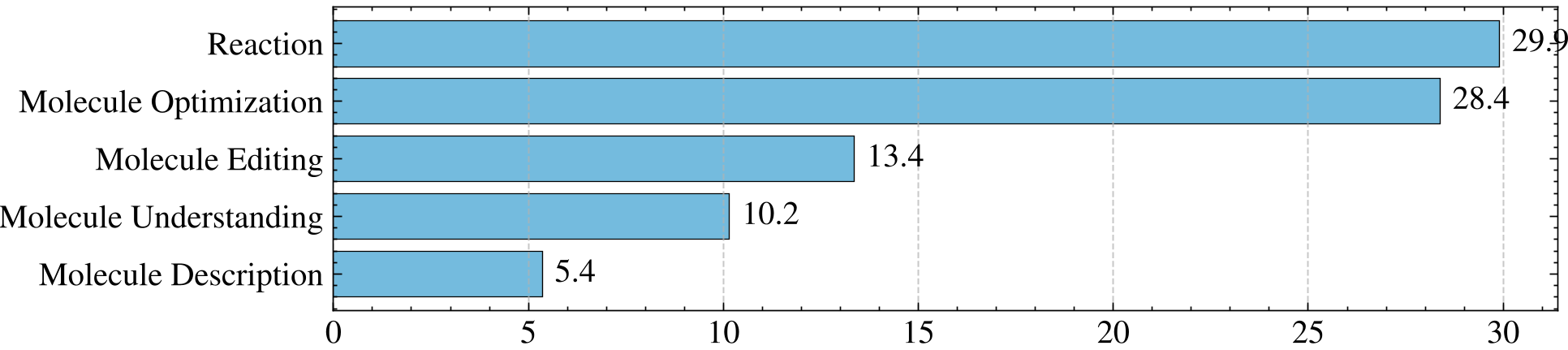
- Inference Efficiency: By eliminating verbose text, the model reduced reasoning overhead by an average of 10.84x. In some optimization tasks, it was 29.9x more efficient.
Causal Necessity: Is the "Silent Phase" actually thinking?
To prove the model wasn't just stalling, the authors replaced the silent thought vectors with Gaussian noise. The result? Performance tanked (see Figure 5). This confirms that the latent states are encoding critical structural information necessary for the final answer.
Critical Insight: Optimization over Imitation
The transition from Stage 2 (Supervised Learning of text CoT) to Stage 4 (RL for Correctness) reveals a fundamental truth: Natural language is often a low-bandwidth constraint for AI.
When given the choice, the model identifies that its high-dimensional internal space is a "native" substrate for chemistry. It reveals a hydraulic trade-off: when the latent thinking budget is restricted, the model spontaneously starts using text again to compensate (Figure 6).
Conclusion & Outlook
LatentChem represents a major step toward "System 1" thinking for scientific AI—fast, intuitive, and high-bandwidth. While we lose some interpretability (we can't easily "read" the latent thought), the gains in efficiency and structural precision are too significant to ignore. The future of scientific AI may not be an chatty assistant, but a silent architect.
Takeaway: Decoupling reasoning from language allows AI to align its "thought" hardware with the mathematical reality of the physical world.